

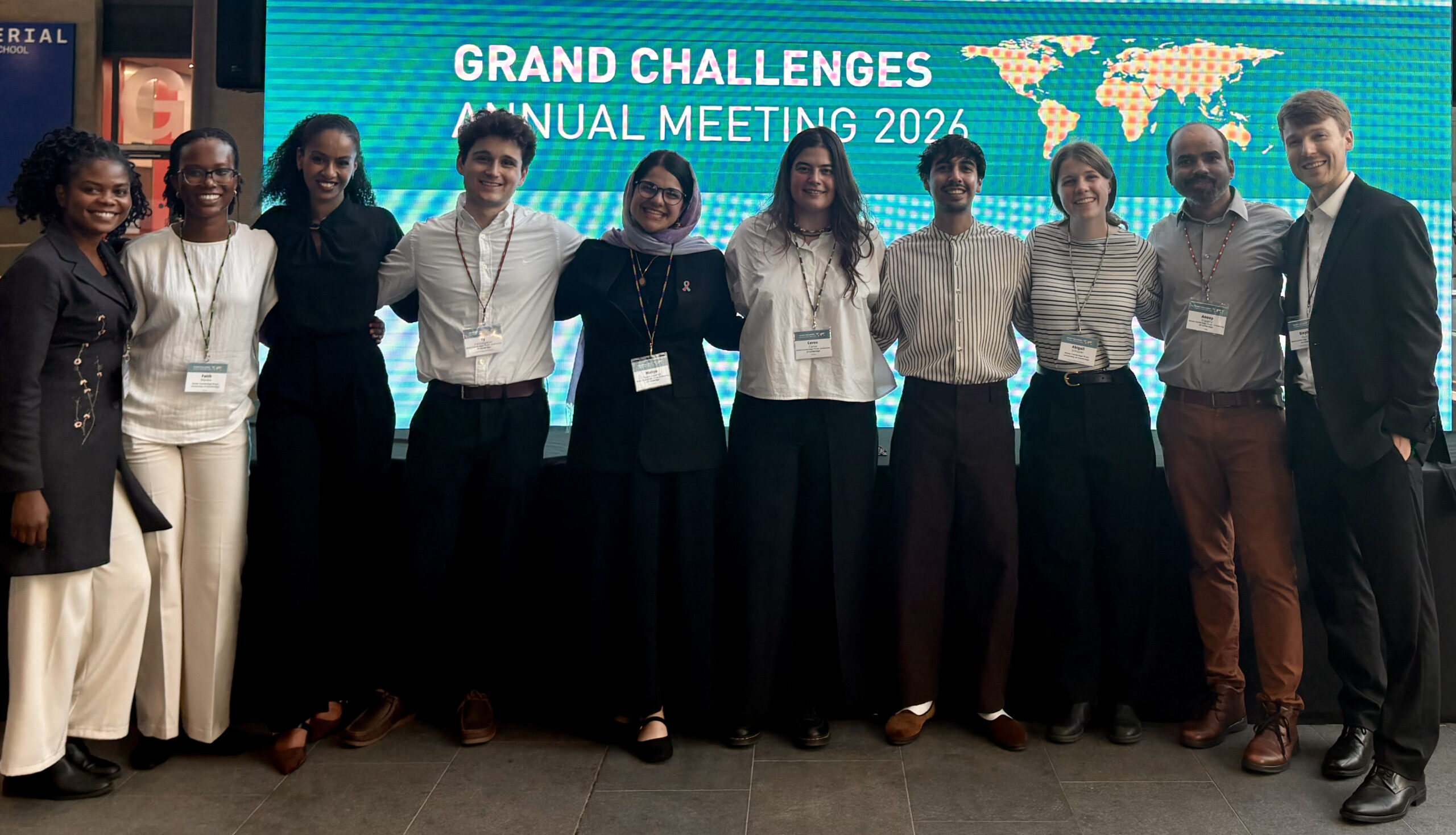
Ten Scholars were selected to take part in the Gates Foundation's Grand Challenges event in London last week.
Our Scholars were inspired by those working across research, innovation, policy, advocacy, and funding - from strategies for ending malaria to strengthening African R&D ecosystems.
Stephen Metcalf
Ten Gates Cambridge Scholars were selected to attend a full day of the Gates Foundation’s Grand Challenges Annual Meeting last week.
The event, which has run annually for over two decades, brings together “a diverse global community to advance innovation and partnerships to solve the most pressing health and development challenges”. The goal is to accelerate progress by enabling a broad, inclusive community of problem solvers to shape an innovation agenda and generate the breakthrough science to achieve it.
This year’s event, which took place in London, focused on malaria, maternal health, and research and development ecosystems.
All 10 Scholars, accompanied by a Trust representative, presented posters on their research across these themes and had the opportunity to learn from leading international researchers, practitioners and policymakers about key issues, for instance, strategies for ending malaria.
The Scholars selected were:
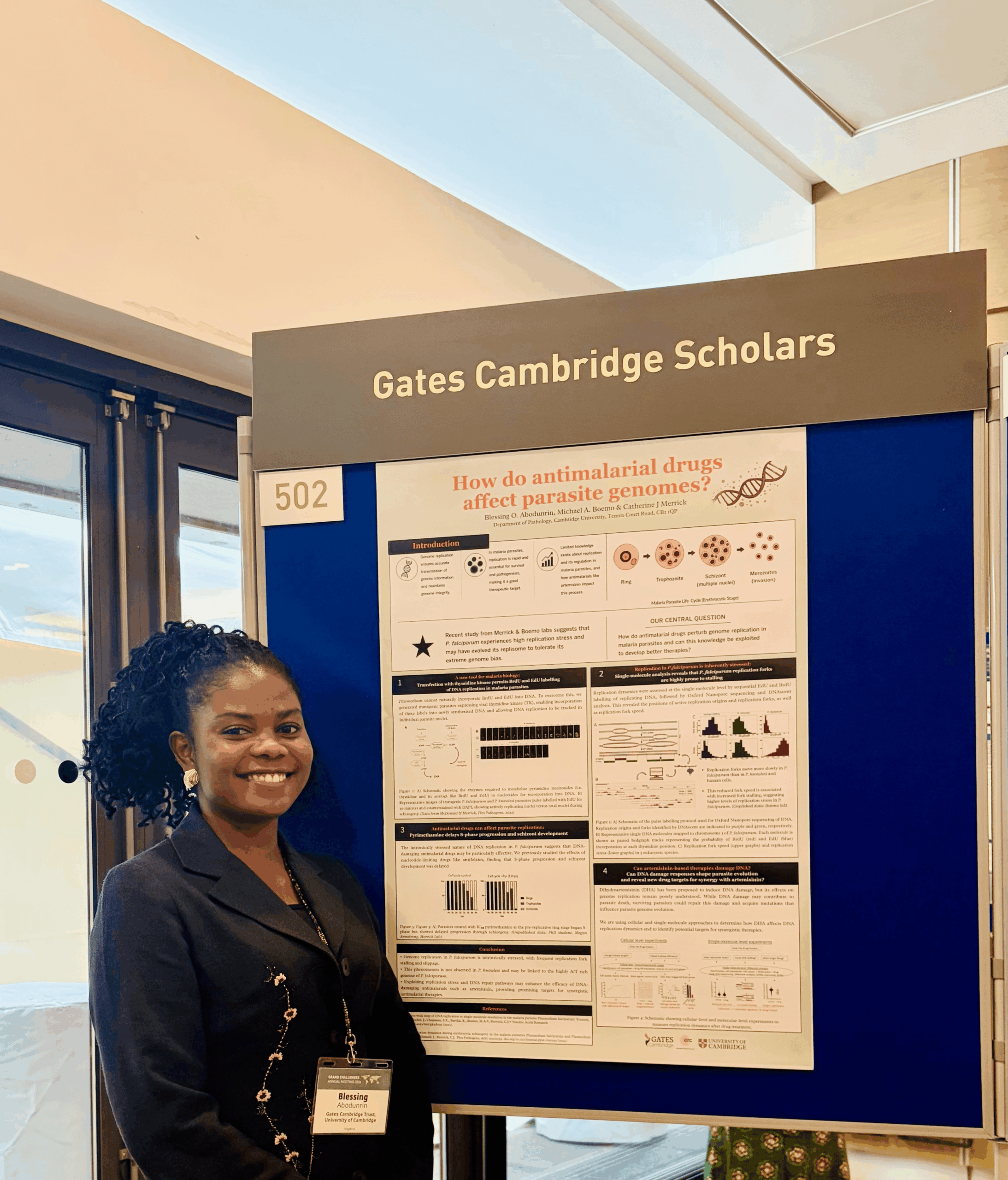 Blessing Abodunrin [2025, pictured with her poster left], who is doing a PhD in Pathology, studying DNA replication in malaria parasites using cutting-edge DNA sequencing technology integrated with AI and bioinformatics. Blessing also serves as Postgraduate Representative for the School of Biological Sciences at Cambridge and as General Secretary of the Cambridge University Nigeria Society as well as being the author of Recalibrate — A Significant Blueprint for Academic Excellence.
Ghufran Al Sayed [2025] who is doing a PhD in Medical Science on adolescent wellbeing and digital innovation, with a focus on enhancing young people’s active involvement in designing digital health systems that affect them. Ghufran has worked with European, UK and global bodies, including the World Health Organization and the Gates Foundation Goalkeepers in Abu Dhabi, on adolescent mental health and health inequalities research. Recently, she was awarded a UKRI Innovation Fellowship with the UK Department of Science, Innovation and Technology to facilitate the translation of pertinent technological and research agendas into national policy.
Ceren Canse [2024] who is doing a PhD in Physiology, Development and Neuroscience on placental development. By studying the earliest stages of placentation utilising stem cells that allow modelling of these critical stages outside of the body, her work aims to improve understanding of pregnancy complications stemming from defective placental development, including miscarriage, foetal growth restriction and pre-eclampsia.
Mahya Fazel-Zarandi [2025] who is doing an MPhil in Medical Science at the Cancer Research UK Cambridge Institute. Her project is focused on developing CRISPR-engineered fallopian tube organoids to model early disease processes in ovarian cancer. The aim of engineering these models is to capture the earliest genomic changes that drive malignancy, and hence enable interventions that target disease at its origin. Mahya has also founded Women’s Health Without Borders, a non-profit initiative dedicated to improving reproductive health education and access for refugee women. She worked with the United Nations Population Fund in Uzbekistan as a Princeton ReachOut 56-81-06 Fellow on reproductive health challenges and gynaecologic cancer screening.
Ty Kannegieter [2024] who is doing a PhD in Biological Science on developing immunotherapies which aim to block the health effects of persistent organic pollutants (POPs) at the patient level. This project seeks to not only help ameliorate the impacts of acute pesticide toxicity – a condition taking some 200,000 lives a year – but also guard against the impacts of sub-chronic and chronic exposures.
Faith Kiyuka [2025], who is doing an MPhil in Technology Policy on AI and pandemic preparedness. She has professional experience of building health R&D capacity across Africa and managing complex, multi-stakeholder research portfolios within the global health ecosystem. Through her MPhil, she is examining how policy shapes the production and commercialisation of scientific and technical knowledge, with a particular focus on competitive strategy, market dynamics and the innovative performance of economies.
Erixberto Olivencia Alvarez [2025] who is doing an MPhil in Biological Sciences on the effects of environmental stressors on foetal health. In particular, he studies the influence of the uterine environment on embryonic developmental tempo. By generating interspecies chimeras, his MPhil project aims to explore and understand the role of placental metabolism in regulating the rate at which embryos reach developmental milestones.
Abigail Schipper [2025] who is doing an MPhil in Engineering on rapid malaria diagnostic devices and care pathways for obstetric emergencies. Her work focuses on technologies to support community healthcare workers and first responders caring for emergently ill patients in low- and middle-income countries. As an undergraduate, Abigail, who is an Emergency Medical Technician, co-founded the LifeSaveHer project, an initiative aimed at reducing gender disparities in out-of-hospital cardiac arrest care that received the grand prize in the 2023 IDEAS Social Innovation Competition. Her undergraduate research also included the design of a contraceptive implant for settings with limited surgical capacity.
Impact Prize winner Anoop Tripathi [2022] who is doing a PhD in Plant Sciences with a focus on grafting and somatic hybridisation to create novel crop combinations with enhanced resilience and adaptability. His research explores unconventional breeding approaches that could help develop climate-resilient crops capable of addressing future agricultural challenges.
Júlia Viladevall [2024] who is doing a PhD in Haematology where she investigates haematopoietic stem cell fate decisions and lineage specification during human foetal and neonatal life, and how these processes relate to blood disorders later in life. Her research aims to better understand healthy blood and immune cell formation, as well as diseased settings such as Trisomy 21 (Down syndrome), which is associated with a high risk of childhood leukaemias. She is also interested in how the maternal immune system may shape immune development before birth. Due to illness, Júlia could not attend in person, but her poster was displayed on the day.
Stephen Metcalf, the Trust’s Academic Director and a Gates Cambridge Scholar Alumnus himself accompanied the Scholars. He said: “What a remarkable opportunity for Gates Cambridge Scholars to share their research and engage with senior leaders in global health. Scholars were inspired by those working across research, innovation, policy, advocacy, and funding – from strategies for ending malaria to strengthening African R&D ecosystems. We are immensely grateful to the Gates Foundation for inviting us.”