





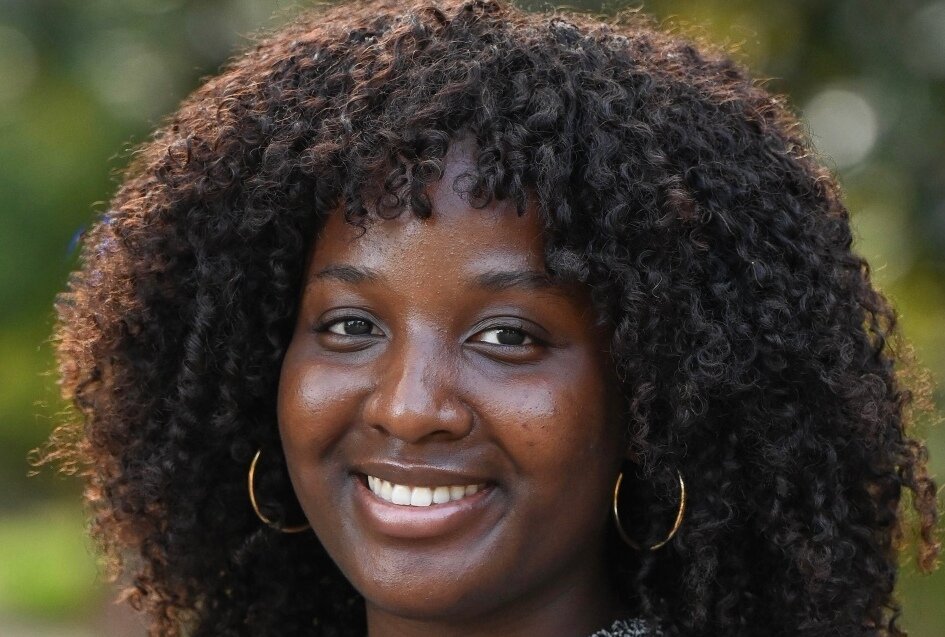
US Scholar-Elect Stephora Cesar Alberi will do her PhD in Biotechnology on computer vision with the aim of making microscopes smarter and faster.
My research is motivated by family members in Haiti who were affected by the 2010 cholera outbreak and are now facing a malaria epidemic. I believe computer vision can accelerate diagnostics and drug discovery for infectious diseases in vulnerable countries in the Global South.
Stephora Cesar Alberi
Stephora Cesar Alberi [2026] has always wanted to use her computer skills to help people, but it was not until she discovered computer vision that she saw where she could best do that.
Computer vision is a branch of AI that enables machines to interpret and analyse visual data, such as images and videos, using deep learning and convolutional neural networks to detect patterns, recognise objects and make informed decisions. “It blew me away,” says Stephora.
That fascination led to work on Estonia’s space rover project and to a PhD at Cambridge, which she starts in the autumn.
Her PhD in Biotechnology involves using computer vision in microscopes. The aim is to enhance microscopy image processing to make it faster and smarter, speeding up the finding of solutions to biomedical problems such as anti-microbial resistance.
Stephora also wants to ensure that computer vision in microscopes is both reliable and affordable in the Global South where she hopes it can be used for diagnostics and treatment of the kind of infectious diseases such as malaria and cholera that have been so prevalent in countries like Haiti where her family is from.
Childhood
Stephora was born on the Caribbean island of Guadeloupe and moved to the US when she was three. Her family is originally from Haiti and her two older sisters remained there with her grandmother when her mother moved to Guadeloupe.
Stephora faced a lot of upheaval in her early life before moving to Maryland after the 2008 financial crash. Her father died when she was just six months old and her stepfather separated from her mother when she was 10. One of Stephora’s older sisters moved in with the family to help out financially and her mother, who is a nursing assistant, took extra shifts to keep the family afloat. Her oldest sister, who had been living in the Dominican Republic since the Haitian earthquake of 2010, was diagnosed with cancer and moved back to Haiti for treatment. She passed away in her early 30s when Stephora was 12, with a huge impact on the family.
Stephora devoted herself to her schoolwork, not wanting to cause any additional problems for her mother. She also helped out at home with the technology issues that her stepfather had taken care of. She soon realised she really enjoyed it. “Computers were something I understood – a place of comfort for me,” she says.
Undergraduate studies
When she finished school it made sense for her to pursue computer science. However, during her undergraduate studies at Salisbury University she began with cybersecurity classes and found that was not for her. She started exploring AI and became involved in a National Science Foundation Research Experiences for Undergraduates project on maths theory as part of a 10-week research experience programme.
There she met people who were working in deep learning, including image processing – the use of algorithms to manipulate and enhance digital images, extracting important information for applications like face recognition, object detection and image compression. She had never heard of it before. She became fascinated by deep learning. She asked one of her professors to help her learn more and spent a semester working on a facial emotion recognition model project with Dr Shuangquan Wang.
Stephora wanted to take that work further, but there were not the resources at her university to do so. She went first to her adviser Dr Margaret Sebastian at the university’s TRIO office, which works with first-generation, students with financial need, and students with disabilities.
They recommended that Stephora go to the fellowships office where she met Dr Kristen Walton who helped her secure a study abroad opportunity in Estonia at the University of Tartu, doing a summer course on vision in space and learning how to apply various image processing techniques to autonomous systems. Stephora immediately felt that this was the field for her. “It seemed to have so much potential,” she says. She learned about the different computer vision techniques which were being applied to Estonia’s first lunar rover. “I learned about optics, machine learning, deep learning and more and did lots of different workshops. I was amazed by it all,” she states.
Computer vision
She spoke to Quazi Saimoon Islam, the CEO of the KuupKulgur project that she had been working on and asked if she could return as a research intern working on computer vision. He said yes if she could get funding so she spent the next months researching fellowships. She eventually won a Boren Scholarship, which commits award winners to securing national security employment for at least one year in the US federal government after finishing their studies.
In Estonia, Stephora has been working with Quazi Saimoon Islam and Ric Dengel to analyse feature detectors, testing and experimenting with Superpoint [a framework for interest point detection and description in images] and doing literature reviews. The research will be used in lunar rovers to help them detect the different objects they come across, with the data being used as a baseline for 3D reconstructions of any hazards detected.
At the same time Stephora is taking classes in everything from digital imaging processing to neural networks and machine learning for synthetic biology.
She is very excited to be coming to Cambridge and says her mother is very proud of all her achievements. She says using computer vision in microscopes is still in its infancy, but she feels it has the potential to make a big impact. “Biotechnology departments are increasingly looking for computer scientists to apply computer vision in molecular microbiology and in microscopes,” she says.
She adds: “My research is motivated by family members in Haiti who were affected by the 2010 cholera outbreak and are now facing a malaria epidemic. I believe computer vision can accelerate diagnostics and drug discovery for infectious diseases in vulnerable countries in the Global South.”
*Stephora is one of 26 new US Scholars-Elect, announced earlier this month.