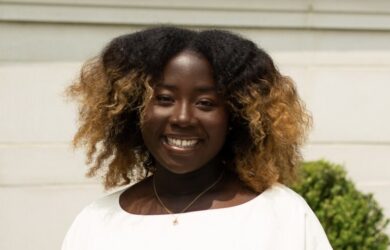


Tovah Ackerman talks about the link between crime discourse and sentencing policy.
How do sensationalised stories about crime affect sentencing policy?
Tovah Ackerman believes there is a link between how a crime is presented and sentencing policy. She also believes that painting a true narrative of the lives of some people who are accused of crimes can lead to more lenient penalties.
She plans to do her MPhil in Criminology on narratives of criminality, particularly the dehumanising rhetoric used to describe criminals in the US and UK, such as calling them monsters and beasts.
She says: “In my experience such language is often followed by espoused support for harsh punishment. I am curious about how such a narrative might relate to a national attitude on criminal punishment.”
Tovah didn’t show an interest in law until university. Born in Minnesota the youngest of four children who were all just two years apart, her mother is a writer and her father is an entrepreneur in the medical field.
While she was at school she sang in the state choir and was heavily into sport and played soccer at state level. She also ran for her high school and at one point the team ranked fourth nationally. She says she spent around a hour a day running after school and two hours a day on soccer most days. She ran for a year in college, but got injured and decided to refocus her energy on her academic work. She was a research assistant to a number of professors when she took up her undergraduate course in Law, Jurisprudence, and Social Thought at Amherst College.
She says that before she started her undergraduate degree she had not been expecting to focus on law. However, a professor who went on to teach her gave a freshman seminar on law jurisprudence and social thought which got her hooked. “I liked the fact that law was so far-reaching and touched so many things,” she says.
Her interest in how language and culture affects law started at university. A lot of her classes were interdisciplinary and focused on film, literature and law. She also worked on the Innocence project for one summer.
This involved reading the letters people had sent in asking for help. “They were telling their own story in the letters. It got me interested in how language and words could be used to humanise people,” she says.
It was an idea that came more to the forefront when she started working in the public defenders office in Manhattan where she is now. “A lot of what I do now is gather stories from clients which attornies can use in their defence. A lot of people use statistics in criminology, but they never give the full story,” she says. “By portraying the true human story behind their circumstances you get people to listen and they might be treated more mercifully and leniently.”
She says one of her clients was from South America and had become involved in the sale of drugs as a child. When he was 11 he became addicted to heroin after trying it once. “After that his life unravelled and his addiction became out of control,” says Tovah. “He started dealing drugs to support his habit and was craving more drugs. His offence was linked to that. Also nearly every one of his family members and friends had died after contracting AIDS from using heroin needles. We could explain this to the judge and he was moved. He gave him a lengthy jail sentence, but it was nowhere near what the government was asking.”
She has been working in the public defender’s office for over two years, but says she always wanted to continue her studies and was looking to gain an international perspective. She says that while the US and UK share a history of a sensationalising crime in popular discourse, they deal with crime and sentencing in a different way.
She hopes to travel around Europe while she is at Cambridge and to visit jails in different countries. In the long term she plans to return to the US and attend graduate school for a PhD in legal studies. She may also eventually attend law school. She says: “I want to teach, research, and work with non-profit prison reform organisations to try to affect real-world change based on my research.”