





Scholar-Elect Chudi Martin talks about his research which explores Afro-diasporic traditions such as steelpan and djembe.
I am interested in historic knowledge transfer and in acknowledging the long foundations that influence my work.
Chudi Martin
Chudi Martin [2026]’s research focuses on exploring Afro-diasporic traditions, including steelpan, djembe and Capoeira Angola, and how they serve as tools for joy, storytelling and liberation.
By investigating the roots of these traditions, he says he aims to acknowledge all those who have fought to keep Afro-diasporic traditions alive, and to offer a detailed mapping of efforts to respect the intellectualism of diverse populations and forms of expression.
He believes his MPhil in Social Anthropology, which he begins in the autumn, will give him access to archives that will ensure his work contributes to the development of a truly global mindset that pushes boundaries and diversifies the range of scholarly views within academia.
Childhood
Chudi was born and grew up on Chicago’s south side. He is the second eldest of five siblings and grew up in a busy household with his mother and grandparents. His aunt and uncles lived with the family for some time, too.
 Chudi comes from a family of educators, going back to his great grandparents. His mother works in a community college and his aunt is a teacher . “They told me that teachers give students everything they need, but at the end of the day education is the student’s job,” he says. “They said that you have to be on top of your education because it opens doors.”
Chudi has always loved learning. “It can be about anything. It is the process of learning that aligns with who I am,” he states.
At school – a Catholic all boys’ high school, he first became involved in student politics and founded its Black student union where students could talk about the issues that mattered to them and about Black history and culture.
Although he now studies Afro-diaspora music traditions, it was not until his undergraduate studies that he really got into music, although he had grown up listening to a lot of his mother’s music at home, from Calypso and Reggae to James Brown and Michael Jackson.
Chudi was also active in other areas at school. He was the water polo team manager and took part in theatre improvisation and choir. He also achieved the rank of Eagle Scout and went camping every summer.
University
Like many students, the Covid pandemic had a profound impact on Chudi’s studies. He started as a Biology major at Oberlin College, but all the science classes were virtual and students weren’t allowed lab partners. He decided that science was not for him. “For me science was very much in person and with a lab partner,” he says.
He was also taking courses in African American politics and Africana popular culture. These awakened him to issues of Black identity that he had not fully explored at school where honours students were not allowed to study African American history, although he recalls the impact reading Ta-Nehisi Coates’ Between the World and Me in English class had on him. So he switched to Africana Studies, saying it gave him a real-time understanding of himself.
Throughout his undergraduate studies, Chudi was living in Afrikan Heritage House, a Program House on the Oberlin College campus for students interested in learning about and celebrating Africana cultural traditions and he met most of his friends there.
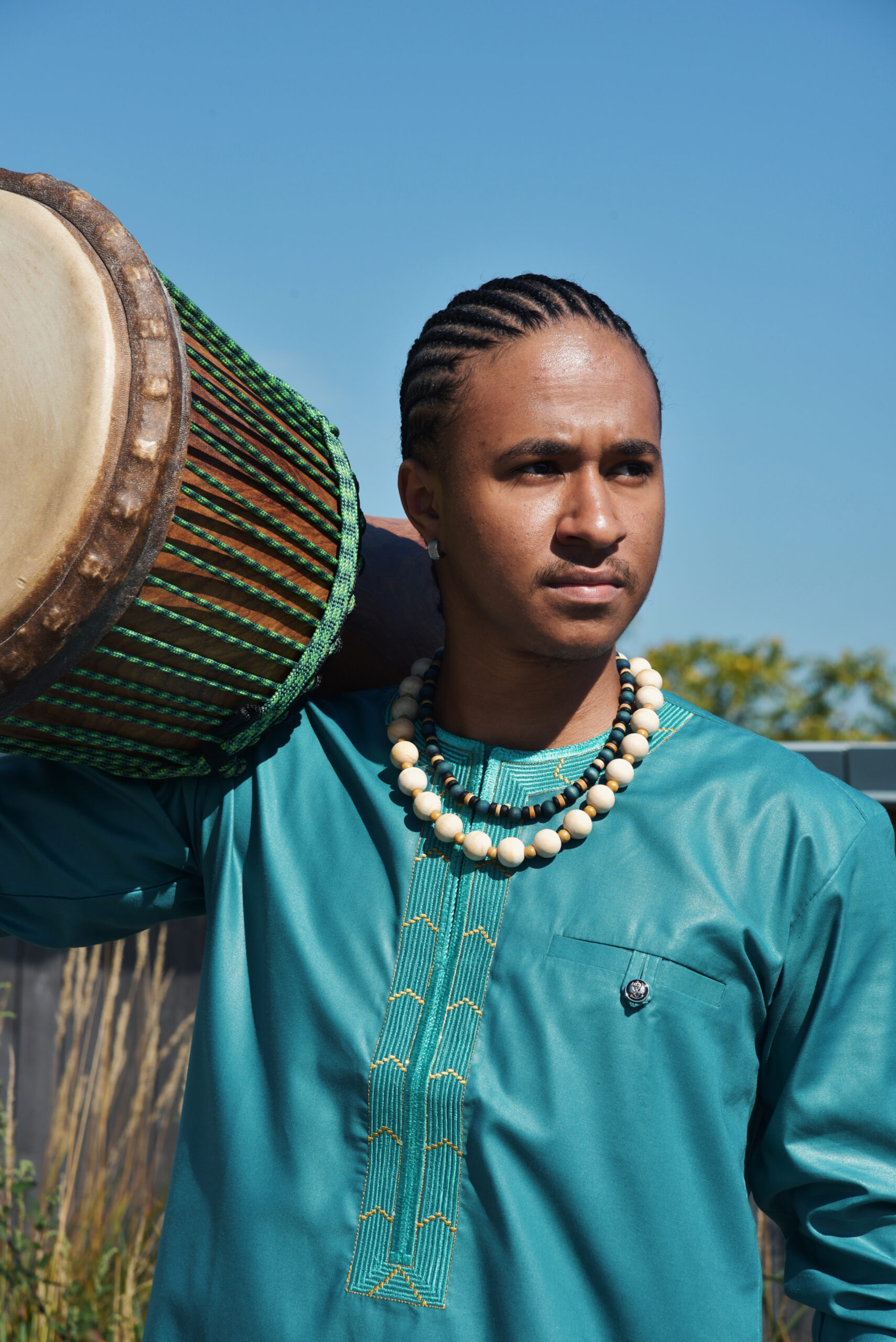
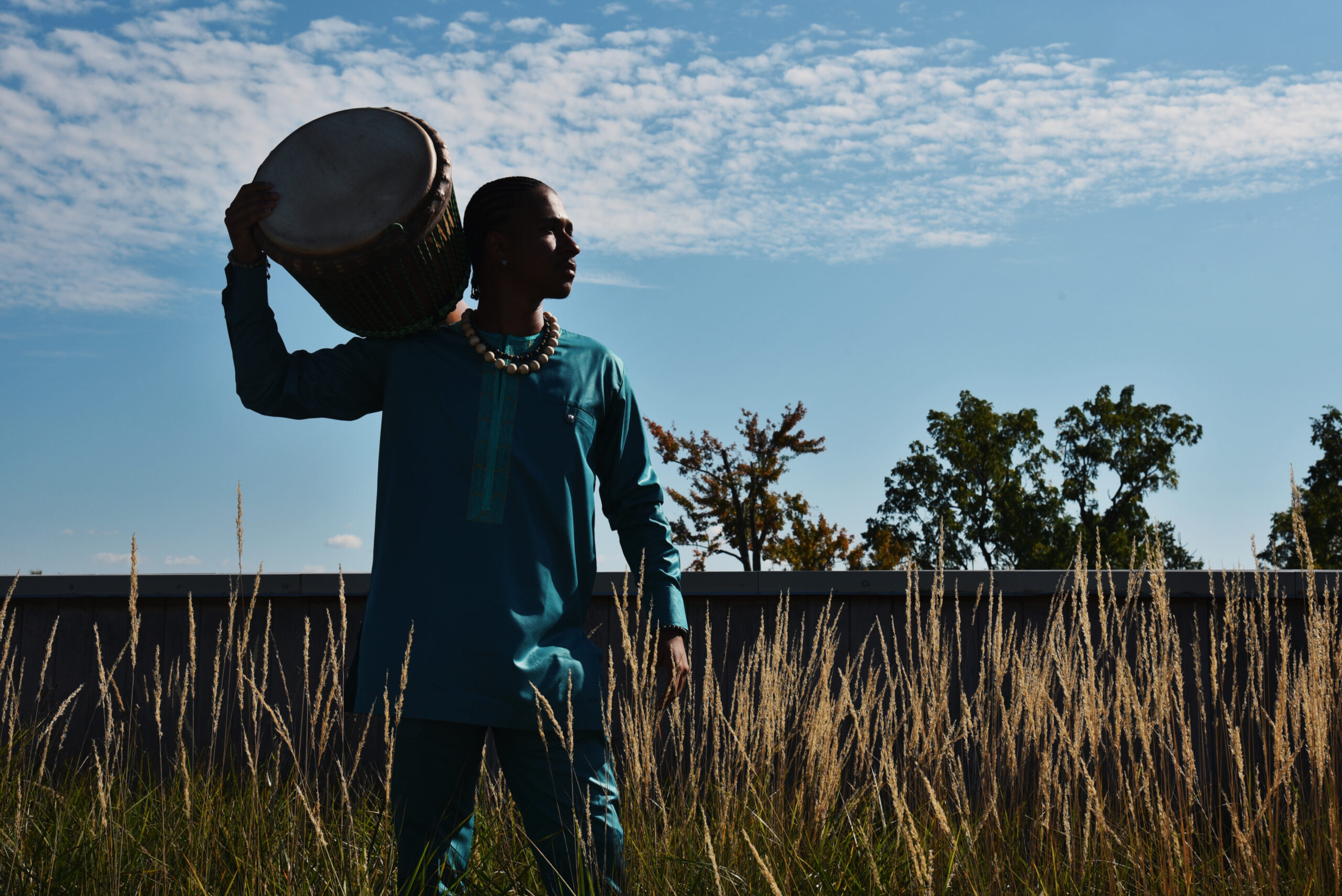
Chudi holding djembe
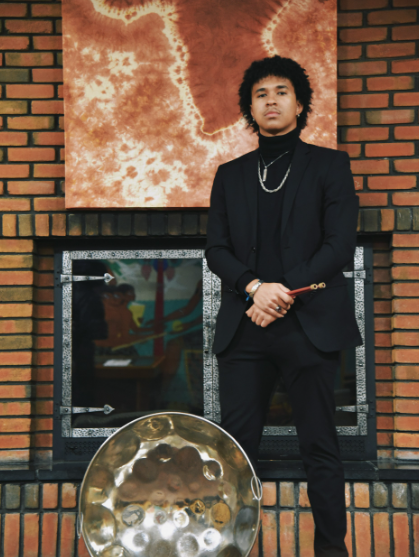
While Covid had a big impact on his classes, there was a silver lining – Chudi had the unique opportunity of learning from his peers through experimental college courses, including a steelpan course. He learned to play and through that course he joined the steelpan band in his second semester, remaining a member of the band until he graduated.
From there Chudi started taking Capoeira Angola classes, the traditional style of the Afro-Brazilian martial art, led by Mestre Justin Emeka. “That class was eye-opening, mixing culture, music and dance,” he says. Later, Chudi joined Oberlin’s djembe orchestra which helped him to develop his own identity and sound and to understand the culture behind traditional African drumming.
Chudi graduated in Africana Studies and Environmental Studies with a minor in African American music, having spent a lot of his time crossing between Oberlin College and its Music Conservatory.
During one Black History Month he went on a college trip to Detroit to visit the Charles H. Wright Museum and the Motown Museum. That experience stayed with him and two weeks after graduating in 2024 he moved to Detroit.
Beyond graduation
He applied for Teach for America, following in the footsteps of his family along an education path. Teach for America recruits and prepares recent college graduates and professionals to teach in low-income schools, with the aim of advancing educational equity and improving student outcomes. Chudi completed a summer immersion programme and began teaching at an elementary school. Soon, however, he realised that teaching at the elementary level was not for him and that his interests lay more in Africana studies and in academia.
He applied to the University of Cambridge to do his MPhil in Social Anthropology. He is keen to explore the rich archives in the UK on African diasporic culture and to study abroad, given his activities as President of the Student Senate meant he didn’t get to do his semester abroad.
Chudi eventually wants to do a PhD in Social Anthropology on African diasporic culture, particularly West African drumming. His aim is to eventually return to Oberlin College and teach Africana Studies. One of his mentors, Mestre Emeka, was an Oberlin graduate who was taught by the writer bell hooks. “I am interested in historic knowledge transfer,” says Chudi, “and in acknowledging the long foundations that influence my work.”