

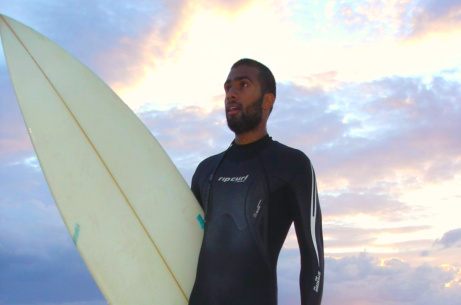
Niraj Lal has won a prestigious fellowship to study nanophotonics.
The Australian Department of Energy has awarded a prestigious fellowship with the Australian Solar Institute to a Gates Cambridge scholar as part of its $5 billion Clean Energy Initiative.
Niraj Lal will take up the three-year fellowship with the Australian Solar Institute [www.australiansolarinstitute.com.au]at the Australian National University later this year.
The names of the recipients were announced today by the Minister for Resources and Energy, Martin Ferguson.
The Australian Solar Institute is part of the Australian Government’s $5 billion Clean Energy Initiative with an objective to advance and accelerate innovative concentrated solar thermal and photovoltaic technologies in Australia.
The ASI awards up to five extremely competitive three-year Post-Doctoral Fellowships annually with the aim to ‘retain local and attract international expertise in solar energy research’.
Niraj [2008] will be researching ‘nanophotonics for enhanced photovoltaic efficiencies’ with Dr Kylie Catchpole in the Center for Sustainable Energy Systems at the Australian National University.
He is completing a PhD in Physics at the University of Cambridge’s Nanophotonics Centre. His research focuses on nanovoid plasmonic enhanced low-cost photovoltaics – making solar cells more efficient using very small structures. The aim is to produce solar cells which are both cheaper and capable of delivering more electricity for the same amount of sunlight.
While he has been at Cambridge he has been very active in outreach work in the community and is passionate about explaining the science behind sustainability solutions to the public.
He has been working with the University’s Community Affairs team on their Rising Stars public engagement programme and has worked with disadvantaged secondary school students from the Cambridge region on the science of the future through the Wysing Arts Centre. Through his interest in outreach work, he has also appeared on the Naked Scientists, who run an award-winning radio show on the BBC.