





Six Scholars outlined questions from their fieldwork in areas from healthcare to archaeology at the Lent Internal Symposium.
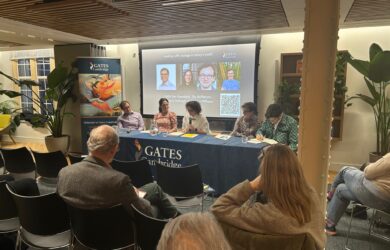
Six Gates Cambridge Scholars in disciplines ranging from public health to criminology and zoology talked about their ‘Notes from the Field’ at the Lent Internal Symposium last night.
The six were introduced by Justin Wei [2023], Internal Officer of the Scholars’ Council, who organised the event.
Elijah Darden [2025] spoke about his master’s work on healthcare inequalities in outpatient care. He works out of Cambridge University Hospitals (CUH), investigating the social determinants of health. These determinants are often not captured during routine data collection at CUH and other hospitals.
Elijah is working on a novel intersectional framework that links publicly available and routinely collected data to identify social determinants and their interactions with outpatient outcomes, such as missed appointments. He hopes this framework might be utilised across NHS hospitals to guide research and interventions tailored to their specific populations, for instance, missed appointments in one area may be due in part to transport issues or childcare and the data could build a case for more targeted interventions to address these.
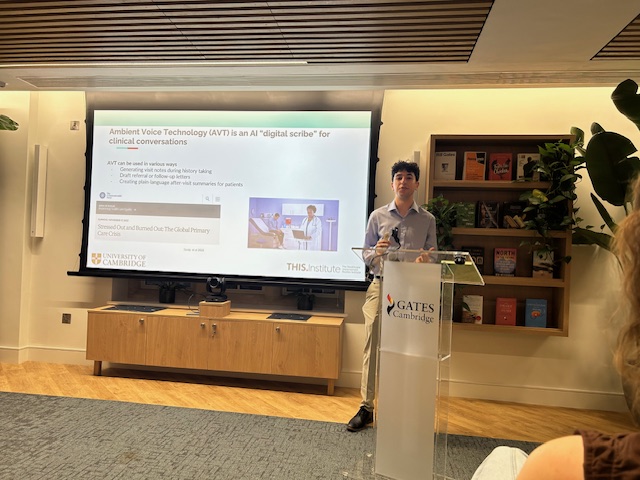 Tristan Jafari’s MPhil research [2025] is also related to the NHS and investigates Ambient Voice Technology (AVT), often described as a “digital scribe”, which uses artificial intelligence to transcribe clinician–patient conversations into clinical notes. One of the main challenges is that adoption is patchy across the NHS.
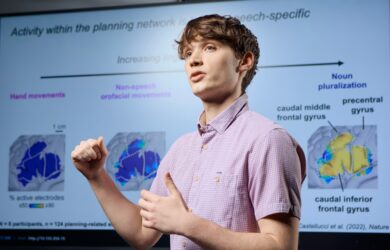
Tristan [pictured right] is working with the newly launched AVID (Ambient Voice Innovation and Development), a national online innovation community of clinicians, researchers and policymakers focused on AVT in the NHS. His research aims to identify the needs, concerns and priorities related to AVT expressed by AVID members and to characterise patterns of engagement within the platform. He said NHS England is keen to know what people think of the technology and that this could inform national guidance. The research could also be a good model for future innovation communities.
 Jasmine Jordan [2o21] spoke about her PhD fieldwork on the activism and community involvement of formerly incarcerated Black women in Michigan. The US has the world’s highest number of incarcerated individuals, with one in five of the world’s prisoners being in the US. This number peaked in 2008, but rose again after Covid. The number of Black women incarcerated has dramatically declined in recent years, unlike the number of Black male prisoners. Most scholarship focuses on male prisoners and on issues such as housing on release from prison.
Jasmine’s research addresses a significant gap in scholarship in prison reform discourse, which often overlooks political action by those who have a lived experience of incarceration and its aftermath. She is seeking to ascertain the extent to which mass incarceration in the US mobilises or politically silences those directly affected by it.
She spoke mainly about the ethical issues related to her research and how she went about it. She built relational networks – referred to as snowball sampling – to find a qualitative sample of ex women prisoners to interview and spoke at community events, churches and more to get to know people. She spoke of the need to build trust and to address feelings that academics are exploiting their subjects.
Kiah Johnson [2022] spoke about the six field trips she has made into the lower Namib region, Namaqualand and Bushmanland, for her PhD research. The Namib Desert ecosystem is located along the Atlantic coast of southwestern Africa, stretching across Namibia, Angola and South Africa.
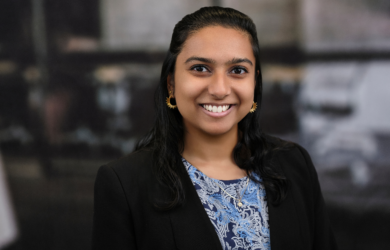
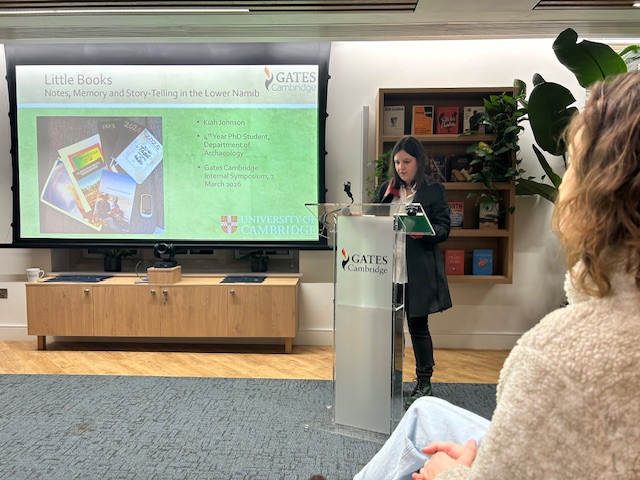 Kiah [pictured right], who focused on South Africa, described the remote, desert-like conditions in underpopulated areas where droughts can last for 10 years and the resourcefulness needed to survive there. She also spoke of academics coming in and extracting information on a range of issues and never informing research participants of the outcomes of their studies.
She too had used snowball sampling, trying to build trust with local people, such as a local postmistress and police officer with good networks and long memories of the area. She listened to the stories people told her which helped her to understand the complex ecological and social dynamics, past and present, in that area. She said that, due to distrust of people writing in notebooks she tries to record those conversations via memory, through repeat visits. Every time she goes there she asks for permission and tells the people she is speaking to about what she is doing. She emphasised that her work is about collaboration with the community, not extraction.
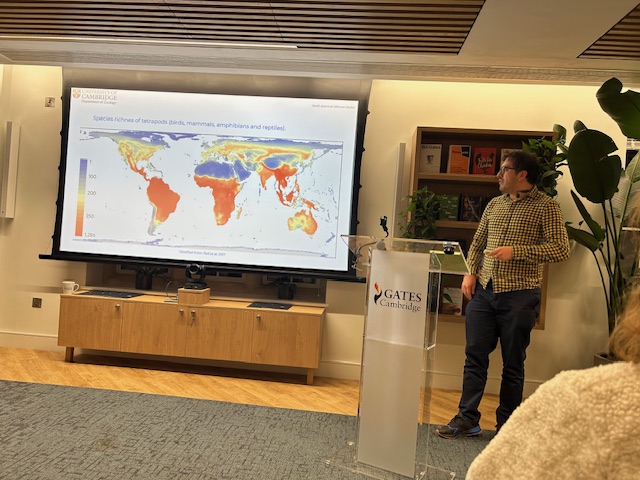 Andrés Alfonso-Rojas [2022] spoke about his palaeontology work in Colombia. He says: “Deserts are often imagined as lifeless, static landscapes, yet the arid badlands of northern Colombia preserve the remains of ancient tropical forests and long vanished wetlands. Fossils of different plants and animals reveal that what is now a desert was once part of a humid, biodiverse corridor that shaped the early history of South American ecosystems. They also raise deeper biogeographic questions: how did animals disperse to and across the continent when Central America was not formed?”
He spoke about his research results in Colombian badlands and deserts, focusing on fossil snakes as key indicators of past environments and dispersal routes. These fossils document shifts from Miocene wetlands to forested floodplains and provide evidence for early connections between northern South America and the proto-Amazon Basin.
By integrating geology, vertebrate paleontology and comparative anatomy, Andrés’ research helps clarify the origins of the Amazonian drainage system and sheds light on the evolutionary pathways that produced today’s remarkable diversity of Neotropical reptiles, revealing the dynamic landscapes and biogeographic processes that shaped modern South American biodiversity.
He said he had found a new species of snake and that everything he learns he shares with the local community who run a museum in the area he works in. “For the first time, we are not taking anything out of the area,” he said.
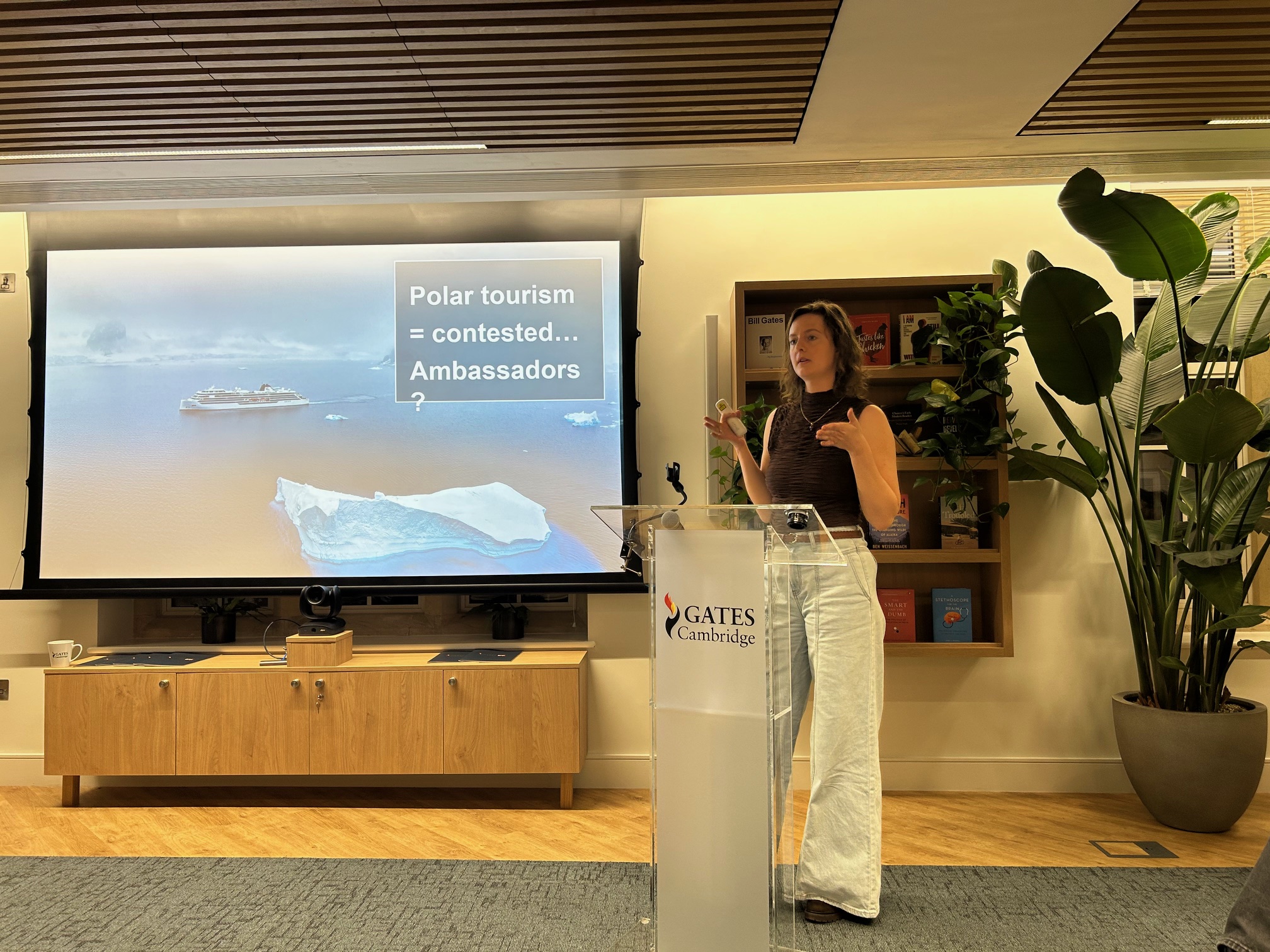
Simone Eringfeld [2022 – pictured top] discussed her PhD work on Polar tourism in Antarctica. She said there is controversy about the impact of tourism in the area, which attracts 120,000 tourists a year, mainly by ship. Some argue that visitors can become ambassadors for the region. She wanted to know what could strengthen that ambassador effect and what kinds of encounters actually cultivate care and responsibility and looked at whether a shift from sightseeing to sighthearing might make a difference.
Simone spent three months aboard expedition vessels in the Antarctic Peninsula working both as a researcher and polar guide. During this time, she conducted 30 field recording workshops with 266 tourists, inviting participants to practice intentional listening to wildlife, ice, wind, water and human-made sounds. She said these sonic “notes from the field” — audio recordings, observations and participant reflections — offer insight into how heightened attention to sound reshapes perceptions of place and presence.
She argues that listening — understood as an embodied and ethical practice — can strengthen the transformative potential of Polar tourism, moving encounters beyond spectacle toward attentiveness, connection and stewardship.