





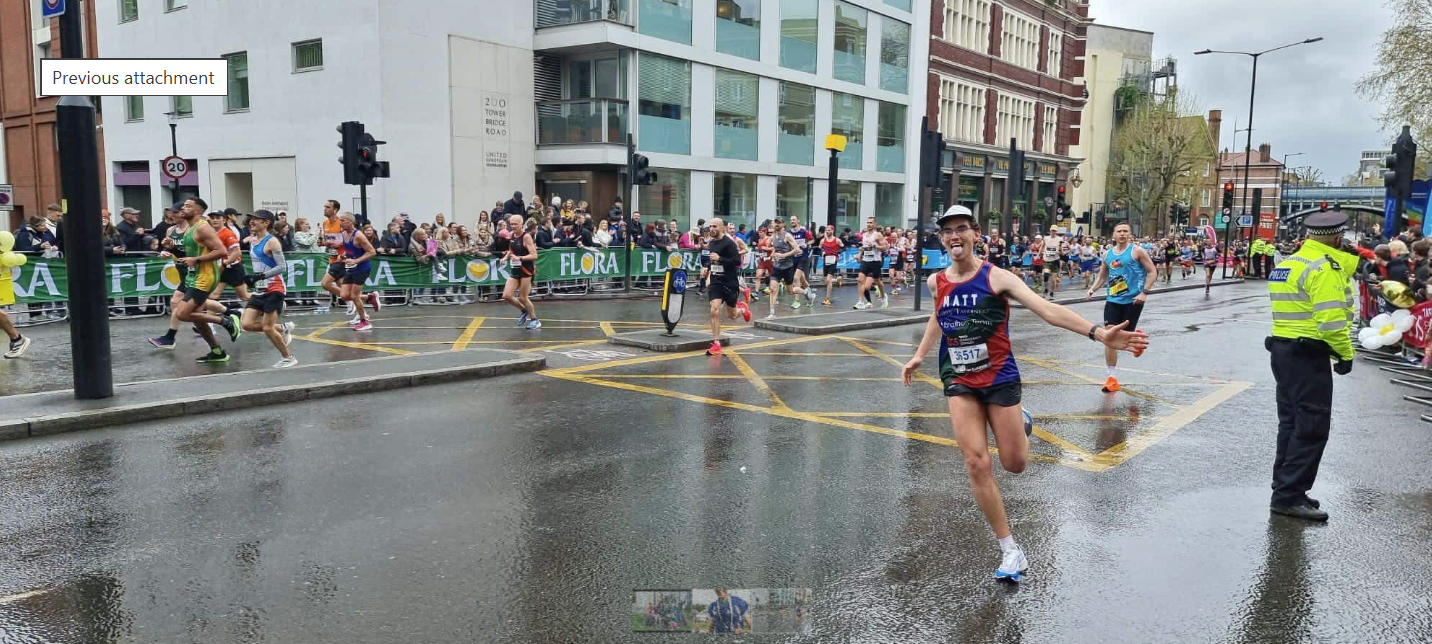
Matthew Blacker talks about his path to Gates Cambridge, his passion for quantum physics and for improving the lives of others both physically and mentally.
If something happens to you, think about how you can make it better for the next person.
Matthew Blacker
Matthew Blacker – or “Blacker” to his friends – has a lot of strings to his bow. He is a physicist with a fascination for quantum gravity and, in particular, for explaining it to others – a fascination honed at an early age through YouTube video making. And he is also an ultra marathon runner, a charity campaigner and has a passion for pastoral care.
Mental health has been a constant in his life – from seeing friends suffer while he was at school and being involved in pastoral care as an undergraduate. He has also shown an outstanding commitment as a Gates Cambridge Scholar to extending that sense of care to the scholar community, while simultaneously experiencing his own challenges.
Blacker suffers from anorexia, a subject he is keen to talk about and highlight, particularly as men are commonly thought not to suffer from it. He is determined to put his own experiences back into helping others.
“Pastoral care and looking after others has been an undercurrent of my life,” he states.
Early years
Blacker [2022] was born in Perth, Australia. He credits weekends spent with his parents at Scitech and the Western Australian museum with giving him an enthusiasm for all forms of science. He was good at school and many people suggested he pursue a career in medicine or engineering, but his parents always encouraged him to follow his passions. His physics teacher Mr Audino also helped him apply for opportunities such as the National Youth Science Forum. “Without Mr Audino, I probably wouldn’t be doing physics today,” he says.
He also credits his high-achieving friends pushing him. While at high school, Blacker started making videos with his friend James Dingley under the name of Atomic Frontier, doing “random science experiments” to explain the world and enhance their school assignments. The video-making continued through his time as an undergraduate and he recalls one experiment in particular conducted in 2021 which aimed to explain why rockets don’t fall over. The two friends built prototype rockets and went into the outback to launch them in a Mars-style landscape. They started to film at sunrise and kept firing and rebuilding the rockets all morning while the light was good.
The YouTube videos, some of which have up to 2.5 million views, also have a behind-the-scenes podcast which Blacker co-hosts with James, who is now at MIT and who Blacker describes as “reasonably famous”.
But it wasn’t just science that interested Blacker. Alongside running long distances [which later developed into ultra marathon running], he was also into cricket, drama and philosophy – he took part in Philosothons, debates around different ideas and enjoyed both asking questions and facilitating discussion. These taught him the importance of collaborative thinking, making mistakes and being able to change your mind.
ANU
When school ended, Blacker applied for a scholarship to do a Bachelor of Philosophy at the Australian National University [ANU] in Canberra and ended up winning three during the course of his undergraduate career. His degree included a research element every semester and he was able to work on very different topics, from fusion and dark matter to plant biology. He did his honours research on cold atom technology because it was the hardest physics he could find at ANU. Cold atom experiments are among the most powerful and precise ways of investigating and measuring the universe and exploring the quantum world. He was drawn to quantum gravity, which brings relativity and quantum theory together and which he describes as “the Holy Grail” of physics, but no-one in Australia was working on it. Whilst he did a self-guided research project during his undergraduate course, he realised that to go any further he would need to leave Australia so he applied to Cambridge to do his master’s.
As an undergraduate Blacker had taken part in the annual Inward Bound competition run between ANU residential halls and the Australian Defence Force Academy. This is a 100km endurance and orienteering running competition. He recalls being dropped off in the middle of nowhere with three others at midnight with nothing but a map and the GPS coordinates of the finish line. After figuring out their location, teams embarked on a 100km foot race to the endpoint. Blacker credits this with sparking his love of ultramarathon running.
Mental health
His student digs were at Bruce Hall, ANU’s oldest college. He got stuck into college life. He was secretary of the college in his second year and then took on a pastoral care position in his third year. This involved him dealing with critical incidents involving mental health crises, being a first aid responder and supporting survivors of sexual assault. He was also responsible for setting the culture of the college. This reenforced Blacker’s passion for advocating for mental health, first developed at high school where some of his friends faced serious mental health challenges. He says that forced him to grow up a lot.
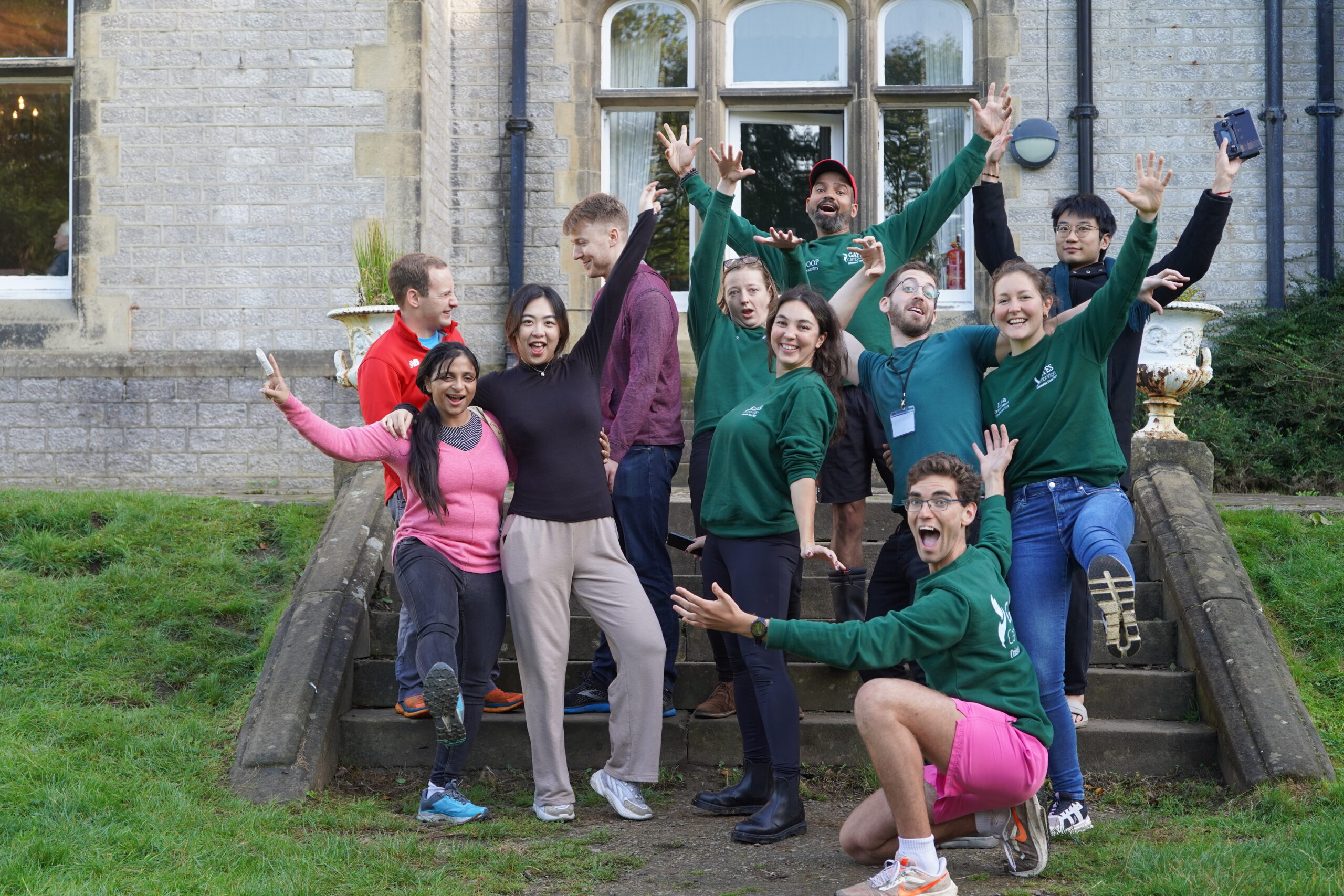 As a Gates Cambridge Scholar he used those experiences to help the scholar community. In 2022, when he began his master’s, he took part in the first post-Covid orientation programme and in 2023 he co-directed it and attempted to build a pastoral care framework around it, including workshops on wellbeing and vulnerability exercises. It was structured to ensure scholars were in groups which overlapped on activities, making it easier to bond with each other. They were in the same group at the beginning and end in order to be able to reflect more deeply on the experience.
“I was keen that our materials could provide a template for the future,” he says. In 2024 he was an orientation assistant and he says he is very proud of the template he helped create and which is now being built upon. “We created open conversations and prepared people for how to engage with a diverse community respectfully,” he states.
Quantum gravity and cricket
Blacker’s PhD was initially going to explore cold atom technology to probe whether gravity is quantum or not, having spent a few months in Japan before starting it to expand his quantum gravity knowledge. However, he switched to a focus on how to build a theory of quantum gravity after changing supervisors.
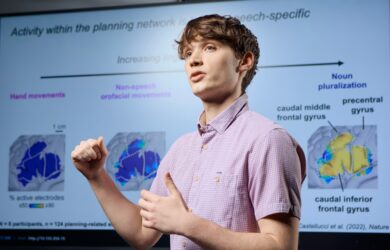
He wants to make quantum gravity more accessible as part of his contribution to the Gates Cambridge mission to change the lives of others, recognising that it can be hard to explain. He initially thought it would take a long time to be a good communicator, but he now thinks he can start doing so while completing his PhD, having recently given an outreach talk via Zoom back in Perth. His long-term goal is to ensure quantum gravity is not just studied in the northern hemisphere.
While doing his PhD, Blacker became involved in the Lord’s Taverners, a UK youth cricket and disability sports charity which aims to make sport more accessible to all children through cricket. “In Australia, cricket is very egalitarian, which is not the case in England,” says Blacker. “The Lord’s Taverners were looking to break down the class barriers in the UK.” He helped out at the Lord’s Taverners programme in Cambridge and offered to run a marathon to raise funds for the charity. He ended up doing both the London and Edinburgh marathons in 2023. In 2024 he did London and coached others to do the Edinburgh marathon. In 2025 he wanted to do both, but, due to illness, he ended up doing neither. In 2026, he will be captaining the Lord’s Taverners 2026 London Marathon team.
Rebuilding after crisis
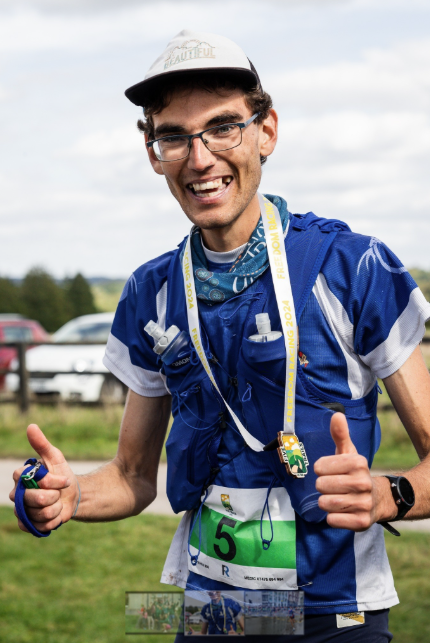 The early part of 2025 was a terrible year for Blacker health-wise. His anorexia led to him nearly dying and being hospitalised in April, which proved “a real wake-up call”. Blacker says that, while he had always loved running, it had become a tool to burn calories and a form of self harm.
“It was very scary,” he says. “I was like a skeleton.” He credits his parents, friends and the Lord’s Taverners with saving his life by giving him a greater purpose. While he was ill he received messages from Lord’s Taverners runners he was coaching who had managed a personal best in the London and Edinburgh marathons. Those messages inspired him to come back healthier and happier in 2026.
In the last few months Blacker has been able to rediscover his love of running as he has spent time “rebuilding from ground zero”. He is very keen to talk about his experiences of anorexia. “That monster took over my brain and the voices are still there,” he says. “Talking about it makes the monster shut up.”
He says he has been supported by Gates Cambridge Scholars – “they had my back” – and, most importantly, by his parents.
Throughout the last few months, his father has been a particular role model. His father was a neurologist and, after being diagnosed with Parkinson’s, he set up a boxing clinic for Parkinson’s patients, which has stopped the progression of the disease in both his patients and himself. His dad is now the fittest he has been in his life, according to Blacker. “He has made something good out of his diagnosis and that philosophy has inspired me,” he states. “That drives me – if something happens to you, think about how you can make it better for the next person.”