





Four Scholars spoke at the Cambridge Festival about leadership and resistance.
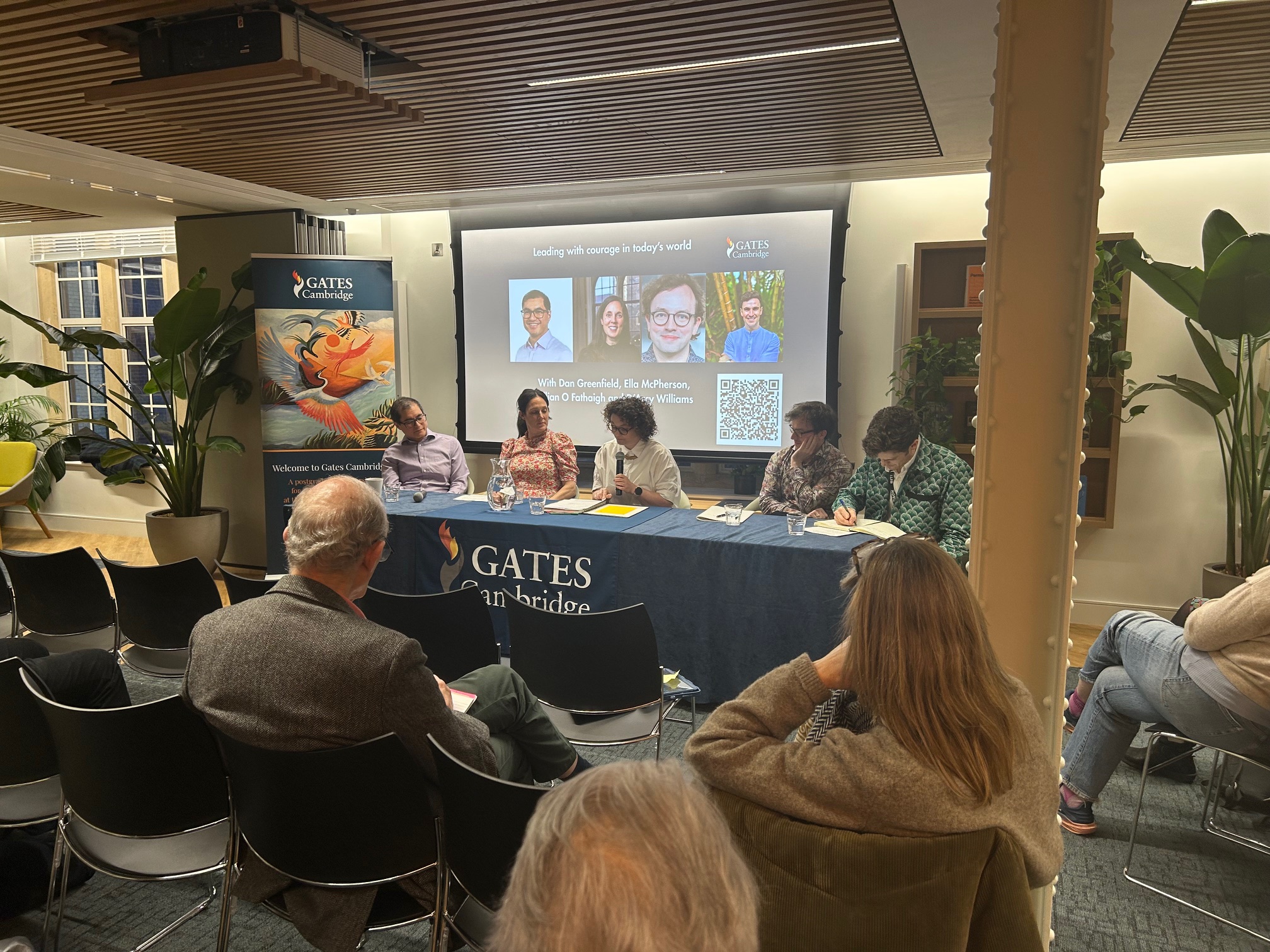
Four Gates Cambridge Scholars spoke about leading with courage in today’s world at the Cambridge Festival last night.
The event, chaired by journalist Catherine Galloway and held at Bill Gates Sr. House, featured discussions about everything from the role of leaders in resisting Big Tech, Big Food and ‘Big English’ to the importance of embedding ethical practices in their work.
Ella McPherson [2004], Professor of the Sociology of Media and Technology, Co-Director of the Centre of Governance and Human Rights at the University of Cambridge and Deputy Head of Cambridge’s School of the Humanities and Social Sciences, linked growing concerns about the use of generative AI in scholarship and its threat to the core values of academia – learning as doing and the joy of discovery as well as worries about plagiarism and the environment – with the 19th century Luddite movement which opposed the move to industrialisation.
She said Luddite is now used as a pejorative term, but the Luddites were “really brave people” fighting against a move to push them out of their homes where they had more control over their routines and stripping the joy from what they did, causing alienation and destroying the community nature of their work. Ella said that the type of technology pushed by Big Tech is not inevitable and that that idea should be resisted.
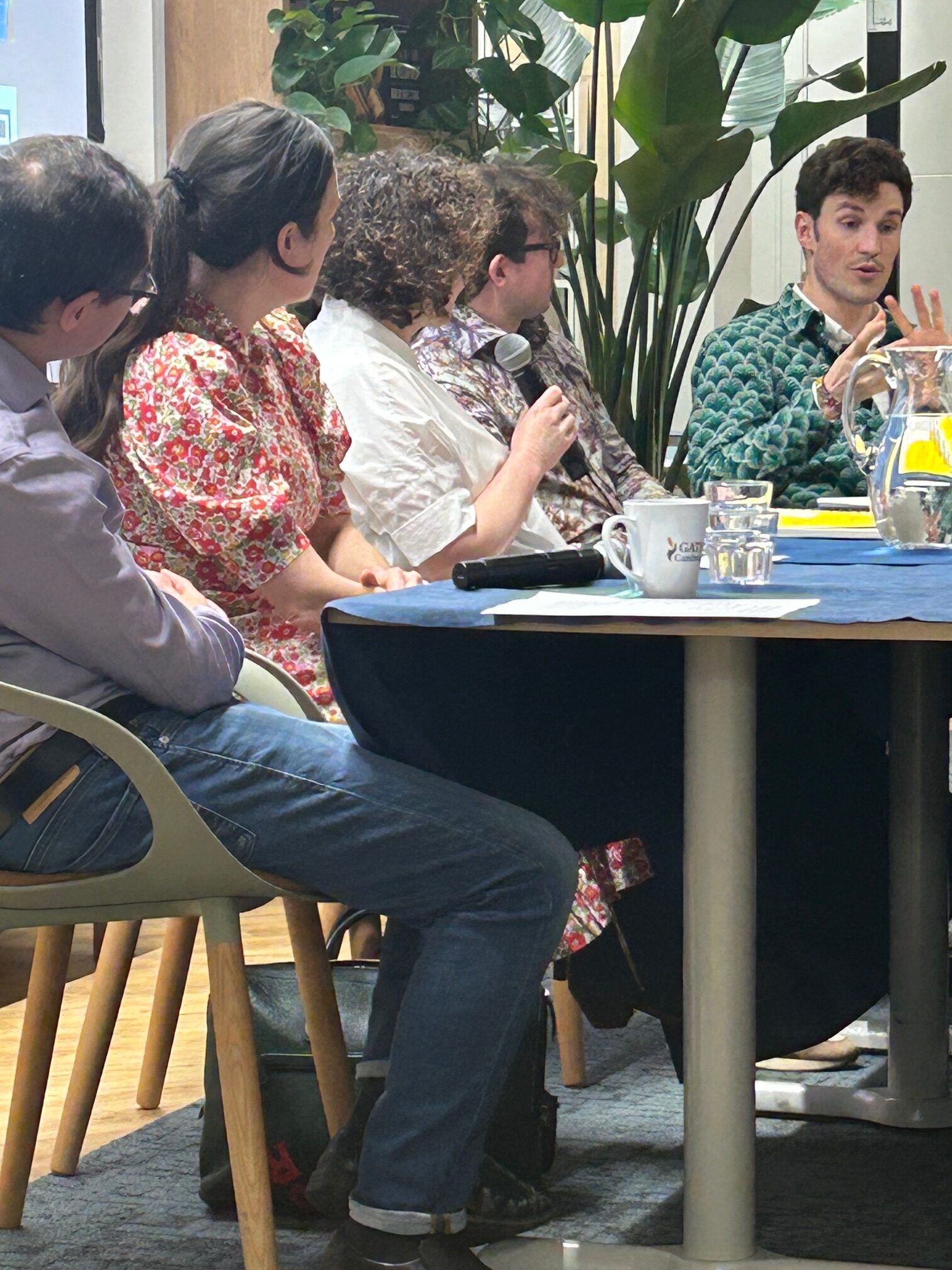 D’Arcy Williams [2019], CEO of youth-led movement Bite Back, is also opposing the cultural zeitgeist in his role in enabling young people to speak truth to power about how food systems are failing them and causing ill health. He said the food industry had been good at promoting the idea that individual actions are the best way to promote health rather than taking responsibility for how Big Food is driving unhealthy patterns of eating.
Better regulation is the best way forward, he said. Bite Back provides strong pastoral care for young people as well as getting them in front of policymakers. D’Arcy said it is hard for politicians not to listen to what they are saying as it is based on their actual experience. “Young people frame things in a way that cuts through,” he said. That has led to nine major national and local wins in the past few years for Bite Back, he said.
Dan Greenfield [2005], co-founder of PetaGene, a leading genomic data management company, spoke about his experience of setting up his company and putting ethics at the centre from the start. He did not have a background in genomics, having done his PhD in Computer Science, but he had an interest in many subjects and was talking to a friend about the challenge of the vast growth in genomic data and its storage and transfer for use in personalised medicine. He realised he could do something about it.
He spoke about the ethical challenges in his sector and unethical practices which can result in the de-anonymisation of data, which could lead to problems not just for the individuals whose data is exposed, but also their children and other relatives. There are now standards in place which promote the ethical use of data, but some operators are not conforming to them.
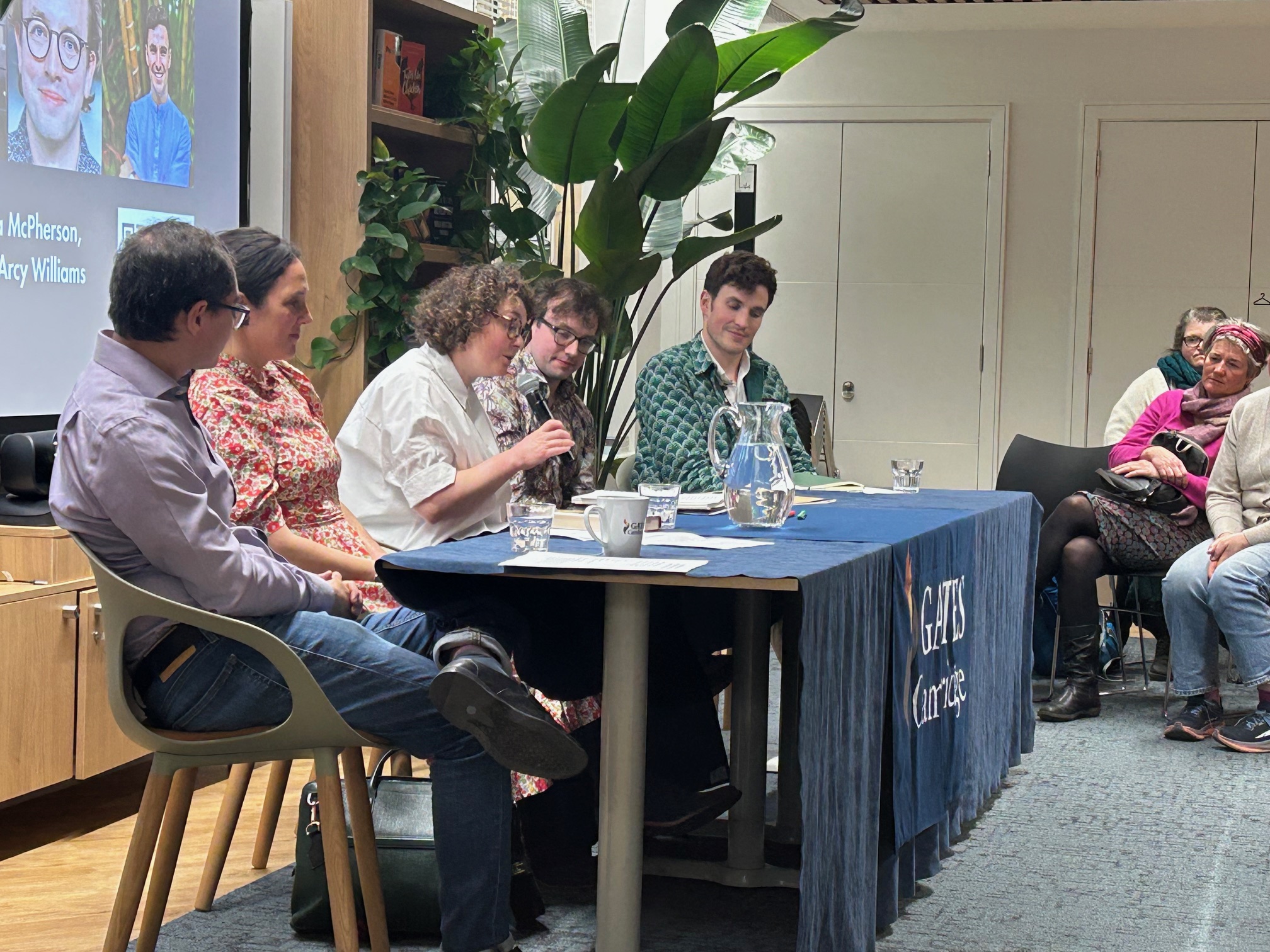 Cillian Ó Fathaigh [2014], Assistant Professor in Philosophy at the Jagiellonian University Kraków and co-founder of edtech start-up Pulc, said education is often assumed to be an inherently good thing that drives equality, but that is not always the case, as his friend and fellow Gates Cambridge Scholar Arif Naveed had taught him.
He said that Covid exacerbated education inequality. His start-up, which uses genAI to tutor students rather than doing the work for them, is looking to address this as well as the crisis in the humanities and to boost minority languages in the face of ‘Big English’. He said Big Tech is trying to convince people that there is only one way to use AI based on extraction of data, but the new AI tools can be used by anyone to create different models.
Inspiration
The speakers spoke about those who inspired them, including in Ella and D’Arcy’s cases, their mothers who work in conflict mediation and child nutrition respectively. All had leaned on their mentors and friends to support them and felt it is important to be open to failure and to not assume a career will be linear.
Several speakers talked about being inspired by young people, including, in Ella’s case, her own students. D’Arcy said it is vital to step back and uplift the voices of those who are facing particular issues every day.
Dan, who spoke about the importance of supporting those who he has to make redundant to find new jobs, finished with a call to business to hire young people so that they are able to learn from their mistakes to become better middle and senior leaders in the future.
And Cillian said people should experiment with technology. “Don’t let Big Tech own technology,” he said. “Go and play with it yourself, even if you don’t have a technology background.”