





Scholar-Elect Luca Abu El-Haj talks about his path to doing a PhD exploring the physics of the early universe.
We think there was an extremely accelerated expansion at the very beginning - like a proton expanding to the size of an orange in a tiny fraction of a second. We are exploring what observational features we would see today if extremely massive particles were created in that instant.
Luca Abu El-Haj [2026] was not sure he wanted to study physics when he started his undergraduate degree, but halfway through he discovered cosmology and he hasn’t looked back since.
His passion for theoretical cosmology and high energy physics has led to an interest in understanding what happened at the beginning of the universe and the constraining phenomenological features of new particles in the very early universe.
His PhD in Applied Mathematics and Theoretical Physics will probe the physics of the early universe. He aims to adapt the theoretical building blocks that have been successful in particle physics to cosmological backgrounds.
Luca is also keen to share his excitement for maths and physics with young people. He currently works with a project at Columbia University that engages with elementary school students to teach them maths literacy and hopes to be involved in similar teaching outreach at Cambridge.
Early years
Luca was born in New York and grew up in Philadelphia from the age of five. He has a younger brother and both his parents are academics. His father is a sociologist who teaches urban studies. His mother is a constitutional law professor. He grew up hearing lively discussions about social theory and law. It was not until later in his school years that he moved over into science.
As a young child, Luca was a big reader of fantasy novels and spent a lot of time outdoors playing football, ending up on the school soccer team and a local club team. As he progressed through school, he had excellent science teachers, and he recalls, dubious about its accuracy, a project he wrote on cosmology aged 13.
He attended a large magnet public school which admitted students on the basis of an application. At the end of high school, he wasn’t completely sure he would study physics. He had greatly enjoyed physics at high school, but he also liked history.
Aware that physics coursework builds on itself from the start, he thought it would be better to commit early to the introductory physics sequences at Columbia, so that he would not have to catch up later. He also felt he could explore other interests later if he didn’t enjoy that first year. However, he had a “phenomenal” first year physics professor and grew to love the discipline.
Undergraduate studies
Luca started at Columbia in 2022. It was an easy decision to go there. The urban campus felt familiar and since his father taught at Barnard College, which is associated with Columbia, it also conveniently meant tuition was free. It was here he was first introduced to scientific research. Despite having seen some colloquia related to cosmology his first year, it was not until his second year in 2024 that he became really excited by it. The spring of his second year, he took a course on general relativity taught by Professor Colin Hill who he has gone on to do research with. The last two weeks were devoted to cosmology. Spurred on by this, while at a research internship that summer he attended weekly cosmology group meetings which were open to everyone.
By the autumn he started taking a graduate cosmology class at Columbia. He had a question at the end of one class and was advised to email Professor Hill about it. That question eventually led to his current research project which he began in Spring 2025. “I have been so lucky to have Professor Hill and Professor Frederik Denef as my mentors. They have an infinitely large number of clever ideas and take time to answer my questions,” he says.
Research

Luca Abu El-Haj
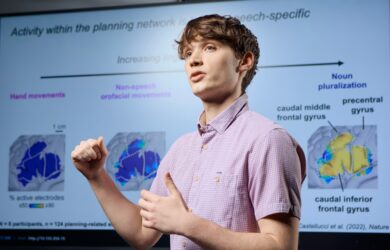
Luca [pictured left] had previous experience of research, which had given him a sense of what doing science was like, but had not done anything on cosmology. His current project attempts to understand whether or not there were new massive particles at the very beginning of the history of the universe. “We think there was an extremely accelerated expansion at the very beginning – like a proton expanding to the size of an orange in a tiny fraction of a second,” says Luca. “We are exploring what observational features we would see today if extremely massive particles were created in that instant.”
The initial results from the project were released in October on a public archive. Luca is currently editing that paper. It found no evidence to support the existence of these new massive particles. He is currently exploring other consequences of the same physical mechanism for his senior thesis.
In the past, a couple of research groups had attempted to constrain this type of theory using the temperature of the Cosmic Microwave Background (CMB), a snapshot of the universe just 380,000 years after the big bang, to search for the presence of these particles, but Luca’s work examines their features in the polarisation of the CMB. Polarisation in cosmology refers to the orientation of the oscillations of CMB light waves as they travel through space. With Professor Hill, and Professor Oliver Philcox at Stanford, Luca developed tools using polarisation to constrain these massive particles. Luca says: “It’s a complex process of going backwards in time to figure out what would have happened. Often the best we can do is to exclude things that likely did not.”
Luca’s PhD in Applied Maths and Theoretical Physics will cover different but related ground. It aims to adapt the theoretical building blocks that have been so successful in particle physics over the last century to a cosmological context, focusing more on pen and paper theoretical approaches to our understanding of the very early universe. “I am interested in how the underlying theory works, not so much if it is true, but what we would expect to see if it was,” he says.
He adds that cosmology begins from the general assumption, one that is observationally confirmed to reasonable precision, that the universe is homogenous whatever distance or direction you look at it from it if you look at it on a large enough scale. But on a smaller scale, for instance, galaxies [which are small in relation to the universe] this is not true. Luca is interested in the physics that generated these fluctuations away from homogeneity.
The best theory, he states, is that there were quantum fluctuations in the very early universe that effectively got stretched out as the universe expanded rapidly much “like a balloon with bumps on it which, when it expands, results in the bumps getting bigger,” says Luca. He adds that statistics related to these fluctuations are etched into the late-time universe [the current phase of cosmic acceleration] as a consequence of the fact that in Einstein’s theory of general relativity the speed of light is constant.
Luca says he applied to Cambridge because it has such a strong record in the theoretical cosmological research he is interested in. “The intellectual community of Cambridge was really important to me when applying, and I am excited to join that community,” he says. He was particularly keen to work with Professor Enrico Pajer who will be his supervisor.
Outreach
While he has been doing his degree, he has also taken time volunteering with the Maths Reading Team which sends Columbia students out to an elementary school to teach maths literacy. “We teach them that math is enjoyable and worth pursuing, that it is both fun and important,” he states. Luca began working with the group in his second year and this year is co-leading the group of fifth grade teachers. Imparting his own love of maths to others has been a constant in Luca’s life.
When he was at high school, he tutored some of his fellow students, and at Columbia he has worked as a teaching assistant both in the introductory physics courses and in higher level courses for physics students. With the elementary school students he enjoys finding new ways to engage them and build their confidence. “It’s really fun to see kids look at a problem and understand that they can figure it out,” he says.
*Top photo by Jeremy Thomas on Unsplash