

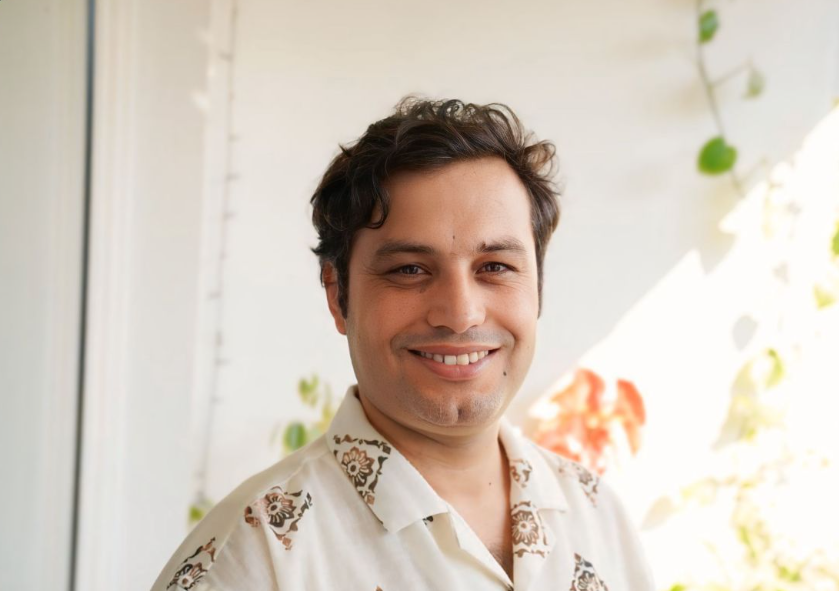
Scholar-Elect Jihad Hami talks about his PhD on self-determination and how his life as a Syrian Kurd has informed it.
The PhD is an opportunity to work on the questions I have been struggling with that affect me and my community and to find different alternatives to overcome the problems we have faced.
Jihad Hami
Jihad Hami’s PhD will explore self-determination beyond the framework of the nation state with reference to the Kurds, the Kurdish movement and its philosophy. He is interested in new alternatives to the nation state which are grassroots, communalist and democratic – what he calls “radical democracy” – where communities come together to make choices about social, economic and political issues.
His work builds on his own experiences as a Syrian Kurd who has lived through discrimination as a child, the promise of the Arab uprising and then the brutal aftermath which forced his family to flee first to Turkey and then to Europe, with Jihad one of the hundreds of thousands of Syrians who made the dangerous trek from Greece to Germany in 2015 to seek safety and stability.
Jihad [2026], who has published many articles on issues of nationalism and belonging and has co-edited a book on Kurdish identity and politics, says: “The PhD is an opportunity to work on the questions I have been struggling with that affect me and my community and to find different alternatives to overcome the problems we have faced.”
Childhood
Jihad was born in Kobani in the Kurdish north-eastern region of Syria. The family of six children and his parents moved to Damascus in 1999 two years after Jihad started primary school. Jihad was immediately aware of being in a very different environment where racism against Kurds was commonplace. “I felt I did not belong. The entire environment was Arab. That was where my questions about belonging and nationalism began,” he says. He could not speak Arabic at first and did not initially understand what was going on at school.
While he got support from his family and Kurdish activists in Damascus, he says that when he was not with his family members he felt “as if I didn’t exist”. Activists would come to the family home and this raised Jihad’s awareness of politics from an early age. “It was a healing process to listen to them,” he says.
2011 brought the Arab Spring and a sense of possibility for those opposing the regime. Jihad said this inspired him and he began to join some of the demonstrations. One of his brothers was a journalist and activist and was arrested and tortured, only being released when he was very sick with kidney failure as a result of torture. The family had to move to Turkey to get him the treatment he needed as he was still wanted by the Syrian regime.
A new identity
They crossed into Turkey in 2014, which Jihad says marked a turning point in his life. “The moment I crossed the border I had a new name and a new identity – refugee. It was a different form of othering to what I had experienced before as a Kurd. It made me question how social identity is constructed. You are not born a refugee. You become one,” he says.
He speaks about the violence his family encountered at the border. “The moment you cross illegally into another country you have no protection. The guards can do whatever they want to you,” he says. He adds that in Turkey he faced different forms of oppression, exploitation and anti-Kurdish discrimination. He remained in Adana for a year and a half taking any jobs he could get, including working 12 hours a day in construction.
In order to help his brother who was still suffering, his family sent him to Europe where they thought his brother could get the medical help he needed. Jihad joined fellow Syrians, crossing the sea to Greece and walking up through Macedonia, Serbia, Hungary and Austria. The journey took him 40 days. He was walking with a group of around 20 people who came over on the boat with him. They included children. It was a dangerous trek. Sometimes the group had to sleep in forests; sometimes there was no water or food available and they had to deal regularly with smugglers who were only interested in money.
Jihad decided to continue his journey to Germany which was welcoming Syrian refugees at the time. His family eventually moved to Austria and his brother joined him in Hamburg.
For the first one and a half years in Germany Jihad and, later, his brother, lived in a camp where he took courses in German. His plan was to continue his education. In 2019 he started a degree in English and American Studies at the University of Hamburg, to explore his love of literature, and he and his brother moved into a flat. Jihad was caring for his brother while studying and had to be particularly careful during the Covid period. His brother is now studying for a master’s.
Master’s
After finishing his degree in 2023, Jihad decided he wanted to stay in academia and to study issues relating to nation states, borders and identity.
He started his master’s in English and American Studies at the University of Hamburg which he finishes this year. Jihad has written a collection of poetry about his journey from Turkey to Germany. Some of these poems were published in P. N. Review in Manchester. He feels that through poetry he can more easily reach people about the experience of being a refugee. “Poetry is borderless,” he says. “I want to challenge the dehumanising nature of social media. I want to document those experiences from the refugee perspective to reach a broader audience.”
Alongside his poetry he has continued to write about the Kurdish movement, a subject he has been exploring since 2012. He began writing political articles for online platforms in 2015 after he met the person who will be his PhD supervisor at Cambridge, Thomas Jeffrey Miley, a world expert in political sociology and national identity, and started asking him questions about nationalism. Last year he co-edited a book with Dr Miley, entitled Rojava in Focus: Critical Dialogues. The book is a collection of essays which advance a discussion about the feminist, anti-capitalist Rojava revolution in North and East Syria within the framework of Democratic Confederalism, assessing its achievements, contradictions and various shortcomings.
Jihad says Dr Miley encouraged him to apply to Cambridge. “He is the best person to work with on this issue and Cambridge has a very strong history of studying nationalism,” he says.
He adds: “Through everything I went through I was always reflecting on the questions these experiences threw up about identity, nationalism, belonging, borders, camps and the nation state. These were my own personal experiences, but they have a universal dimension.”