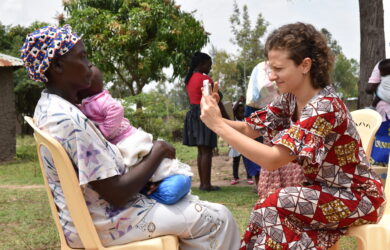







Scholar-Elect Tenzin Dhondup speaks about his work advocating for better healthcare for refugees and migrants.
Human movement has always shaped our shared history and will continue to define our future. What is not inevitable are the inequities that so often accompany it.
Tenzin Dhondup
Tenzin Dhondup’s work spans refugee health policy, humanitarian response and health equity.
Tenzin [2026], a Tibetan-American who grew up between the United States and a Tibetan refugee community in India, brings both a personal and professional commitment to his work. He says: “I’ve always known that I would be spending my life advocating for migrants and refugees. Some of my earliest memories are of listening to family members in my village recount the nearly 50 years since they had fled Tibet. We were dislocated, just about 1,500 miles from Tibet’s nearest borders.”
He adds: “What once sat in my chest as loss is now where I draw much of my motivation. In working with asylum seekers and refugees – from Armenia to Honduras to Syria – I’ve tried to understand each community and their stories, and to find ways to collaborate. Studying migration and public health together at Yale has given me the language and tools to begin making the changes I hope to see, and a clearer understanding of how much work remains.”
His MPhil in Population Health Sciences, which he will begin this autumn, will focus on health outcomes across the life course of displaced populations, with the aim of advancing durable, evidence-driven approaches to humanitarian response, health governance and resettlement policy and building systems that extend health, dignity and the resources for people to thrive wherever they find themselves. He says: “The UN now estimates that many displaced communities remain so for decades. If displacement is happening on this timescale, why isn’t public health keeping up?”
As climate change, conflict and global insecurity continues to drive the scale and duration of displacement, Tenzin is focused on how health systems can better respond to the needs of displaced and mobile populations today. Reflecting on the broader purpose of this work, he says: “Human movement has always shaped our shared history and will continue to define our future. What is not inevitable are the inequities that so often accompany it.”
Early years
Tenzin [2026] was born in New Haven, Connecticut. He spent his first six years living in the Hunsur Tibetan Refugee Settlement in South India with his aunt, uncles and older sister.
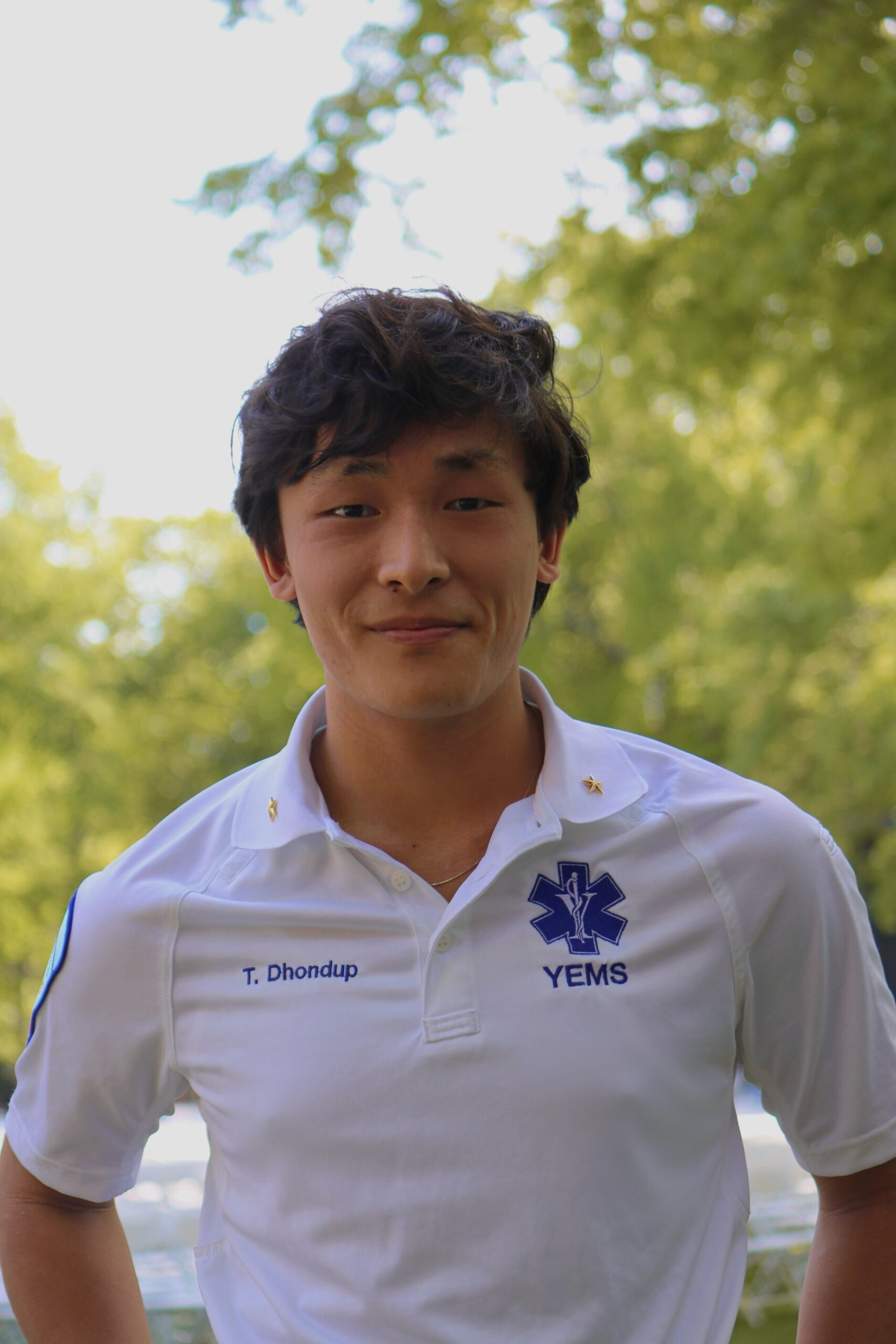 He returned to the United States in 2010 speaking only Tibetan. Navigating the public school system in Naugatuck, Connecticut, he did not become fluent in English until the age of 10. During this time, his parents, balancing nursing school and multiple jobs, made a point of taking him to the public library, instilling in him a lasting love of learning.
He says: “I was raised by parents and a community that instilled a deep sense of service to others. My mother is an emergency room nurse and my father is a technician supporting public schools and hospitals.”
At high school, Tenzin began to define what advocacy would look like for him. During the Covid pandemic, he organised tutoring support for hundreds of local students, worked as a student-teacher for elementary school students learning English as a second language and served a two-year term on the Naugatuck Public Schools District’s Board of Education, representing more than 4,000 students. He reflects: “Much of that work was about insisting that students deserved more and that we owed each other more in ensuring access to education.”
The pandemic also shaped his understanding of public health. He witnessed both the politicisation of health measures and the toll on frontline workers, including his mother who returned home from long shifts exhausted, and at one point, sick with Covid herself. At the same time, he worked with young people through his town’s Youth Services programme on substance use initiatives and trained as an emergency medical technician at evening classes. He now responds to medical emergencies in his community, sometimes handing patients over to his mother at the hospital.
Undergraduate studies
Tenzin began his undergraduate studies at Yale University in 2022, determined to be closely connected to the New Haven community.
Since arriving on campus, he has worked extensively in both clinical care and public health systems. Throughout his studies he has worked at a free student-run primary care clinic that partners with Yale University and connects over 550 undocumented and recently immigrated patients to specialised care each year. As a Referrals Director, he and his fellow co-directors have ensured that all patients being seen by the clinic are given some form of insurance before accessing specialised care, saving over $1.25 million for 2,000+ patients since December 2023.
Tenzin has also served as Deputy Chief of Service for Yale Emergency Medical Services, coordinating care at large-scale campus-related events, and continues to work overnight shifts with Oxford Emergency Medical Services, responding to medical emergencies, fires and accidents across Western Connecticut.
Although he was initially surprised that Yale did not offer a formal public health major, Tenzin used this as an opportunity to shape his own interdisciplinary path. He pursued studies across the History of Medicine and Public Health and Ethnicity, Race and Migration programmes, complemented by coursework in humanitarian health and population health.
Beyond the classroom, he has worked on research, policy and systems change related to public health. He collaborated with Yale New Haven Health to remove race-based clinical decision-making tools across specialties, reducing bias in care for more than two million patients annually. At the Kaiser Family Foundation, he produced national analyses on HIV and racial disparities that were cited in US Supreme Court amicus briefs (Kennedy v. Braidwood). As the first undergraduate fellow at Yale Law School’s Solomon Center for Health Law and Policy, he investigates the global practice of medical repatriation, examining how hospitals and private actors facilitate the deportation of undocumented patients without due process.
This work informs his academic research. He says: “My history thesis examines over 700 cases of medical deportation globally since 1945, while my second thesis in migration studies explores how refugee communities have navigated long-term displacement by building their own health systems and infrastructure.”
His migration research focuses on the Tibetan Government in Exile’s Department of Health, established nearly two decades after initial displacement, as a case study of refugee-led governance – a government he has also contributed to through his own work.
Advocating for immigrants and refugees
 While at Yale, Tenzin traveled to Dharamshala, India, home to the Dalai Lama and the Tibetan Government in Exile, after reaching out to the Secretary of Health. There, he was tasked with analysing data on more than 100,000 Tibetan refugees across India, Nepal and Bhutan to produce a national health profile. His work identified rising burdens of hypertension, diabetes and cancer.
He later returned to Dharamshala to draft a National Health Policy for the Tibetan Government in Exile, working closely with the Executive Secretary of Health and senior leadership. The policy outlines priorities for system-wide planning, including workforce development and community health programmes, and is intended to guide the future direction of healthcare for Tibetan refugees.
Returning to Yale, he carried this work into local and national advocacy. He was appointed as a Commissioner for the City of New Haven, representing more than 25,000 immigrant residents during a period of heightened uncertainty. Working with the New Haven Immigrants Coalition, he helped connect families to food resources, accompanied individuals to court proceedings and supported fundraising efforts for bail and legal assistance.
Tenzin has also worked with the United Nations High Commissioner for Refugees on the response to the Nagorno-Karabakh crisis, which displaced more than 140,000 Armenians from Artsakh. Drawing on interviews and focus group data, he helped identify critical protection risks, including the loss of identification documents that prevented displaced individuals from accessing banking, employment and housing. Following reductions in UNHCR capacity, he continued this work with Mission Armenia, supporting integration programmes for displaced communities. He recalls being struck by the parallels with his own community’s history, as families fled with only what they could carry, navigating unfamiliar systems without recognition or support. “I saw what a population health scientist could do in these settings to expose structural barriers and help address them,” he says.
Alongside this, Tenzin’s research has focused on the experiences of asylum seekers across the Americas. With Physicians for Human Rights, he evaluated asylum clinics serving thousands of individuals from more than 125 countries, studying how medical and legal systems intersect in shaping access to protection. His work has examined the role of clinical evidence in asylum claims, raising questions about why individuals must rely on medical validation to substantiate lived experiences of harm.
These experiences have shaped his commitment to addressing the health impacts of global displacement, a phenomenon that continues to grow due to conflict and climate change. He says: “Knowing my country’s story of displacement for nearly 70 years, and that many other communities will remain displaced for decades, I hope to advance the research, policy and health systems that ensure displaced populations can live with dignity, access care and rebuild their lives.”
Tenzin hopes to contribute to the next generation of efforts shaping how institutions like the United Nations respond and support the health and wellbeing of migrants, refugees and displaced populations.