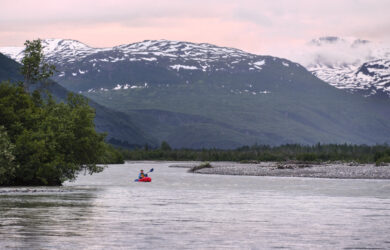



Mia Bennett will study how climate change affects two shipping routes in the Arctic.
How will people adapt to climate change in the next century?
The answers may be visible today in the Arctic region where indigenous people are already dealing with melting sea ice and changes to their way of life.
Mia Bennett, whose interest up to now has been on how climate change is affecting the infrastructure and governance of the Arctic region, wants to focus specifically on the consequences for the two main potential shipping routes in the Arctic for her MPhil in Polar Studies, which she begins in the autumn at the Scott Polar Research Institute. Eventually, she hopes to broaden her focus to look at climate change adaptation globally.
She has been fascinated by the northern countries of Europe for many years.
At college, she spent a summer in Sweden learning about Swedish culture and language, partly because of her family background. Her father is from Minnesota and his background is part Scandiavian. “My relatives still cook Swedish food,” she says. She was also drawn to Scandinavian countries’ strong sense of environmentalism.
The following summer she did an internship at the US embassy in Oslo and had a crash course in the political issues linking the US and Nordic countries. One of these is energy resources. She attended the International Geological Congress which discussed circumpolar oil and gas resources and became more and more interested in the kind of issues this threw up, including multilateral relations, the environment and potential boundary disputes.
She began to delve more into the region and in 2009 started a blog on geopolitical and strategic issues in the Arctic region through the Foreign Policy Association.
Despite being born many thousands of miles away in San Francisco Mia has always been interested in international affairs and different cultures. Although her family are steeped in law – her mother is a paralegal and her father is an attorney – the legal profession never interested Mia. “The aspect of my dad’s work that most interested me was international travel,” she says.
Mia, an only child, adds that her father was very interested in history and political science and these were the subjects she was drawn to at high school, spurred also by a good teacher.
At the University of California Los Angeles she was a political cartoonist for the main student newspaper, The Daily Bruin. “I had always been into art,” she says. “Doing the political cartoons was a way to combine my interest in drawing and illustration with current affairs.”
Her cartoons tended to be issue related and about national current affairs. “I was not too interested in campus politics,” she says.
At UCLA she majored in political science and European studies. Given her background and experience, she was particularly interested in the Nordic countries’ relationship with the European Union.
Since she graduated in 2010 she has been working as a recruiter in a high–frequency trading firm. “I wanted a break from academia and to experience New York,” she says. “I wanted to make sure I really wanted to stay in academia.” Now she is sure, she is very much looking forward to arriving at Cambridge this autumn.