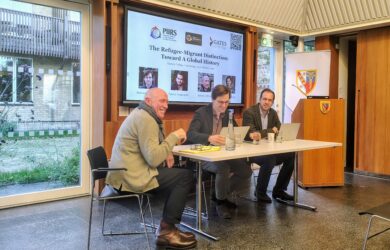


The Lancet's editor-in-chief gave a Distinguished Gates Lecture on global health.
The editor-in-chief of the prestigious medical journal The Lancet used his Gates Distinguished Lecture to issue a rallying call for scientists to work together to tackle insidious world problems, from infectious diseases to global warming.
Dr Richard Horton gave his lecture, entitled Global health is dead. Long live Global health, on 14th May.
He announced at the beginning that the talk was not, however, about global health, but about “the future of our species”. Invoking Lord Rees’ claim that the chances of survival for our species at the end of the century are ’50/50′, Dr. Horton used his lecture to weave a complex narrative of global health concerns, whilst highlighting that most recent scientific breakthroughs are the result of increasing scientific collaboration and cooperation.
Labelling climate change one of the biggest global health threats of the 21st century, he touched on a range of issues, from obesity to children’s mortality. He said that new technology and strengthened healthcare systems had led to some health successes in recent years and added that technology was key to tackling greenhouse gas problems. However, he said the response to healthcare problems was inadequate and that many health problems required a cross-disciplinary response.
He stated: “We are living in a health time bomb incubated by how we organise our society.” Better coordination and more cooperation across society was needed. Instead the World Health Organization was in crisis and countries were “not working together as effectively as they could”. Growing social inequality was also contributing to the problems.
Dr Horton called for greater use of evidence-based science to tackle these global issues, but added: “It’s not just about gathering data; it’s about ensuring our institutions are accountable to society.”
Dr Horton has been editor-in-chief of The Lancet since 1995 and has been at the forefront of many of the biggest issues in medicine during that time. At a major conference on global health last year he said that the centre of gravity in global health research is increasingly shifting away from the traditional multilateral institutions of public health based in Europe and is increasingly dominated by American academic institutions. He urged the global health community to come together to establish priorities and agree on how to evaluate progress.