






When institutional legitimacy erodes, we need to be attuned to what might come next, says Catherine Tan.
If we don't adapt our understanding of sovereignty itself, we risk entering a future where legal authority is up for grabs, and the power to define reality belongs only to those bold enough to seize it, regardless of democratic consent or social legitimacy.
Catherine Tan
The world has become a live design lab for what used to be unimaginable. We now share it with robots that consume other robots, shape-shifting machines, AI systems designed from mystical principles and plant-object cyborgs. These aren’t just curious novelties or imports from science fiction; they’re techno-utopian prototypes that actively re-write the rules of reality.
If we could visualise legal reality as an iceberg, the treaties, legislation and visible machinery of law are just the surface. Meanwhile, these inventions are contesting the deeper, icier foundations below, destabilising the core principles and assumptions that give law its shape: what counts as a person, what counts as a territory, what counts as authority.
During my stint as a Gates Cambridge Scholar, my PhD examined how techno-utopian communities are prototyping new sovereignties. Circa 2020s, they don’t simply seek permission. They declare their own legal status, creating what I call “ontological crises” for law, moments when existing categories simply cannot hold.
Into the field
For the past five years, I’ve followed seasteaders, blockchain democracies, outer space architects, techno-utopianists and virtual world builders as they construct governance systems from scratch. My research took me into constitutional conventions held over Discord at 3AM, karaoke sessions that morphed into debates about citizenship and role-playing simulations where participants stress-tested their own conflict resolution mechanisms.
The numbers: 77 formal interviews. Over 10,000 messages across digital platforms. Conferences from Prague to the Bay Area. But figures can’t capture what it actually feels like to watch someone build a court system in a virtual world they cannot physically touch, or to hear a middle-class professional explain why they’ve funnelled their life savings into a floating platform in the ocean.
Why do people do this? That question drove me into this research, and the answers I found were rarely what I expected.
Not escapists, but architects
 The dominant narrative frames techno-utopians as libertarian escapists, people running away from society to be sheltered from its harms and immunised from its deeper conflicts. To some extent, this holds. But my fieldwork revealed something more complex co-existing with that analysis. Many participants were refugees from failed states, veterans of brittle institutions, whistleblowers who witnessed state horrors or people systematically excluded from traditional democratic participation. They weren’t fleeing governance. They were hungry for it; just not the kind that had failed them.
One participant, a stateless person who now holds citizenship in a blockchain-based jurisdiction, put it simply: “I spent 30 years floating in the void and sort of asking to be let in. Now I’m just done asking.”
This shift from sovereignty as something granted to sovereignty as something declared is the transformation my research documents. These communities don’t wait for external validation. They create legitimacy by attracting voluntary participants, building functional institutions and demonstrating that their systems actually work.
The deeper pattern
What united these otherwise disparate communities wasn’t ideology necessarily: libertarians sat alongside postcolonial Marxists, venture capitalists alongside stateless refugees. What they shared was a particular way of seeing.
Most reformers try to change the rules of the game. These builders had noticed something else: the rules are symptoms of deeper assumptions. What counts as a person. What counts as a place. What counts as authority. These foundational premises, largely invisible, rarely questioned, generate the entire legal and political landscape we navigate.
Their insight was almost architectural: if you want a genuinely different building, you can’t just rearrange the furniture. You have to dig down to the foundations and build from there.
This type of operating-system (OS) thinking has proliferated across the technosphere over the past two decades. It’s a relic, perhaps, of the internet age, where programmers learned early that surface-level patches rarely fix architectural problems. What these communities have done is apply that logic to governance itself.
It explains why they built floating platforms and virtual jurisdictions instead of lobbying for policy reform. They weren’t interested in better laws within the existing system. They were interested in changing the underlying principles that make certain laws thinkable and others unimaginable. One participant described it as “debugging reality at the operating system level”.
It’s a strange thing to witness. But once you see it, you can’t unsee it.
Whether you call this first-principles thinking, systems-level intervention or simply a neurodivergent cognitive style that notices patterns others miss, I encountered it consistently across communities that otherwise had little in common. They weren’t trying to win within the existing game. They were prototyping different games entirely.
Learning to see differently
Early in my research, I made a methodological error that transformed how I understand academic knowledge itself. I arrived at one community with formal consent procedures, structured interview protocols and all the proper ethical safeguards. Four different participants, independently, told me this approach would fail.
“When you ask people to sign consent forms, you’re making this a thing,” one explained. “We’re post-formalists. You’re applying bureaucratic frameworks to people who reject bureaucratic frameworks.”
Another warned me more bluntly: “These people can be dangerous. They’ll doxx you.”
A third offered reassurance: “These are some of the most open people I’ve ever met. When they agree to talk to you, that’s already consent.”
This range of responses, from radical openness to protective defensiveness, taught me something crucial. These communities have complex relationships with external institutions, shaped by histories of misrepresentation by journalists and academics alike. To understand what they’re building, I had to develop what I call a “hermeneutics of presence”, a way of engaging that is informed by somatic therapy and how to engage with the radical other. It promotes psychological honesty and factors in emotion and attunement.
Why This Matters Now
Here is what’s at stake: traditional institutions are eroding, whether we study them or not. Trust in governments, courts and international bodies has declined across virtually every metric over the past two decades. The question isn’t whether alternative forms of authority will emerge. It’s whether we’ll understand them when they do.
These techno-utopian experiments are already handling real consequences. Blockchain-based dispute resolution systems now arbitrate millions of dollars in transactions. Virtual worlds have developed property rights, taxation systems and enforcement mechanisms that function without any physical territory. Seasteading communities are negotiating with nation-states not as supplicants but as proto-sovereign entities with something to offer.
Some of these experiments will fail. Some already reproduce the exclusions they claim to escape: plutocratic drift, accessibility barriers, environmental costs that contradict their stated values. My research doesn’t celebrate these projects uncritically. But it does take them seriously as attempts to answer a question that traditional political theory has largely ignored: what comes after institutional legitimacy erodes?
If scholars, policymakers and citizens don’t develop frameworks for understanding these new forms of authority, we cede that understanding to the builders themselves, who may or may not be asking the questions about consent, equity and accountability that democratic societies need answered.
The emerging question
If we don’t adapt our understanding of sovereignty itself, we risk entering a future where legal authority is up for grabs, and the power to define reality belongs only to those bold enough to seize it, regardless of democratic consent or social legitimacy.
But there’s another possibility: these experiments might be prototyping forms of authority that could help us navigate an era of institutional crisis. The question isn’t whether techno-utopians have all the answers. It’s whether we’re paying attention to the questions they’re forcing us to ask.
And we should be.
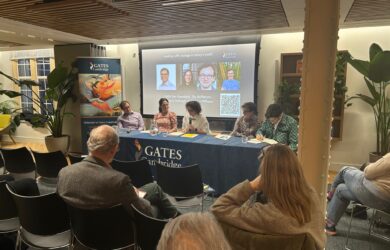
Catherine D. L. Tan [2022 – pictured above] is the founder of Uncommon Future Press, a Gates Cambridge Scholar on legal world-making and avant-garde technologies, and a former economic diplomat. UFP launches its portal in 2026. Follow its work at @UncommonFuturePress.
Picture: András Gyõrfi, “The Swimming City”, courtesy of Wikipedia.