

Event co-organised by Gates scholar attracts 150 people.
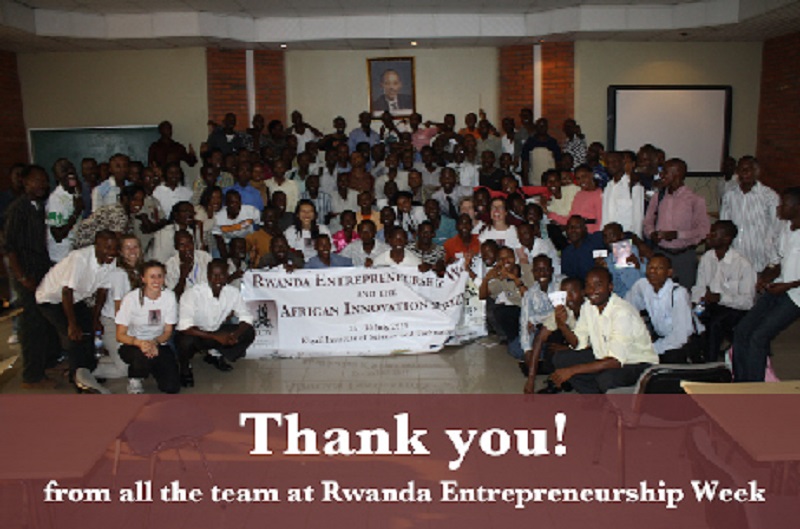
One hundred and fifty Rwandan students attended the first Rwandan Enterprise Week last week.
The Week is an initiative of a group of Cambridge students, including Gates scholar Julia Fan Li [2008].
The organisers had hoped for a maximum of 100 students, but 240 had registered online before the event and the organisers had to select the most enthusiastic. “They came from universities across Rwanda. After the first day, some were so impressed they told their friends and they came. Some had even taken a two-hour bus ride to get there so we tried to squeeze them in,” says Julia.
The event, which ran over six days in association with the Kigali Institute of Science and Technology (KIST), is a spin-off from the African Innovation Prize which was piloted in Rwanda last year. The African Innovation Prize has now been successfully running for two years at KIST and organisers are taking the business plan competition nationwide and adding the National University of Rwanda (NUR) and the School of Finance and Banking (SFB). They are also looking at making it a pan-African event.
Julia says the part of the week students seemed to benefit from most was support with how to get their ideas implemented. She is delighted that one outcome of the Week is that students are now setting up their own entrepreneurship clubs which they hope to run themselves.
She adds that the Rwandan Government is keen to encourage private sector development – entrepreneurship is now an essential course at universities and resources have been invested in high schools. “On the first day we didn't have to define what an entrepreneur was. People knew and lots of students were running their own businesses,” says Julia.
The week was divided into 24 hours of curriculum teaching (led by Rwandan entrepreneurs) in the afternoons and mornings reserved for one-on-one consulting sessions with serial entrepreneurs, business people and lawyers.
At the end of the six days the winners of this year's innovation prize were presented with their awards by the governor of Rwanda's central bank (Ambassador Claver Gatete), who used to be the Rwandan ambassador to the UK. The 2011 African Innovation Prize award went to HP&A Eden Flower Project by Patrice Habinshuti and Marie Louise Uwimbabazi. The business focuses on creating a horticulture centre in the growing city of Kigali.
Julia also followed up on the progress of the 2010 AIP Award winners. One team-member is using his winning project – for an ecological toilet – for his honours thesis and both winners plan to roll their project out from September after graduation.
Julia and her co-organisers are now looking at spreading the African Innovation Prize business plan competition to other universities in Africa, particularly Sierra Leone and Nigeria, where they have had interest from potential partners. They are looking for funding and are seeking partnerships with other global entrepreneurship initiatives. Their next event is in November when they will link up globally with other entrepreneurial students as part of Global Entrepreneurship Week.