


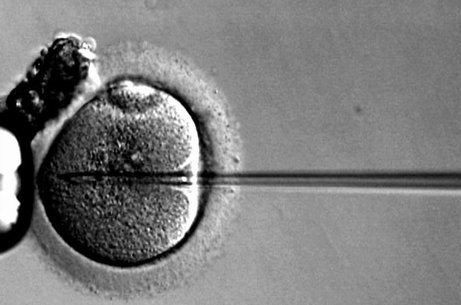
Egg freezing for non-medical reasons is not empowering, according to four feminist scholars studying assistive reproductive technologies.
Egg freezing for non-medical reasons is not empowering, according to four feminist scholars studying assistive reproductive technologies.
In an article entitled “Breaking the Ice: Young Feminist Scholars of Reproductive Politics Reflect on Egg Freezing”, published this week in the International Journal of Feminist Approaches to Bioethics, the four women, including Gates Cambridge Alumna Katie Hammond [2011], offer their personal and academic reflections on social egg freezing. They question cultural assumptions about childbearing, the disclosure of risk, failures to consider sexual diversity and socioeconomic status in relation to access to reproductive technologies and the expansion of the market in reproductive tissues.
The article follows the decision by the American Society for Reproductive Medicine’s recognition in 2012 that social egg freezing should no longer be considered experimental and an article by feminist anthropologist Marcia C. Inhorn, published the following year, advising female graduate students to find a supportive partner with a flexible career path and consider freezing their eggs so they can choose when to become a mother.
It also comes just a week after reports that Facebook and Apple are offering to pay female employees to freeze their eggs so they can delay starting a family.
The authors conclude: “The assumption that some women can ‘have it all’ by first establishing a career and then raising biologically related children (conceived from frozen eggs) oversimplifies the challenges [faced by women] by suggesting that egg freezing offers women an effective, possibly “easy” solution to complex social and cultural questions. It advances a bioessentialist understanding of the family and does not recognise the underlying inequitable socioeconomic structures that limit our reproductive choices.”
They continue: “Considered together with the limited disclosure [or data] about the long- and short-term risks of egg freezing, the presumption of heterosexuality in how reproductive technologies are theorised and applied, and the commodification of women’s reproductive tissues in both egg freezing and research, we argue that there are strong reasons to challenge advice to “consider freezing your eggs”. As young feminist scholars engaged in reproductive politics, both personally and professionally, we contend that the option of social egg freezing not only is shortsighted but also fails to challenge the very conditions that produce its need. We reject the claim that egg freezing empowers all women by offering a non-problematic reproductive choice.”
Katie, who did an MPhil in Multi-disciplinary Gender Studies with the support of a Gates Cambridge Scholarship, is currently at Wolfson College studying for a PhD in Sociology at the University of Cambridge.
For more information, click here. Photo credit: RWJMS IVF Laboratory and Wiki Commons.