


The fourth episode of the Gates Cambridge podcast addresses whether ethics can keep up with the pace of AI development
Three Gates Cambridge Scholars address the ethical implications of Artificial Intelligence and the need for ethics to keep up with the pace of change in AI in the fourth episode of the Gates Cambridge podcast, So, now what? out today [30th May].
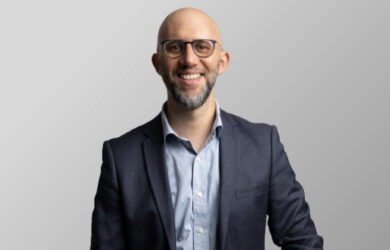
The episode, featuring Andreas Vlachos, Kerry McInerney and Richard Diehl Martinez was hosted by broadcast journalist Catherine Galloway and recorded, for the first time, in person at Bill Gates Sr House.
The speakers discuss the challenges of bias and misinformation in AI, the concentration of power in big tech companies and the need for more competition and open models, the environmental impact of AI and the importance of public awareness and education. They also highlight the need for regulatory measures, such as transparency in AI models and data sets and tools to navigate and detect biases.
The episode concludes with a call for a renewed focus on protecting individual rights in the digital age and cultivating greater public awareness of AI’s capabilities and limitations.
Andreas Vlachos [2006] is Professor of Natural Language Processing and Machine Learning at the Department of Computer Science and Technology at the University of Cambridge. His current projects include dialogue modelling, automated fact checking and imitation learning. Before this he was a lecturer at the University of Sheffield, working on the intersection of Natural Language Processing and Machine Learning.
Dr Kerry McInerney [2017] is a Research Associate at the Leverhulme Centre for the Future of Intelligence at the University of Cambridge where she researches AI from the perspective of gender studies, critical race theory and Asian diaspora studies. She is also a Research Fellow at the AI Now Institute and in February 2023 will be a Visiting Fellow at the Sarah Parker Remond Centre for the Study of Race and Racialisation at the Institute of Advanced Studies, UCL. She is the co-editor of the upcoming collection Feminist AI (Oxford University Press), the co-editor of The Good Robot: Feminist Voices on the Future of Technology (Bloomsbury) and the co-host of The Good Robot podcast on feminism and technology, which has received over 20,000 downloads to date.
Richard Diehl Martinez [2021] is doing his PhD in Computer Science. His research explores strategies for minimising the data and size requirements of AI language models while preserving performance relative to their larger counterparts. Through this process, he also investigates the parallels between the learning mechanisms of language models and human language acquisition. Previously, he worked as an Applied Research Scientist at Amazon Alexa, where he focused on language modelling research.
*You can download the podcast by clicking here or below.