





Scholar-Elect Cassandra Vega talks about why the MPhil in Education (Knowledge, Power and Politics) is perfectly suited to her interests in education, civil rights and ensuring an equal voice for marginalised communities.
We all share the same Earth, and the purpose of whatever it is we choose to do with our lives has to be towards creating a kinder and more peaceful world. I believe that world is possible.
Cassandra Vega
Cassandra Vega [2026] is a community activist who puts education at the centre of her work.
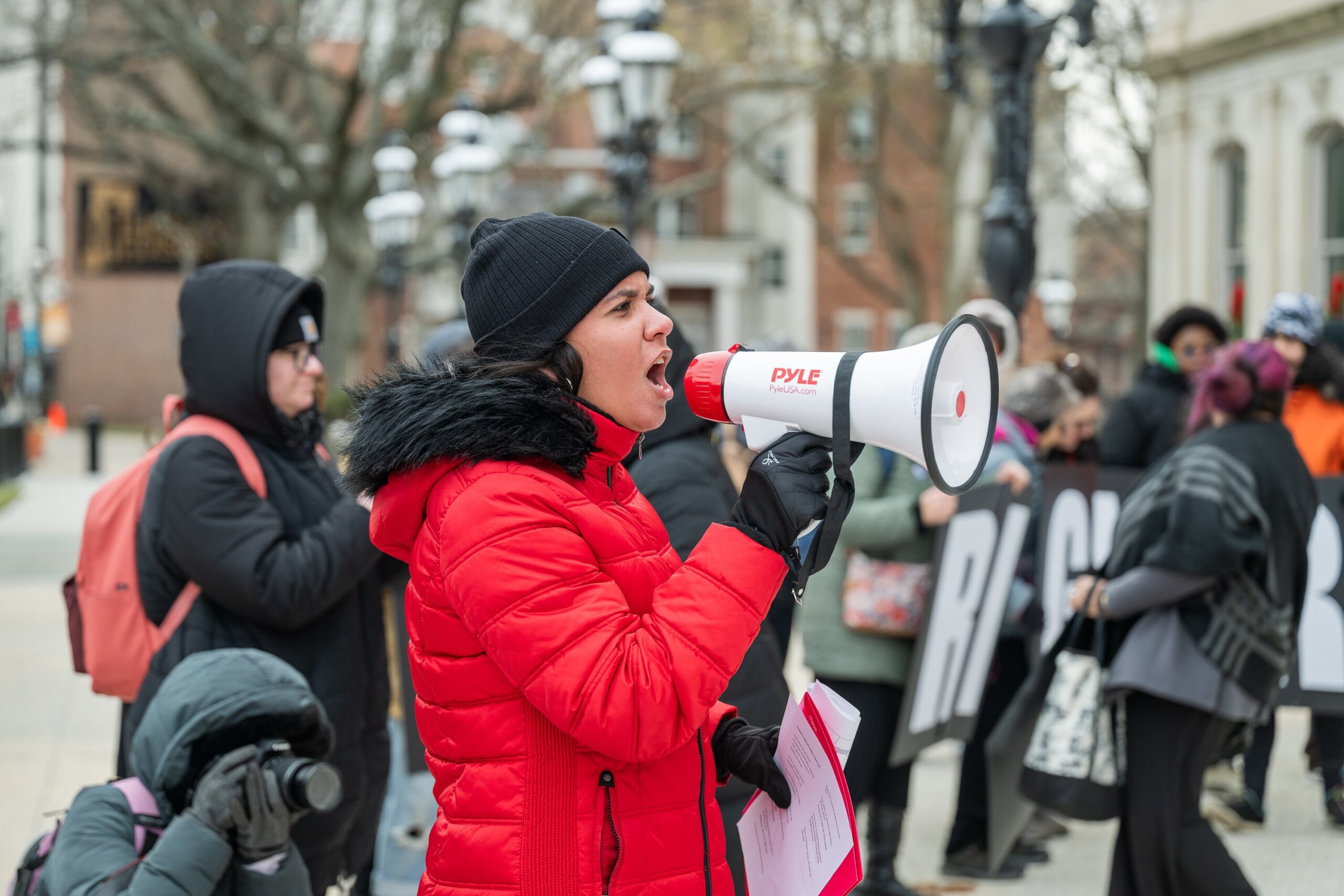
Through her advocacy, including co-founding the Fellows in Racial Justice Learning Community and the Women’s Pre-Law Society at Rutgers, as well as her current role at the American Civil Liberties Union of New Jersey, she has demonstrated energy, initiative and a deep commitment to ensuring an equal voice for marginalised communities.
This autumn, she will begin the MPhil in Education (Knowledge, Power and Politics) at Cambridge. The programme brings together her interests in education, justice, politics and democracy, and Cassandra hopes its international lens will give her a clearer understanding of how we can create a more empathetic and equitable society.
For her, community is at the heart of who she is. She attributes her Gates Cambridge Scholarship to every mentor and teacher she has had, and to all the people who have inspired, encouraged and paved the way for her.
New Jersey girl
Cassandra was born in New Jersey and describes herself as a “Jersey girl through and through”. Her grandparents came to the US from Puerto Rico and the Dominican Republic in the 1960s. Her parents met during high school in Perth Amboy, New Jersey, a low-income Latino neighbourhood that, in the 1970s and 80s, was largely dominated by European immigrants. The discrimination her parents faced, both social and structural, influenced their decision to move to the wealthier township of South Brunswick, where Cassandra and her younger brother were raised.
Yet every Sunday, she returned to Perth Amboy for church and family gatherings, witnessing firsthand how inequity manifests across communities. She was drawn to the gaps in education, which she says is exacerbated in New Jersey where she says there are nearly 600 school districts in the state, all rooted in redlining practices from over a century ago, practices which saw financial services withheld from neighbourhoods that have significant numbers of racial and ethnic minorities.
“You cannot avoid the wealth and educational inequality in our state,” says Cassandra. Growing up, she noted the differences between her friends in South Brunswick and Perth Amboy. “They lived such dramatically different lives, although they were only half an hour away from each other,” she says. “All that separated us and them was where we grew up.”
Cassandra’s mother, a library supervisor, worked at the Centre for Women’s Global Leadership for over 20 years. “That exposed me to all the issues around international, intersectional feminism and also how many people were working on solutions. I credit my mum with a lot of my understanding of the world,” she states.
Her father works as an IT analyst, but spends most of his time giving back to the community. He
coached her and her brother’s youth basketball teams and has been coaching youth sports for over two decades. “He wanted to set an example for my brother and I,” she says. “He taught us the purpose of service. I would not be who I am without my parents.”
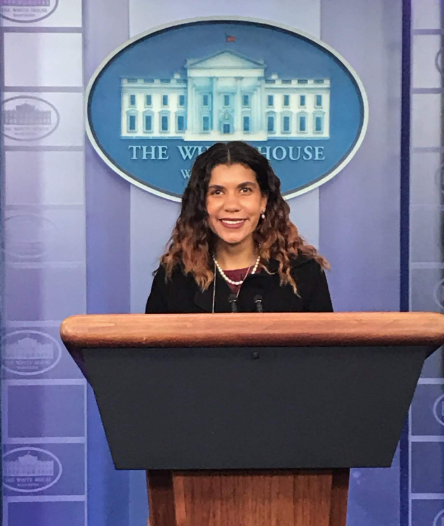 Described as “a force” even in pre-school due to her big personality, Cassandra channelled her energy into both academics and athletics. In high school, she served as Managing Editor of the school newspaper, initially envisioning a career in journalism. During her junior year, she participated in a nine-day journalism fellowship for people of colour, where she met a prominent journalist at a Black-focused media outlet.
At just 16, she was invited to cover an event at the White House. The journalist had to drop out of the event at the last minute, so Cassandra went alone with her mum’s camera, waking up at 4am to make the journey. It was during Trump’s first term, and the Young Black Leadership Summit she covered was sponsored by Turning Point USA, an organisation whose principles she strongly disagreed with. Rather than dismissing attendees, she chose to engage with them – seeking to understand their motivations.
She is still motivated by a desire to tell people’s stories and says: “I want to help people to understand their inherent power as democratic citizens and to recognise the value of telling their story.”
At the same time, Cassandra was a dedicated athlete. She competed twice in national track and field competitions, ranked among the top 100 cross-country runners in her state and served as a two-time captain of her varsity basketball team. As a three-sport varsity athlete for four years, she trained or competed six days a week, year-round. She initially thought she would go to college for track, but chose instead to prioritise an academic route. “I loved sports, but wanted to reach my academic potential and give everything to that. So I doubled down on my studies,” she says, adding that she has applied her cross country coach’s advice of ‘be content, never satisfied’ to everything she has done since.
Undergraduate studies
Cassandra began her undergraduate studies at Rutgers University in 2020, at the height of the Covid pandemic – which put many things into perspective for her. As a member of Douglass Residential College, a women’s college founded in 1918 which was absorbed by Rutgers nearly a century later, she learned how to transform her beliefs into action.
She joined the college’s Public Leadership Education Network, served as an ambassador for their Human Rights House and helped found the Women’s Pre-Law Society in 2021, the first identity-focused organisation of its kind at Rutgers which promotes women’s access to careers in law.
Her involvement in Douglass and in other organisations throughout the university led her to work with the Institute for the Study of Global Racial Justice to form the Fellows in Racial Justice Learning Community in 2022, a Rutgers programme which aims to identify, accompany and mentor generations of lifelong intellectual activists in racial justice across the university’s three campuses and across all disciplines. Her motivation came from working in student government and noticing that there were no spaces nurturing racially and economically diverse students to become leaders.
She is very proud of her time with the Racial Justice Learning Community, saying the community’s students embody her firmly-held belief that when you empower someone with education, you help them put the pieces together about how systems operate and enable them to take control of their lives. She mentions a South African student in the programme who has gone on to write a children’s book about Black health. “She is emblematic of the power of education. She used this opportunity to empower and educate the next generation,” she states.
Cassandra’s summers were spent interning for Congresswoman Bonnie Watson Coleman, Congresswoman Nydia Velazquez, the Pioneering Ideas for an Equitable Future Team at the Robert Wood Johnson Foundation and serving as a New Jersey Governor’s Hispanic Fellow. She also represented the state of New Jersey on the national level at the Henry Clay Center’s College Student Congress.
Cassandra graduated summa cum laude in 2024. Though she began her studies intending to pursue journalism, she majored in political science with minors in Latino and Caribbean Studies and women’s and gender studies. Before graduating, she completed a research fellowship on Puerto Rican history under US rule and how it can and should inform the island’s political future. She also earned certificates from the Institute for Women’s Leadership and the Eagleton Institute of Politics. In her final year, she began working for the New Jersey Department of Labour as a policy coordinator, assisting undocumented workers who had been exploited by their employers.
Civic engagement
Cassandra would have stayed in that role, but had the opportunity to join the Coro New York Fellows Programme in Public Affairs, a year-long rotational programme which helps launch the next generation of civic leaders into careers of impact and purpose. Through Coro, she worked in a government agency, a union, a non-profit, a business and in a community justice clinic. “It is the most incredible experience I have had,” she says. “Coro challenged me on a daily basis and pushed me to investigate why I believe what I believe, and why I want to do what I want to do. It made me a better scholar, a better person and a better professional.”
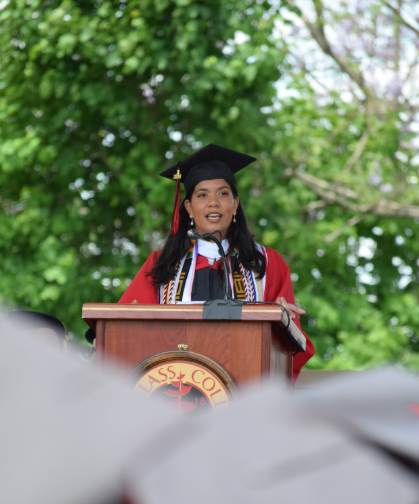 Cassandra recently joined the American Civil Liberties Union of New Jersey as a civic engagement organiser. Given her background in areas such as community volunteering and youth empowerment, the position suits her perfectly. “It brings together all the things I care about – working with underrepresented communities, educating people and giving them the tools to take control of their lives,” she says. “At ACLU-NJ, I am surrounded by advocates who are working every day to make New Jersey a more equitable place.”
She adds that she is lucky to live in a more progressive state, and that working proactively alongside the political advocacy team she is on is a privilege. Having been a self-identified pessimist in the past, she is very much focused on the future. She says that she used to be consumed by ‘doomscrolling’ every day about the state of democracy in the US until a friend asked her why she didn’t just do something about it. “Rather than being frustrated, I realised that I could use my abilities to make a difference,” she states.
The MPhil at Cambridge felt like a natural next step. “It made sense. I can gain invaluable information to bring back to the communities I care about,” she says, adding that having an international perspective is a critical part of the programme. “We Americans love to use the word unprecedented, but the reality is that other nations have knowledge and experience that can help us find solutions to what we are facing today,” she says. “We all share the same Earth, and the purpose of whatever it is we choose to do with our lives has to be towards creating a kinder and more peaceful world. I believe that world is possible.”