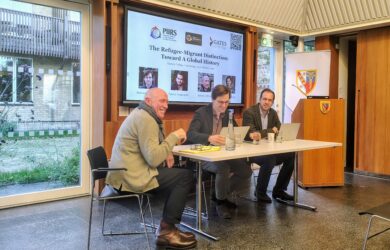


Reid Lidow will join Nobel Laureate Michael Spence and Mohamed El-Erian, President of Queen's College, to deliver the 2024 Gates Cambridge Annual Lecture
This year’s Gates Cambridge Lecture will include a Nobel Laureate, a President of a Cambridge college and, for the first time, a Gates Cambridge Scholar.
The Lecture, A global turning point: how to escape the permacrisis, will be given on 22nd April [5-7.30pm] at St John’s College and will feature Nobel Laureate and economist Michael Spence, Dr Mohamed El-Erian, President of Queens’ College, Cambridge, and Gates Cambridge Scholar Reid Lidow.
The three will discuss their new book co-authored with former Prime Minister Gordon Brown, “Permacrisis: A Plan to Fix a Fractured World”. It argues that at the heart of today’s permacrisis are broken approaches to growth, economic management, and governance, but that these are not beyond repair. It explains where we’ve gone wrong, and offers a provocative, inspiring plan to do nothing less than change the world.
The authors set out how we can prevent crises and better manage the future for the benefit of the many and not the few.
The lecture will include introductory remarks, a panel discussion and a Q&A session and will be followed by a drinks reception. The lecture is free and open to all.
Reid Lidow [2014] served as Executive Officer to the Mayor of Los Angeles. In this role, he provided strategic counsel to Mayor Garcetti and ensured the execution of his day-to-day goals. Before this, Reid worked for Gordon Brown on a range of initiatives – from encouraging countries to deliver an inclusive and quality education for all children to the campaign against Brexit. He continues to work with Brown on projects exploring global governance and nationalism and will be attending law school later this year.
Michael Spence is the Philip H. Knight Professor Emeritus of Management in the Graduate School of Business at Stanford University, a Senior Fellow at Stanford’s Hoover Institution, and a Council on Foreign Relations Distinguished Visiting Fellow. He is an adjunct professor at Bocconi University and an honorary fellow of Magdalen College, Oxford. He was awarded the Nobel Prize for Economic Sciences in 2001.
Mohamed A. El-Erian is the President of Queens’ College, University of Cambridge. Since 2014, he has served as Chief Economic Advisor at Allianz, the corporate parent of PIMCO where he formerly served as Chief Executive and Co-chief Investment Officer. He is Chair of Gramercy Fund Management, a columnist for Bloomberg Opinion and a Financial Times contributing editor. He is a Senior Global Fellow at the Lauder Institute and the Rene M. Kern Practice Professor at the Wharton School of the University of Pennsylvania.
*To book a ticket, click here. There will be an opportunity to purchase “Permacrisis: A Plan to Fix a Fractured World” at the event.
**Picture credit: Wikimedia commons and Racaille1950