






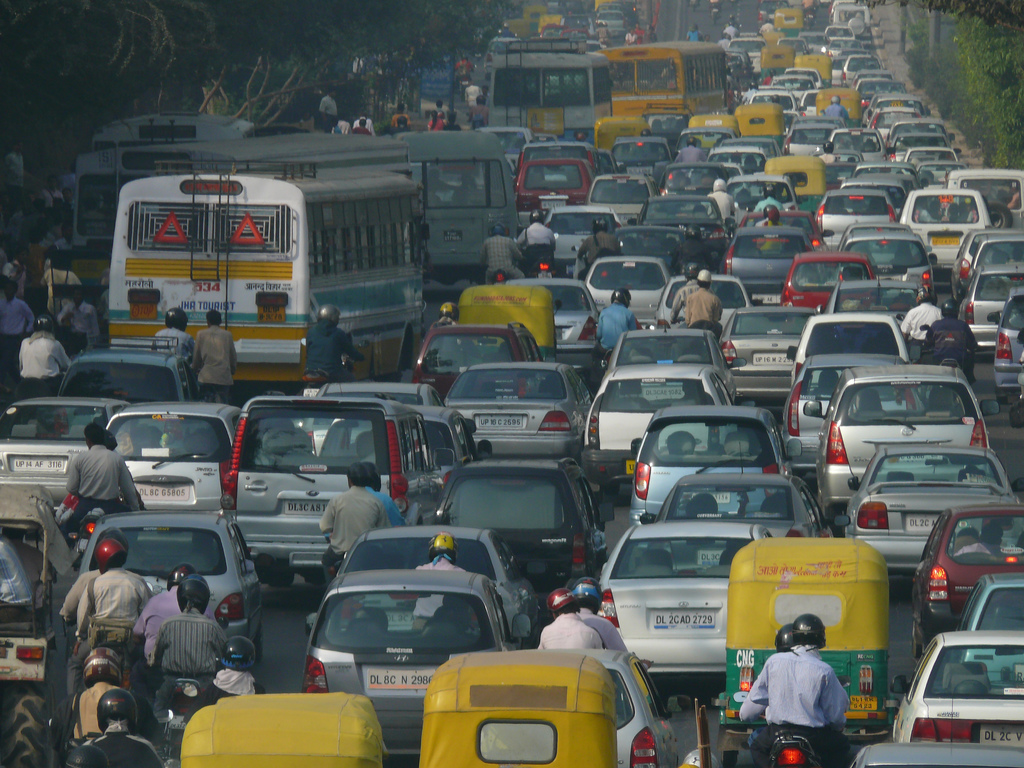
Scholar Dr Vijay Kanuru explores how Metal-Organic Frameworks - for which three academics won a 2025 Nobel Prize - offer India the opportunity for a genuine breath of fresh air.
Air pollution requires moonshot-level ambition - and the science is already in our hands. The 2025 Nobel Prize sends a clear message: the world now has tools powerful enough to reverse pollution's trajectory. What remains is political will, industrial collaboration and grassroots adoption.
Dr Vijay Kanuru
The 2025 Nobel Prize in Chemistry awarded to Susumu Kitagawa, Richard Robson and Omar M. Yaghi for their work on Metal-Organic Frameworks (MOFs) is more than an academic accolade – it’s a beacon of hope for India, which grapples with some of the world’s most severe air pollution. This nanotech innovation offers practical, scalable solutions that could transform environmental management and public health.
The challenge of India’s air
For millions in Indian cities like Pune, Mumbai and Delhi, air pollution is a daily health crisis. PM2.5 levels consistently exceed safe limits, leading to surging respiratory ailments and reduced quality of life. Current solutions focus primarily on emission control, but offer limited options for actively scrubbing existing pollutants or managing industrial emissions at the source. MOFs arrive precisely when India needs scalable, science-driven solutions to reclaim the right to breathe.
MOFs explained: The world’s smartest nano sponge
A MOF is a nano-sponge created by linking metal ions with organic molecular “connectors” in a crystalline network. The result is a structure riddled with pores – spaces so small and orderly that scientists can design them to capture specific pollutants like magnets. If pollution is the problem, MOFs are the nano-architect’s answer: structures with rooms that trap the culprits.
Imagine a microscopic sponge engineered with atomic precision with an internal surface area so enormous that a spoonful contains the equivalent of an entire football field.
Why MOFs are a breakthrough
Traditional filters are blunt instruments – they strain out dust, but can’t stop dangerous nanoscopic pollutants and toxic gases that slip through freely. MOFs function like magnets, grabbing carbon dioxide, sulfur dioxide, nitrogen oxides, volatile organics, ultrafine PM2.5 particles and heavy metal dust. Each pore is a customised trap waiting for a specific molecule.
MOFs are programmable nano-filters. Using computational power, we can design application-specific MOFs at scale. They trap, store, break down or transform pollutants with surgical accuracy, and can be regenerated and reused. The Nobel Prize acknowledges their arrival at maturity where real-world deployment is finally possible.
Where MOF technologies are already making a difference
Across the world, MOFs are accelerating solutions that once felt futuristic:
· MOF-lined air purifiers that outperform HEPA filters
· Smart coatings for buildings that actively absorb pollution
· MOF-infused masks filtering both particles and harmful gases
· Industrial scrubbers capturing emissions at the source
· Catalytic MOFs that convert pollutants into harmless by-products.
What makes them revolutionary is efficiency: more purification with less material, less energy and often lower cost once scaled.
Why this matters to India
India faces a generational paradox: developing rapidly and urbanising at record speed, yet its citizens breathe the world’s most toxic air. Air pollution contributes to a $5 trillion global economic burden, but for India, it’s an acute crisis – an economic one, a public health emergency and a national priority.
Children grow up with reduced lung capacity. Cities lose billions in productivity. Healthcare systems buckle under chronic respiratory and cardiac illnesses. Meanwhile, public frustration rises.
MOFs offer something rare: a scientifically credible, technologically mature, scalable solution deployable across sectors. From household devices to highways, factories to farms, MOFs can integrate into India’s existing infrastructure rather than requiring wholesale replacement.
A call to action: Three urgent steps
To make the most of MOFs’ benefits, India needs to do the following:
1. Accelerate public-private MOF innovation clusters
Incubate start-ups and research labs focused on MOF-based filters, coatings, masks and catalytic systems. India can become the world’s largest MOF manufacturer – much as it became a biotech hub for vaccines. Scientists should use AI-driven design to create India-specific MOFs targeting regional pollutant profiles through collaboration across materials science, chemical engineering and public health.
2. Deploy MOF technologies in source control and city infrastructure
Smog towers, metro stations and industrial corridors can integrate MOF filters. Government tenders should incentivise next-generation materials. Factories, power plants, brick kilns and diesel generators can be retrofitted with MOF-coated filters. Instead of expensive overhauls, industries can use plug-in MOF modules to meet emission standards. MOF-based air purifiers remove pollutants orders of magnitude more efficiently than HEPA filters without the noise, energy consumption or frequent replacement costs.
For vehicle exhaust, imagine catalytic converters redesigned with MOFs that absorb toxic gases and break down hydrocarbons, reducing diesel soot. Cities like Bengaluru, Mumbai, and Delhi, hosting over 35 million vehicles, could witness dramatic improvements.
3. Update air-quality regulations to include gas-phase purification
Current norms focus heavily on particulate matter. MOFs can tackle toxic gases that remain overlooked but extremely harmful. Government should create incentives for MOF retrofits and fund pilot projects in India’s most polluted cities.
Without regulatory alignment, innovation stagnates. This is India’s moment to own this space – much as it owned digital payments, vaccines, lunar exploration and affordable pharmaceuticals.
The Nobel Prize as a turning point
Air pollution requires moonshot-level ambition – and the science is already in our hands. Scientific recognition alone won’t clean the air, but it can spark momentum. The 2025 Nobel Prize sends a clear message: the world now has tools powerful enough to reverse pollution’s trajectory. What remains is political will, industrial collaboration and grassroots adoption.
Breathing the future
If India embraces MOF technologies now, the next decade could witness something extraordinary: cities where children play outdoors year-round, winters without masks and skylines where the horizon is actually visible.
The Nobel Prize has placed MOFs on the global pedestal. Now it’s India’s turn to act so the next generation can breathe not hope, but clean air.
*Dr Vijay Kanuru [2006] is a Gates Cambridge Scholar, Helmholtz Research Fellow and Lowry Prize Winner. Dr Kanuru’s nanomedicine research has been featured in leading national dailies like Times of India, The Indian Express & India Today. The views expressed are personal.
Dr Kanuru has proposed the Airpocalypse Shield to the Indian government, a parallel, health-centric defence system, aligned with India’s Graded Response Action Plan (GRAP) and drawing on MOF technology. He says the proposal submitted to the Prime Minister’s Office Advisory and the Union Transport Minister offers a long-term clear air action plan for the country.
**Picture credit: Traffic pollution in Delhi. Source: Wikimedia Commons.