

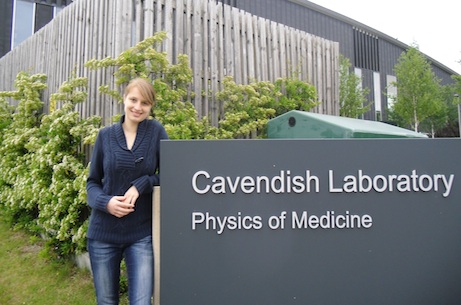
Scholar Elect Kerstin Goepfrich has set an organisation which aims to get people from developing countries to share initiatives that could have currency in the West.
People in developed countries could learn a lot from those countries which have faced years of having to come up with innovative ways of living on limited resources, says Kerstin Goepfrich.
Kerstin [2013], who starts her PhD in Physics, runs a website called AidReversed which aims to turn the traditional way of looking at development on its head.
Kerstin starts her PhD this autumn and will be researching DNA origami. It’s a new field which has only been going since 2006 and involves creating new shapes and structures from short pieces of DNA. Kerstin wants to look at ways it can be applied to biomedicine and used in smart drug delivery systems which target certain cell types, for instance as adaptors that control the function of protein pores in cells.
Kerstin was born in Bavaria, although both her parents grew up in Romania. Her mother is a teacher and her father an engineer.
She was strong in all her school subjects, but was particularly interested in biomedical questions and decided when she left school to study molecular medicine as it involved all the sciences. However, after her first year at the University of Erlangen she realised that physics could deliver interesting new tools for use in medicine and biology.
In the end, she combined physics and molecular medicine during her four-year undergraduate course. All through her school days and university Kerstin took part in vaulting, which involves a team of seven gymnasts performing acrobatics on live horses.
She took part in competitions and came second in the southern German championships and travelled around Europe. The year before she started university she was invited to the US by a contact she had met through vaulting to help set up a sports club for disadvantaged children in Indiana which included vaulting. She spent three months there spreading the word about the project and helping to lay the foundations.
As there is no vaulting tradition in the UK, Kerstin, who did her masters atCambridge, has taken up rock’n’roll, which involves dance and acrobatics and has performed at this year’s May Balls.
Zambia
In addition to acrobatics, while she was doing her undergraduate degree Kerstin took part in an Erasmus scheme in Cambridge where she met her PhD supervisor and a student exchange with Zambian students. It was the latter exchange in Zambia which was the catalyst for AidReversed. She says: “When the Zambian students came to Germany they asked us how they could be more like Germany. I felt I could not answer the question and realised how complex the problems they were facing were. I suggested they ask the question the other way round. What can we learn from you? Their immediate answer was nothing. However, if you think about it you can come up with some very valid ideas that might have an impact in developed countries.”
Kerstin and her boyfriend wanted to explore this idea and find out if there were opportunities for developing countries to exploit more what they could offer developed countries. They set up a website and then a Facebook page (which actually got more than 1000 “likes” within the first month) – since Facebook is particularly popular in Africa – which they use to gather ideas from around the world and get people to think about the question. They have also established campus ambassadors in Zambia to spread the word. They aim to put those ideas into a book and present them to policymakers and people who might put the ideas into action. They also have plans for conferences and an essay competition to bring in more ideas and have linked up with Cambridge’s Humanitarian Centre.
“In the financial crisis we need to be innovative with limited resources. African countries have been facing this for decades,” she says. She cites ideas such as mobile money transfers [cash transfers by mobile phone] which is successful in Kenya and mobile phone-based apps used for doctor appointments which could be adapted to different contexts.
She is also interested in linking her academic research with her passion for development and believes the Gates Cambridge community offers a chance to bring the two together. “I want to work with people in different fields,” she says, “and I believe physics can bring a breath of fresh air to development issues.”