

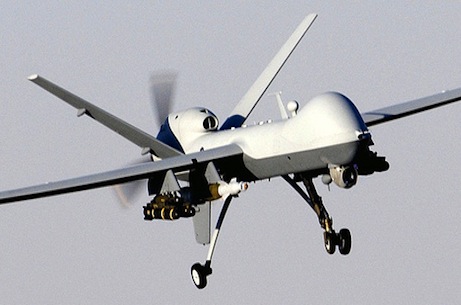
Drones have turned northern Pakistan into a massive occupied zone, according to research co-authored by a Gates Alumna.
The US Government’s portrayal of the use of drones in Pakistan as a surgically precise and effective tool that makes the US safer by enabling “targeted killing” of terrorists, with minimal downsides or collateral impacts is false, according to a major new study which has been co-authored by a Gates Cambridge Alumna.
The report, Living with drones, was conducted and published by both Stanford and New York University Law Schools. One of the authors was Jennifer Gibson [2001] who is a staff attorney with Reprieve, a London-based legal charity that represents dozens of Pakistani drone victims.
Last week she wrote a commentary article on the report for the LA Times.
Jennifer spent weeks in Pakistan interviewing more than 60 people from North Waziristan for the report. Many were survivors of strikes. She says: “All of them live under the constant threat of annihilation.”
She writes of the “constant presence” of drones in the skies above the North Waziristan tribal area in Pakistan, “with as many as six hovering over villages at any one time”. She writes: “People hear them day and night. They are an inescapable presence, the looming spectre of death from above.”
The result, she says, is that parents are afraid to take their children to school, women are afraid to meet in markets, families are afraid to gather at funerals and drivers are afraid to deliver food from other parts of the country.
“The routines of daily life have been ripped to shreds,” she states. “[The presence of drones] has turned North Waziristan into the world’s largest prison, a massive occupied zone.”
She believes drones are illegal under international law and counterproductive.
The Living under drones report aims to draw attention to what it calls a critical gap in understanding, specifically about life under drones and the socio-economic impacts of drone strikes on civilians in North Waziristan. It says there is significant evidence of civilians being injured and killed by drones as well as evidence of drones causing considerable harm to the daily lives of citizens. Furthermore, the report argues that the drones undermine respect for the rule of law and calls for a fundamental review of the policy.
Picture credit: Dreamsaredestiny and Creative Commons.