





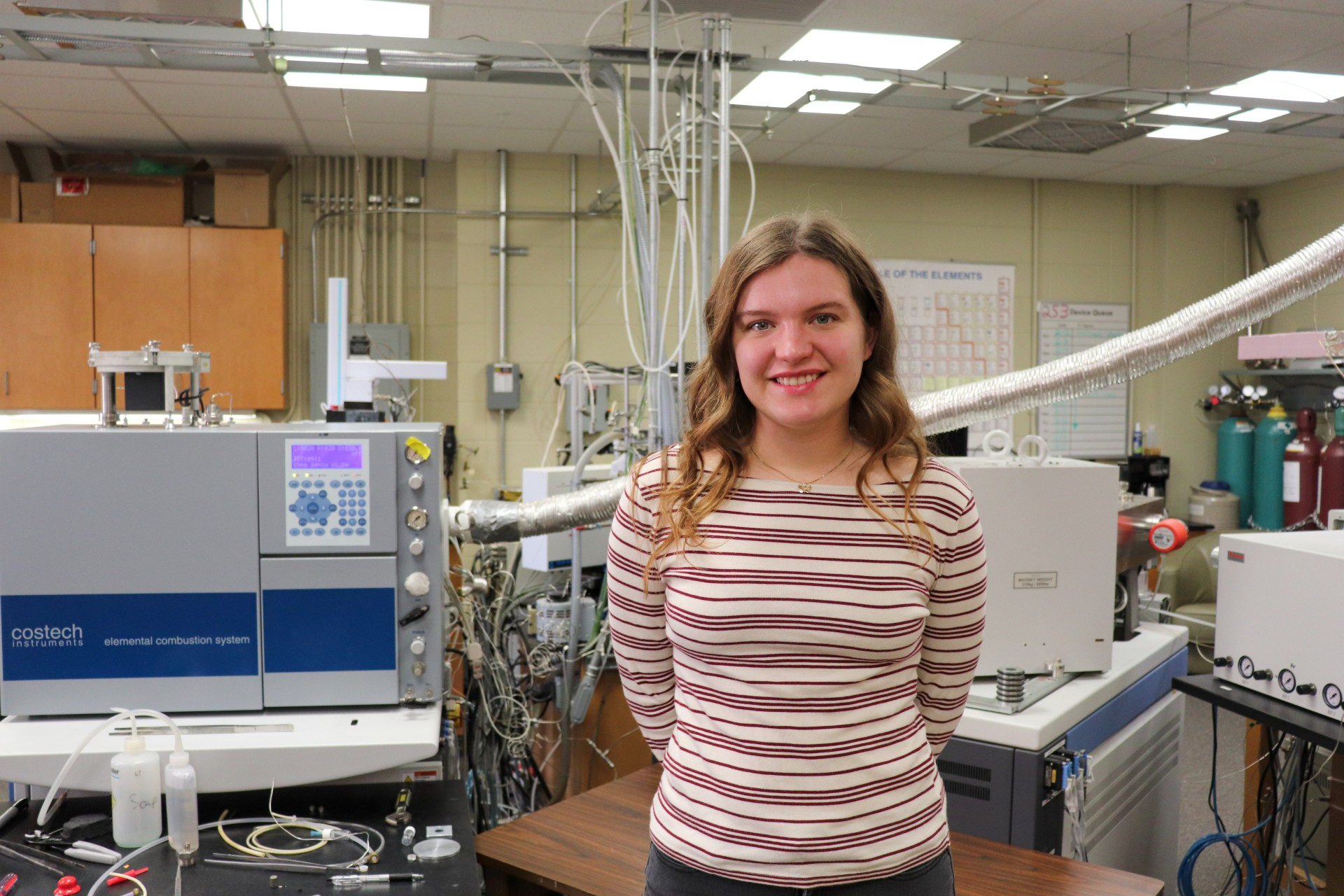
Scholar-Elect Madison Fail aims to quantify the amount of carbon ashes present in peat bogs through a model which connects micro-level chemical developments in peatlands with remote sensing.
My goal is to repair our natural ecosystems, mitigate the impact of anthropogenic carbon outputs and to promote biodiversity. We have to do everything we can to preserve our key ecosystems and understand them so they can do the work of taking care of the world for us.
Madison Fail
Madison Fail [2026] has taken a circuitous route to her current work on understanding carbon storage in peatlands. A seasoned social justice campaigner, she has now found her passion in research and will begin her PhD in Earth Sciences in the autumn.
She says: “Peatland ecosystems are enormous stores of carbon and have the potential to mediate climates if protected. Through machine learning, I aim to connect micro-scale chemical measurements with remote sensing to estimate carbon budgets in ‘pristine’ and ‘restored’ bogs.”
She is extremely proud to have been selected as a Gates Cambridge Scholar, calling it “a generational honour”. She attended university due to a college fund her great grandfather created. She states: “He was a share cropper and military member, yet saw great value in education despite his lack thereof. Recently, I was given his autobiography in which he says: ‘It is my hope and prayer that my great-grandchildren get a college education. Pops is sure that you will take advantage of this resource and will be an asset to your community and nation’.”
Madison says she didn’t grow up in a world where a research career was an option and she is keen to encourage others in her position and to fulfil her great-grandfather’s words and make a difference.
Childhood
Madison was born in Arlington, North Texas and grew up in the tight-knit community of Kennedale. She is the oldest of three. Her mother is a PE teacher at a primary school, the first in her family to go to college, and her father is a sales manager of a supply company. His side of the family were all entrepreneurs, including her grandmother who set up a coding company with her sister in the 1970s. Madison’s parents have always supported her education, but wanted their children to find their own way. Madison just happened to love education.
She describes herself as a curious child. She says her mother likes to tell the story of her being taken on a special outing to McDonald’s only to be found sitting in the corner of the library section. “I always loved words,” she says. She was an all-rounder, but at high school she became heavily involved in theatre and when she graduated she was considering applying to major in Theatre Studies. But then Covid happened and turned all her plans upside down.
She also took on a lot of caring responsibilities. Her last year at school was 2021 and she spent it learning online. For one semester Madison had to teach her younger siblings and her two cousins at home as they had an immunocompromised relative, meaning they couldn’t attend school. All of them have learning disabilities. Madison had to find different ways to help them learn, particularly her youngest cousin. She also helped with doctors’ appointments and school drop-offs once they were back at school.
She claims she had the “easy job” as her parents had to go out to work, worried they would contract the virus. Even before that, her dad had to travel a lot for work so was often away, leaving Madison to help her mother out. “I was already in a caretaking role and I enjoy it. I was happy to help,” she says.
Because of her family’s concerns about immunity, Madison felt it was vital that her community was as protective as possible, but there was a lot of hostility locally to mask wearing and a lot of misinformation. Masks were not mandated at her school so Madison led a petition to enforce mask wearing. She attended a school board meeting and was livestreaming it because a lot of people couldn’t attend. She was told to stop filming. The incident blew up in the local media and Madison became a spokesperson on the issues.
At that same time a Bill was passing in Texas which outlawed abortion after six weeks. Madison says the so-called ‘Heartbeat Bill’ [because it relates to when the foetal heartbeat can be detected] was effectively a total ban on abortion.
Undergraduate studies
In her first year at the University of Texas at Austin in 2021, Madison became a reproductive health advocate, organising protests and writing policy for the university’s student government and senate. She also participated in Black Lives Matter protests and advocacy. Madison was, at the time, majoring in Government and had ambitions to be a lawyer so she could help people by achieving structural changes in the system.
But at the end of her first year Roe vs Wade, the landmark pro-abortion legislation, was overturned. Madison felt very dejected. She didn’t like that feeling of hopelessness so she pivoted instead to thinking about other subjects she enjoyed and her climate change advocacy – her aunt is a biology teacher and has infused Madison with a love of nature. Madison had also been climate policy adviser for her friend’s student body president campaign. “Climate change is one of the foremost issues of our times and will affect every other sphere. I knew I had to do something in that sphere,” she says.
Although there has been a lot of tension around climate change advocacy, Madison could see a way she could navigate a more optimistic path through a focus on research. She started taking Geology classes and found them fascinating. Her teacher – Geeta Persad – encouraged her to switch her major to Environmental Science and she eventually graduated in both Government and Environmental Science.
In her first year, Madison had lived on campus, which made advocacy work easier. Her second year was spent figuring out a way forward, but also working. For over three years she was a paid caregiver. She describes it as “the best job ever”. For the first year she was working with two families, but she then focused on supporting a man who had cerebral palsy and was very severely disabled. “He is a wonderful person and around my age. I call him my twin. He is non-verbal, but very sassy,” she says. She worked 25-30 hours a week with him for the first two years. Her last day of work was in December. “It was a tough day,” she says, but she knew she had to focus on her academic work.
Madison has been working in two research laboratories. One was more Physics-based and involved working on microplastics, including doing field work in lakes in her region. The other is in a Chemistry laboratory where she has been involved in many research projects, including one on clumped isotopes [heavy isotopes that are bonded to other heavy isotopes] and another on drilling carbonates out of snail shells to look at annual banding patterns.
She also started her own project where she is investigating how different microbial respiration pathways impact the saturation of calcium carbonates in weathered soil. She is currently working on experiments to produce methane from wetlands. “The carbonate cycle in wetlands is understudied,” she says.
PhD
This is the work she hopes to continue at Cambridge, where she will do a PhD in Earth Sciences, focusing on building a model using machine learning to connect micro-level chemical developments in peatlands with remote sensing in order to quantify the amount of carbon gases present in peat bogs. “I love this research and feel like I am making progress and can have an impact. I feel like I am working on something meaningful,” says Madison.
She emailed Professor Alexandra Turchyn at Cambridge about her work on carbon cycling in terrestrial ecosystems, saying it was “a shot in the dark”. She replied quickly. “Her work also looks at microbially mediated processes in biogeochemical cycles. It is quite a small field,” says Madison.
It was only during her time working for her undergraduate advisor Dr Dan Breecker that Madison considered a PhD was a viable option for her. Professor Turchyn gave her the confidence to apply to Cambridge. Madison says she grew up in an environment where research was not a career option and she wants her example to encourage others, just as Professor Turchyn encouraged her. “She saw how much I really care,” she says.
Madison is keen to eventually go into the private sector and work for businesses that are involved in using natural methods for sequestering carbon. “My goal is to repair our natural ecosystems, mitigate the impact of anthropogenic carbon outputs and to promote biodiversity. We have to do everything we can to preserve our key ecosystems and understand them so they can do the work of taking care of the world for us,” she says.