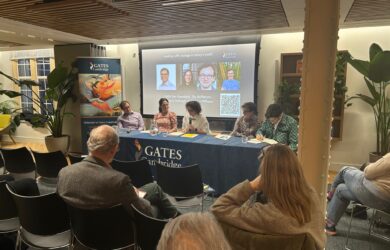






Three Gates Cambridge Scholars will speak at an Internal Symposium this week.
Three Gates Cambridge Scholars will be speaking about their research on meningitis, links between classical and current debates around sexual trauma and the regeneration of biliary tissue outside the liver at an internal symposium this Thursday.
Casey Rimland, Nikolas Oktaba and Laura Cooper will speak at the event on March 10th.
Casey will describe her research on progenitor cells in the human extrahepatic biliary tree and the gallbladder. The extrahepatic biliary tree is responsible for the drainage and storage of bile and digestive juices produced by the liver and pancreas. Casey says diseases affecting the organ involve a failure to properly activate the regenerative response. However, despite their importance, she says little work has focused on the mechanisms involved in regeneration of biliary tissues outside the liver and that even less is known about what differences, if any, may exist between different regions of the biliary tree. Her research has sought to identify and characterise progenitor cells from the gallbladder, pancreatic duct and common bile duct. She says: "These cells represent a promising model for studying biliary regeneration and have already led to an understanding of what signaling pathways may drive the proliferation of progenitor cells in the extrahepatic biliary tree."
Nikolas' talk, Cannabilism and rape, will focus on his close reading of the final scene in Nonnus' Dionysiaca, the story of Dionysus, god of wine and revelry and the longest surviving poem from Greco-Roman Antiquity. Nikloas says: "Recent studies of corporeality, BDSM practice and sexual trauma are germane to the analysis of the rape of Aura in Dionysiaca Book 48." Nikolas will speak about how Aura's experience in both her prophetic dream and in reality of being drugged, bound and raped, destabilises her and causes her to question her relationship to her body, her world and herself. He says: "Her subsequent killing spree and attempts at suicide are a means of public witness to her pain, a non-consensual witnessing that is crucial in recuperating some sense of corporeality and reclaiming her body to whatever extent she can. The act of cannibalism at the final stages of the poem is the culmination of these efforts."
In Laura's talk, Exploring the potential for meningococcal serogroup replacement in the African Meningitis Belt, she will discuss the impact of a vaccine against meningitis A in range of countries in Africa, from Senegal to Ethiopia. Although the vaccine has dramatically lowered the incidence of the disease, the incidence of other forms of meningitis has increased. Laura will talk about how she has created a mathematical model of transmission to demonstrate the importance of cross-protective immunity in determining the extent and rate of replacement of meningitis A with other forms of the disease . The model also evaluates the impact of current and future vaccination regimes in a multi-strain system.
*The Internal Symposium will run from 7.30-9.30pm in the Gates Cambridge Scholars Common Room. Scholars and their guests are welcome. Picture credit of meningitis A vaccination programme: UN.