

Molly Fox is lead author on a study on paternal grandmothers.
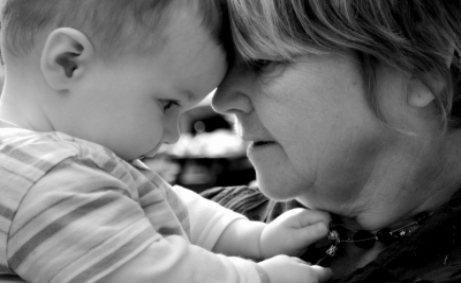
Paternal grandmothers may have evolved to have a beneficial effect on granddaughters and a detrimental effect on grandsons, according to a new study led by a Gates scholar.
In ‘The Selfish Grandma Gene’ published in The International Journal of Evolutionary Biology, researchers led by Molly Fox [2008] found evidence to support the idea that there could be a genetic element on the X chromosome that encourages caring behaviour and consequently longevity.
By mathematically calculating grandmothers’ incentive to behave in certain ways, in terms of evolutionary fitness, they hypothesise thatgrandmothers may show bias towards grandchildren with whom they are more likely to share their X-chromosome. For paternal grandmothers, that would mean favouring granddaughters over grandsons.
“Our findings suggest that grandmothering behaviour and longevity may be related,” says Molly. “Longevity could be a side effect of selection along the paternal line.
Most previous studies have looked at the impact of maternal grandmothers. “We felt they were missing an important part of the picture,” says Molly. She adds that the researchers were surprised at how generous the conditions for adaptiveness were in that the harm to grandsons could be so much greater than the benefit to granddaughters.
The paper’s co-author and Molly’s supervisor Dr. Leslie A. Knapp adds: “The most exciting thing about this research is that it shows that there could be an evolutionary incentive for grandmothers to help certain grandchildren at the expense of harming others, even if the harm is several times greater than the help.”
The researchers say part of the reason researchers have not looked at paternal grandmothers is that they tend to overestimate the percentage of cases where a father turns out not to be the genetic father of the child he is bringing up. One much cited figure given out suggests that there may be paternal uncertainty in as many as 10 per cent of cases.
They have studied the data and believe the percentage is in fact far smaller. Even so, they calculate this has a minimal effect on their findings that there may be a selfish X-linked trait which causes favouritism.
Molly is doing a PhD in Biological Anthropology.
Photo credit: healingdream and www.freedigitalphotos.com