





Best-selling author Alan Guarino told a leadership event that empathetic leaders are needed in today's fast-paced working environment.
We are really in crisis if we can’t get people to be empathetic leaders.
Alan Guarino
A crisis of leadership means large numbers of workers are dissatisfied in their work today due to an epidemic of poor management and the increased complexity, pace of work and need to adapt to fast-changing circumstances, a leadership event heard last night.
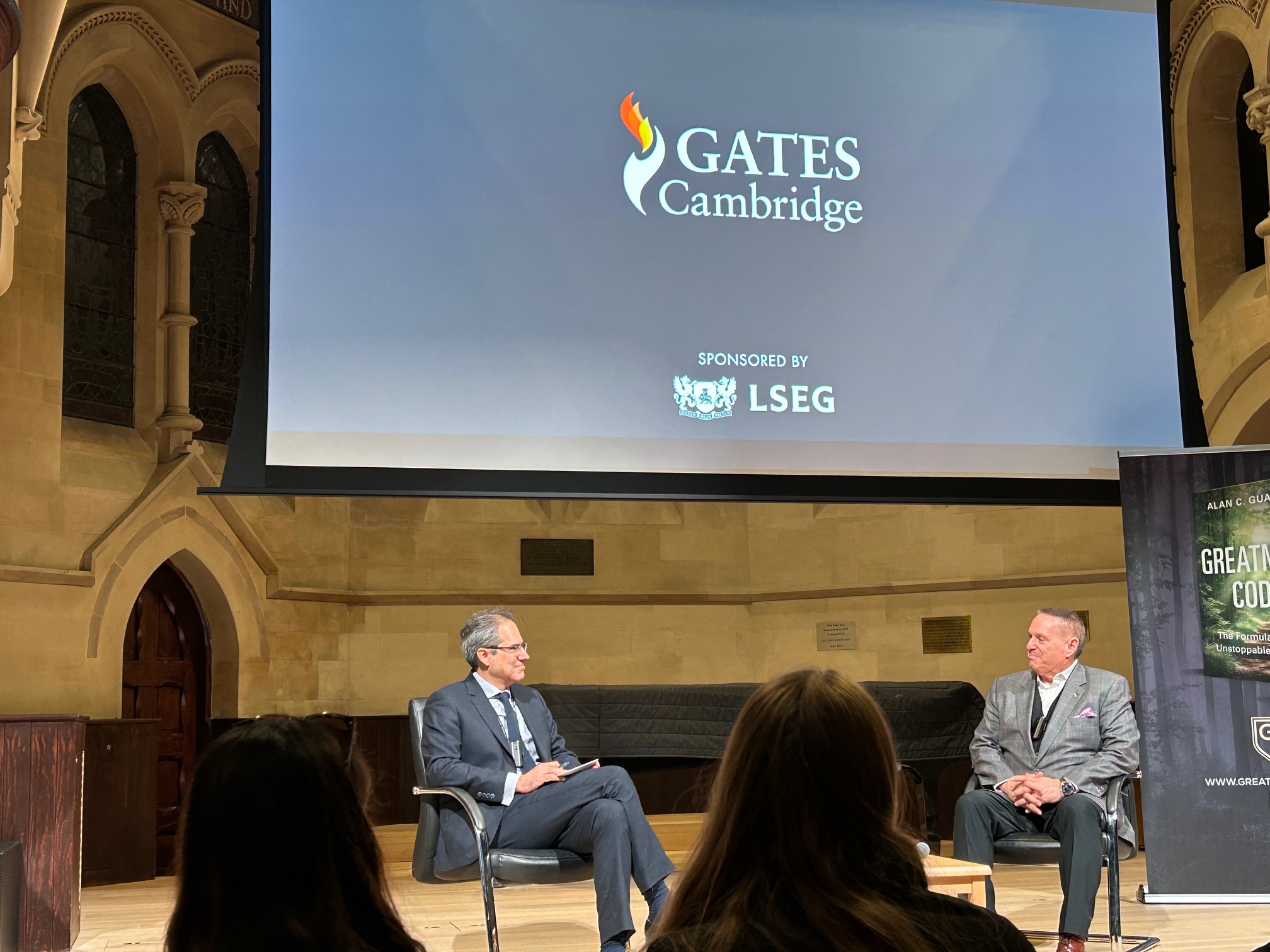
The On Leadership* event with author and recruitment expert Alan Guarino and University of Cambridge Pro Vice-Chancellor Kamal Munir, sponsored by LSEG, was organised by Gates Cambridge in collaboration with Judge Business School.
Held at Pembroke College’s Auditorium, the event was introduced by Gates Cambridge Provost Eilís Ferran who cited the introduction to Guarino’s latest best-selling book The Greatness Code in which he states that leadership is a huge responsibility, but often “practised poorly”.
Guarino is Vice Chairman at Korn Ferry, where he advises CEOs and boards on leadership, succession and organisational performance, and has been a US Army officer and founder of a successful Wall Street search firm.
He discussed his book with Professor Munir, Pro-Vice-Chancellor of University Community and Engagement at the University of Cambridge. It talks about the need for would-be leaders to develop stamina, courage, resilience, persistence and passion as essential “muscles” to progress their careers.
However, to get to a higher level he says they also need to build strong social capital, including a network of mentors and supporters. “Your work will not speak for itself,” he stated. Building that mutually beneficial network takes time and purpose.
Inspiring leadership
Asked how leadership has changed since the 1950s, Guarino said that leaders at all levels no longer need to direct, but to inspire. Younger generations today don’t want to be directed, he said. “Directive leadership infuses pressure.” Because of the pace of work, its complexity and the constant change workers are dealing with today, the system is already creating a lot of pressure, he said. Leaders need instead to take pressure out of the system.
 That means leading with empathy so people feel safe to take risks and encouraged to go the extra mile. Otherwise, Guarino stated, they will only give 70% to their job. If a lot of workers are only giving 70% that amounts to a serious productivity issue, he said.
He added that soft skills are what many businesses say they lack these days and he called on industry to invest more in HR and in human development. “If corporations invested a fraction of what they invest in technology in human development they would be astounded at the results,” he said, adding that this was particularly important in an age of AI. “We need to do more to build the muscles people need,” he stated, adding that empathetic leadership does not mean being weak and not holding people accountable.
Speaking about promotion, Guarino said leadership potential could not be identified through managerial review. They need to be assessed for their learning agility, their ability to apply their knowledge to new situations, and this could be measured through psychometric testing.
Guarino also touched on what great leadership means in different contexts, whether on Wall Street or in poor rural areas. It is not all about being a CEO of a large corporate, he states. He also spoke about the need for women to be more confident about applying for promotion even if they don’t meet all the criteria – because men will.
Q & A
In the Q & A, Guarino was asked about the impact of AI on jobs. He said entry level jobs are going, but he suggested this is not a long-term strategy, given clients and customers will not want to sit across the desk from a bot in negotiations. There is a need therefore to accelerate the learning process for new entrants, he said.
He was also asked whether empathy can be taught. He said people have to have the desire and aptitude as well as the right cultural environment to become empathetic leaders. Yet some leaders are still wedded to the work environment of the past, he said. “We are really in crisis if we can’t get people to be empathetic leaders,” he stated.
Guarino ended by warning that he thinks that the jobs market will rebound, despite the growing encroachment of AI, and that the Great Resignation seen during the Covid pandemic is likely to make a comeback. “The war for talent is not over and will be back,” he said.
*The On Leadership event is part of a series of Gates Cambridge events linked to the launch of its new Leading with Purpose programme.