





Marc Mierowsky's new book tells the story of how writer Daniel Defoe helped England thwart plans for Scottish independence.
The 18th century is the age when the public sphere was created and I am studying how ideas about the political agency of people are enacted and promoted in literature.
Marc Mierowsky
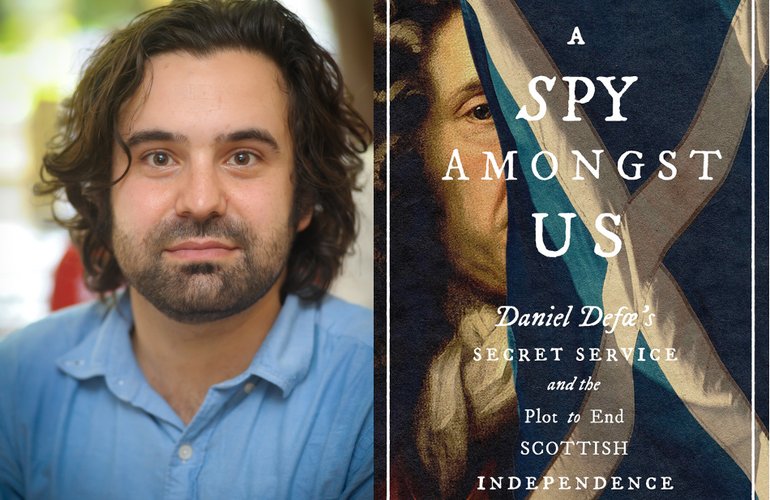
Gates Cambridge Scholar Marc Mierowsky’s new book on how writer Daniel Defoe and his fellow spies worked to end Scottish independence in the early 18th century is out later this month.
His book, A Spy Amongst Us, recounts the story of how English writer Defoe became a government agent for England in the early 18th century as Scottish people protested plans for union with England.
In 1706, Edinburgh was on the brink of a popular uprising. Men and women were taking to the streets to protest the planned union with England, fearing the end of Scottish sovereignty. In their midst was English writer Daniel Defoe, by this point bankrupt and humiliated.
The book tells the dramatic story of how Defoe and his fellow spies sabotaged the Scottish independence movement from the inside. Together they disseminated propaganda and built a network of operatives from London to the upper Highlands, providing the English government with up-to-the-minute intelligence and monitoring its adversaries’ every move.
Marc [2011] is an ARC Discovery Early Career Researcher Award Fellow and Lecturer in English at the University of Melbourne, where he researches 17th-and 18th-century literature and intellectual history. He is an associate editor of The Cambridge Edition of the Correspondence of Daniel Defoe and coeditor of Oxford World Classic’s edition of Roxana: the Fortunate Mistress.
Marc, whose book is out on 10th February, will be taking part in a fireside chat at Bill Gates Sr. House on 17th February with fellow 2011 scholar and English PhD student Devani Singh, who is also an author of the 2023 book , Chaucer’s Early Modern Readers: Reception in Print and Manuscript.
Marc’s book has already created a wave of interest and Marc has done several press interviews, including with the Sunday Post, LBC and the History Extra podcast. He is also doing events at bookshops across England and Scotland.
Marc’s PhD in English explored how ideas of political sovereignty were transmitted through literature. At the time he stated: “The 18th century is the age when the public sphere was created and I am studying how ideas about the political agency of people are enacted and promoted in literature.”
*To book for the Gates Cambridge event, click here.