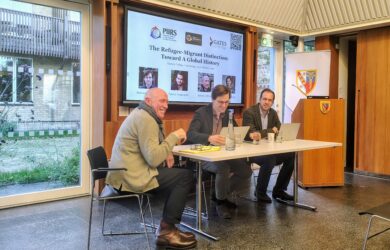


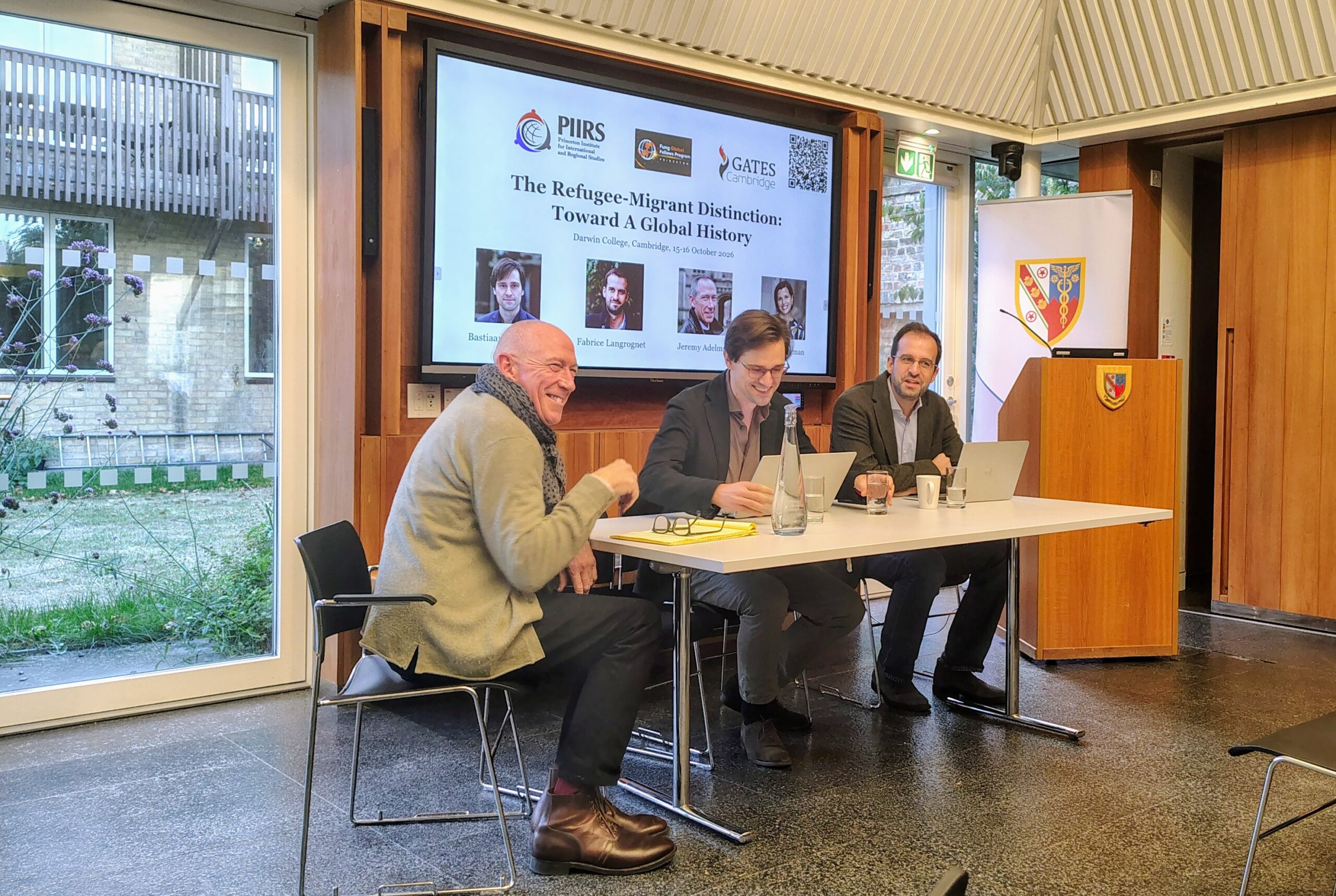
Fabrice Langrognet was co-chair of a conference on migration history last week which was followed by a drinks reception at Bill Gates Sr. House.
We wanted to historicise the distinction that had taken hold – under the influence of international law - between refugees and migrants and see how it worked at different periods and in different geographic settings.
Fabrice Langrognet
Experts from around the world gathered in Cambridge last week for a conference on the history of the distinction between the categories of refugee and migrant.
The Fung Global Fellows Program and Gates Cambridge Trust International Conference, ‘The Refugee-Migrant Distinction: Toward a Global History’, was held on 15th and 16th October and was co-chaired by Gates Cambridge Scholar Fabrice Langrognet [2014], a Tenured Researcher at the Centre national de la recherche scientifique, France; Bastiaan Bouwman, Assistant Professor at Utrecht University; and Professor Jeremy Adelman, Director of the Global History Lab at Cambridge.
The aim of the conference was to more fully elucidate the relational nature of the distinction between refugees and migrants, its function in the wider field of migration and its genealogy. The conference also aimed to expand our understanding of the refugee-migrant distinction’s role beyond the West, given the Eurocentric origins of the 1951 Refugee Convention and the field of refugee law.
It came about after Bastiaan and Fabrice, both historians of migration and both alumni of the Fung Global Fellows programme at the Princeton Institute for International and Regional Studies (PIIRS), successfully applied for a US$20,000 grant from the Fung Global Network Fund (FGNF) to organise the conference, along with Professor Adelman, a former director of the Fung Global Fellows programme and a professor of history at Princeton at the time (now at Cambridge).
The FGNF is designed to re-connect the university with former Fung Global Fellows across the world.
Fabrice says: “We wanted to historicise the distinction that had taken hold – under the influence of international law – between refugees and migrants and see how it worked at different periods and in different geographic settings.”
The conference was initially supposed to take place in 2023. Then, due to the backlog created by the Covid pandemic, it was pushed back to 2026. And in 2025, Princeton University decided to limit the number of international events on its grounds, so PIIRS told the organisers that they could organise the conference abroad. Cambridge seemed the perfect choice as Professor Adelman was now based there and Fabrice had done his PhD at the university. It took place at Professor Adelman’s college Darwin.
There were 19 speakers, six moderators-discussants (in addition to the three co-chairs) and about 20 to 25 attendees. Fabrice says the conference went beyond its original aim by highlighting the multi-level political, social and economic dynamics behind the refugee/migrant classification. It also highlighted the dire situation of archives on the topic, with the UNHCR Senior Archivist attending. The UNHCR Archive is now closed due to funding cuts. The conference also helped to create a network of scholars working on similar issues and there is appetite to continue working together in the future.
The conference was followed by a drinks reception at Bill Gates Sr. House to which Scholars were invited.
Fabrice, who did his PhD on migration history, says the reception went well. “It was a way for me, as an alumnus, to thank the Gates Cambridge community for its support over the years,” he said.
*Top photo of [left to right] Professor Adelman, Bastiaan and Fabrice.