

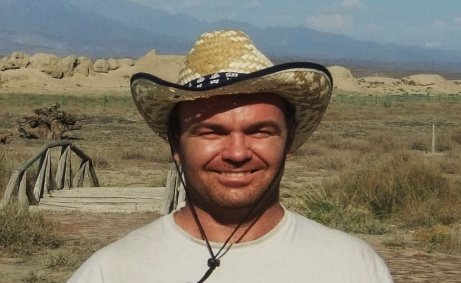
Ross Anthony is researching China's Xinjiang province.
Gates scholar Ross Anthony’s research into Xinjiang and the Uyghurs has seen him interviewed by the international media and he now hopes to write a book on the subject for a mainstream readership.
Ross is in his fifth year at Cambridge, having done a masters and taking four years to complete his PhD in Social Anthropology after spending a year doing fieldwork in China.
His research in Xinjiang province in 2007/8 was timely. A few months after leaving, the capital of the region, Urumqi, where he had been based, was the scene of one of China’s biggest ethnic riots in the last 10 years. Nearly 200 hundred people were killed and around 1,700 injured. Most of those killed were Han Chinese who had been attacked by Uyghurs. Ross had lived in one of the neighbourhoods where most of the killings happened. He has not been able to return since and says he does not know if any of the friends he made there were killed in the riots.
He says the violence and the repression that followed [exiled Uyghur groups claim up to 800 Uyghurs were killed] was no surprise to anyone who knew the region.
“Government policy has left many locals feeling alienated. It was a very repressive climate, where any form of criticism, even if it was legitimate, was portrayed as being pro-separatist. It was very intimidating. There were a lot of fights in the street, a lot of tension. Many young Uyghur men who had come to Urumqi from the oases towns of the south, were unemployed and disenfranchised,” he says, adding that the repression had increased in anticipation that some groups would use the Beijing Olympics as a platform to air their grievances with the government to the world.
Because of his knowledge of the region, Ross was asked onto Al-Jazeera to give an analysis of what was happening. He hopes to turn his research into a book.
Read more