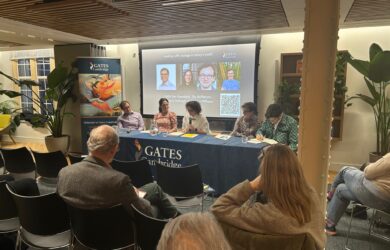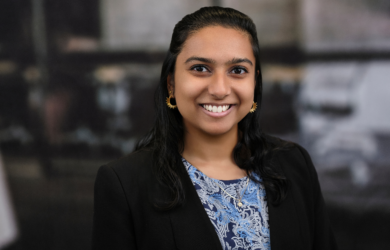







Professor Napoleon Katsos and Minhee Lee talk about their research into the advantages of bilingualism and what conditions are needed to ensure maximum benefit.
I have always been interested in how humans think and speak and was always curious about how young kids can understand what something means without being shown.
Minhee Lee
Professor Napoleon Katsos is from the first cohort of Gates Cambridge Scholars. Minhee Lee is from the 2025 cohort. Napoleon will be Minhee’s supervisor as she explores the multi-layered meanings of language and the benefits of bilingualism. They came together to discuss all things linguistics.
Napoleon says he didn’t know what linguistics was until he went to university to study Classics and found he was more interested in solving puzzles around syntax and the structure of language. “I was a late convert,” he says. Cambridge, where he did his masters and PhD, was an eye opener as it introduced him to linguistics in the mind. Over the last decades Napoleon’s group in Cambridge has become a leader in ‘experimental pragmatics’ – which combines cognitive psychology with linguistics. Pragmatics is about people’s ability to employ their knowledge of language and adapt it to different contexts. It is experimental because it brings together real-life observations of how language is used in context with experiments carried out in a psychology laboratory.
Minhee was drawn to experimental pragmatics from early on in her work on linguistics. “I was interested in how humans think and speak and was always curious about how young kids can understand what something means without being shown,” she says.
She was particularly interested in Napoleon’s research on bilingualism and on neurodivergent children, and the fact that his research spans multiple language and cultural contexts. What’s more, her lecturer at the University of Edinburgh, where she did her undergraduate studies, had been a student of Napoleon’s and said he would be a perfect fit for her.
Nature vs nurture
Napoleon says a big question in his field is about the relative influence of nature and nurture on linguistic ability. A big part of nurture is about the environment we grow up in and how many languages we are exposed to from early on. Bilingualism requires fine tuning of meaning and close attention in conversation and these skills may have a pro-social benefit because they make a person better able – in conversation – to understand the perspective of the other person better and more quickly.
Bilingualism research has expanded in recent years with a focus on the social and other benefits of speaking more than one language, but the findings on pro-social and other benefits have not been universally replicated. That has led to deeper questions about what the necessary conditions might be for bilingual speakers to access these benefits. Napoleon’s hypothesis is that this may be the frequency with which both languages are used rather than how well a person knows those languages, with frequent switching of languages in everyday life being critical.
Neurodivergence
Minhee’s MPhil work will investigate this question in relation to young people. She hopes eventually to study the impact of bilingualism on neurodivergent children’s communication skills. She says parents of children on the autistic spectrum can be hesitant to let their children learn languages because they deem it too difficult and think that learning a second language could hinder their abilities. But what if the reverse were true?
Napoleon has been leading research in this area and, after his first paper on bilingualism was published, he got a call from the parent of a trilingual child who had just received an autism diagnosis. “They asked if the child could keep speaking three languages. There was no published research, but I felt parents needed to know,” he says. He started working with educationalists and speech therapists at the Cambridge Bilingual Network and engaged with the public through science festivals and outreach work with schools, spreading the word about the benefits of bilingualism. His work included helping schools to update their approach to bilingual students. He even talked to first-time parents-to-be in ante-natal classes, the earliest point at which he could affect change.
Both Minhee and Napoleon are also interested in the increasing role of AI in language learning. There are questions about whether it can do any more than teach literal meaning, but Minhee believes it has a huge potential to deepen our understanding of how humans use language.
Napoleon says it can teach us to be more aware of the way AI is trained according to a particular set of values and principles.
Minhee is really excited to be joining Gates Cambridge. Napoleon recalls being part of the inaugural cohort. He says he felt pride, confidence and a sense of responsibility as one of the first people to receive the scholarship to help shape the programme. “It felt very creative, quite challenging, but also very rewarding,” he says. “It was a really formative experience.”
He advised Minhee to take advantage of every opportunity that comes her way. “Throw yourself into it and embrace it all. This is a community of people who lift each other up,” he says.
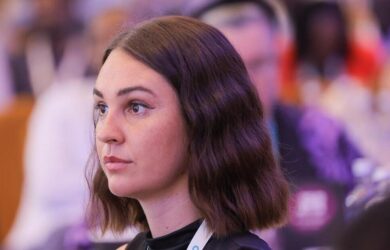
*Photo by Eric Prouzet on Unsplash
**An edited version of this interview appears in the Gates Cambridge 25th anniversary magazine, which is just out here.