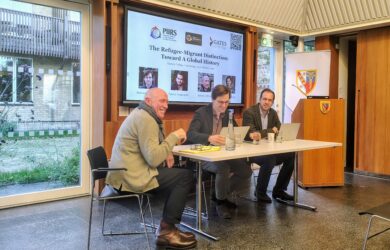


Three Gates Cambridge Scholars will speak about their research on smart engineering, how to estimate the size of early man and whether mobile and wearable technology can boost health.
Three Gates Cambridge Scholars will speak about their research on smart engineering, how to estimate the size of early man and whether mobile and wearable technology can boost health.
The Scholars will speak at the National Association of Fellowships Special Internal Symposium on 27th June in the Gates Scholars Common Room. The Symposium is part of a two-week visit to UK universities by 35 NAFA advisors and representatives from US universities.
The presentations will be followed by a panel of Gates Cambridge and Cambridge Trust Scholars who will talk about their experiences and life in Cambridge. The panel includes the three speakers and Talia Da Silva [2013] who is doing a PhD in Engineering, Jerry Lee [2013] who is doing an MPhil in Epidemiology and Kelvin Mei [2013] who is doing an MPhil in Physics.
The three presentations are by:
– Musa Chunge [2013]. He will talk how embedding fibre optic sensors into structures can help engineers “see” into what they build and gain a greater understanding of structural behaviour. “This creates a feedback system which should stimulate better design and management of the built environment,” says Musa, who is doing an MPhil in Engineering.
– Mariel Williams [2013]. She will speak about research into how to estimate human body mass and stature from skeletal remains. Mariel, who is doing an MPhil Human Evolutionary Studies, says knowledge about an organism’s body size gives significant insight into its ecological, behavioural and life history traits and has significant implications in terms of human evolution. She says: “Because body size has such an important bearing on many aspects of an organism’s existence, paleoanthropologists often infer many characteristics about fossil hominins based primarily on body mass estimates. However, body mass estimates for Homo species have varied greatly, with as much as 50% difference in size estimation for the same individual. This demonstrates the importance of more precise methods of body mass estimation with smaller margins for error.”
Her research investigates the three main methods used to estimate body mass and tests their accuracy using a modern female population.
– Sarah Mummah. She will speak about how mobile and wearable technology can increase healthier eating and physical activity. Sarah is doing a PhD in Public Health and Primary Care at the Institute of Public Health. She says current health-promoting technologies are rarely evidence-based and few have been proven effective. Her research in collaboration with researchers from Stanford University Shcool of Medicine aims to develop a cost-effective, scalable mobile application for improving health outcomes. The products draws on interdisciplinary research insights from psychology, public health and behavioural economics to promote healthier eating. The app is being tested in a large-scale, randomised trial funded by the National Institutes of Health.
By next year, the researchers are looking to be able to demonstrate the effectiveness of the app in influencing dietary habits, physical activity, cholesterol levels and BMI. Sarah is also evaluating the potential for activity-tracking Fitbit wristbands to help individuals increase their levels of physical activity and reduce their BMI. She says: “Ultimately, as technology adoption continues to accelerate, learning how to leverage mobile and wearable technology to encourage healthier behaviours could help turn the corner on the obesity epidemic and healthcare crisis.”