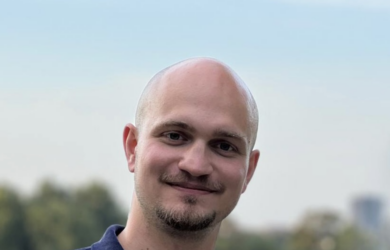


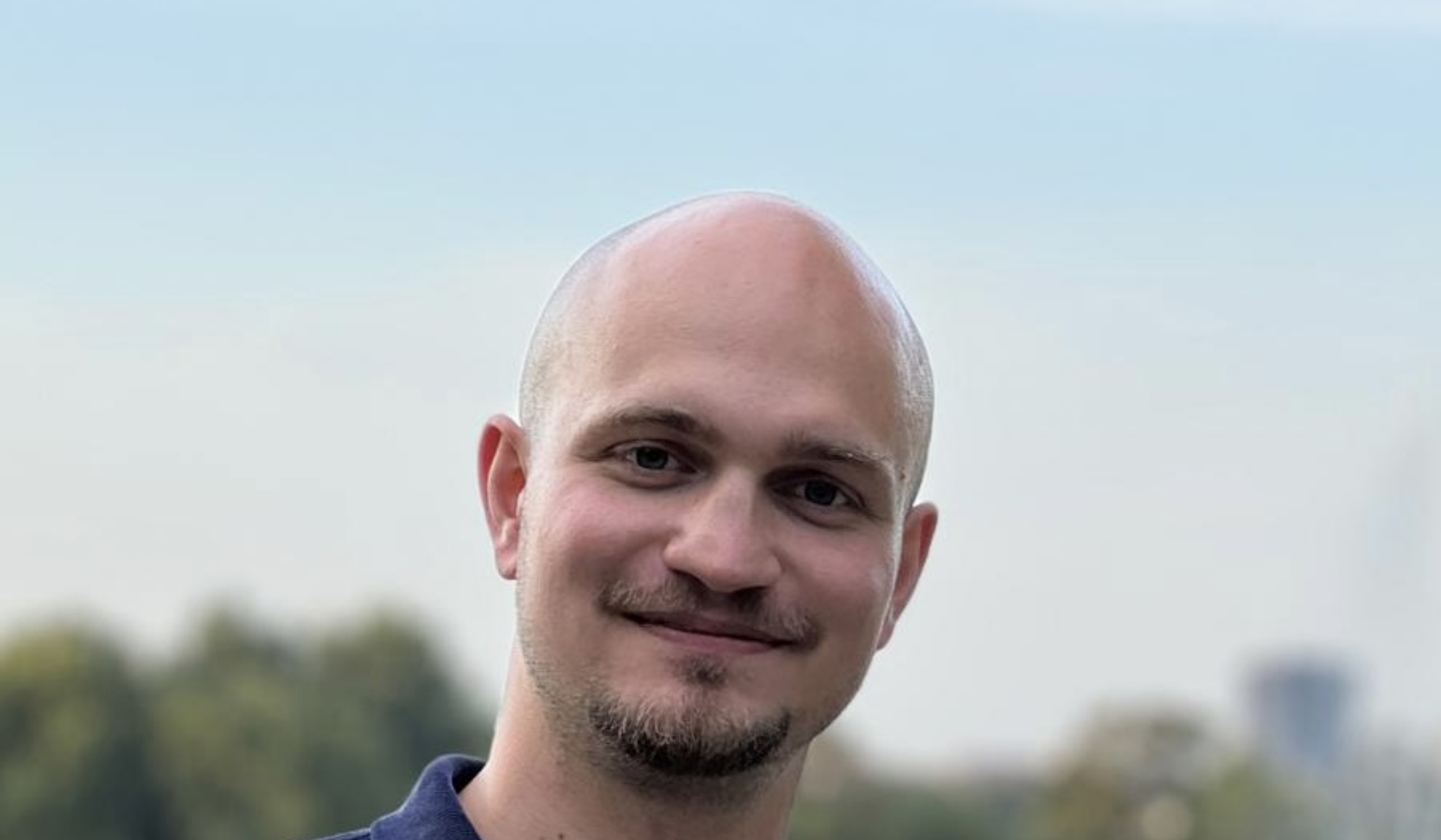
Andrzej Uhl talks about his research on what causes people to act ethically or unethically when it comes to tax evasion
Little can be done against corruption without a nuanced understanding of its causes. Through unpacking the mechanisms behind corruption, I wish to respond to the demand for evidence-based anti-corruption strategies.
Andrzej Uhl
Andrzej Uhl [2023] is interested in understanding how people choose between acting ethically and unethically. His focus is on corruption and tax evasion – acts that benefit individuals at the expense of the broader community. His interest was sparked by observing how newly-won democratic institutions in his home country of Poland were gradually eroded after 2015, set against a global trend of democratic backsliding.
For his PhD, Andrzej devised an interactive game to better understand incentives around tax evasion, pitching personal financial benefit against the common good. His participants earned money in an online task and were supposed to report it in full in return for 35% taxation – a part of which went to the British Red Cross. But they were also able to cheat and some did so, reporting less than they actually earned and keeping more for themselves. “I wanted to figure out what makes people break the rules and cheat in order to understand the psychology of it,” he says.
Apart from his key PhD research on corruption, Andrzej’s work looks at the other side of the coin, how judges fit punishment to a crime. He became intrigued by criminal sentencing and wanted to know whether different judges punish similar cases in the same way. Andrzej says it can be hard to find this out as no two judges will judge exactly the same case.
Comparing sentences in similar cases is also difficult due to nuances that cannot be captured or compared. Some researchers have tried to get around this by giving different judges the same hypothetical case to rule on. Andrzej felt this was equally questionable as judges have little time or incentive to engage with hypothetical cases, meaning it was hard to draw any conclusions from inconsistent decisions made in these circumstances.
However, Andrzej knew through friends who had become judges in Poland that they took a strict exam where they had six hours to give a detailed sentence in relation to the same case. He was able to get access to that data from around 300 examinees who became judges shortly afterwards. He excluded those who had failed the exam and studied the reasoning used by the others. Many arrived at different conclusions, sentencing the person involved to anything from community service to a prison sentence.
“They all applied the law correctly. But there was almost no agreement on the exact punishment, which is where judges exercise discretion,” says Andrzej. “The ones who got the best grades disagreed with each other just as much as the ones who almost failed so it was not due to lack of competence. It shows that translating mitigating and aggravating factors into a single number is a huge lottery.” His results suggest that if you draw a lenient judge you could end up paying a small fine instead of spending a year behind bars. He adds that AI results in a more consistent outcome, but says that could also be problematic – consistent sentences can also be unjust if they are consistently too harsh or consistently biased against minority defendants.
Childhood
Andrzej was born and grew up in Krakow, Poland, the eldest of two sons. His parents work in tourism – his father owns a shop that sells tourist items and his mother is a tourist guide, for instance, conducting tours to Auschwitz where her grandfather died.
Andrzej describes himself as “bookish” at school, but he also loved mountains and went on long hikes alone in his mid teens. He joined a scout troop and describes the experience as formative.
At school he says he struggled with maths, something he brings up now with the students he teaches statistics to, trying to helping them overcome their initial fear of numbers. He initially preferred the Humanities and managed to get chosen for the local History Olympiad team at his middle school. At high school he was also on the Latin Olympiad team.
When he left school in 2014, Andrzej chose Law because it offered better employment prospects. To save up some money before starting university, he came to the UK, working as a waiter and kitchen porter at a restaurant in Baker Street. In London, he shared a flat with other fellow Eastern Europeans in Tower Hamlets. It was an experience that ignited his interest in Criminology. He witnessed gang culture and widespread disorder first hand. The level of crime shocked him and made him wonder about its root causes.
Later, at Jagiellonian University, when he was sitting in his first lecture on Criminology and the professor was talking about crime concentration and social disorganisation theories, everything started to make sense to him. Up until then Andrzej had been taking Law classes, but he realised that social sciences were more interesting to him because they described what things are actually like rather than what is written in a book. In his second year he decided to take Criminology.
University
During his five-year course, Andrzej interned in several law firms and worked at a legal clinic, which offered advice to those who couldn’t afford a lawyer. Andrzej worked in the criminal law section with both defendants and victims.
In his last year of undergraduate studies, he did a dissertation in Criminology on white collar crime, the kind of punishment white collar offenders were given compared to others and what prison was like if they were sent there.
After completing his Law course, he decided to go abroad, concerned by the rise of a populist government that threatened to dismantle the legal system Andrzej had studied for so long. He won a scholarship to the University of Heidelberg to do a degree in German and European Law.
There he conducted a series of interviews with middle-class prisoners – politicians and businesspeople who served time for corruption and white collar crime. He says they were initially frightened by the prospect of being locked up with violent offenders, but then adapted surprisingly well to prison. They tended to have more family support than other inmates, found it easier than other prisoners to resolve conflicts and were often able to curry favor with the prison administration. It was the first bit of empirical research he had conducted. At Heidelberg he also learned about statistics for the first time, using the additional time he had because of Covid to devote to his studies.
Consultancy and beyond
On finishing his course, Andrzej decided to try his luck in consulting. Eventually he moved to Berlin and joined Ernst & Young where he worked on compliance investigations, helping clients to comply with anti-fraud and corruption regulations.
He missed academia, however, and applied to Cambridge to do his master’s as “a long shot”. He was accepted to do an MPhil in Criminological Research with a strong focus on data analysis and research methods. His supervisor was Professor Kyle Treiber and his dissertation was on situations that encourage or discourage corrupt behaviour. To investigate this, he used games that simulated conditions in which corruption might take place, for instance, a game where there was an incentive to earn more money by colluding with a partner versus the incentive of acting for the common good by not colluding. It was a new more immersive way of exploring such social dilemmas which was different from surveys where people might be less likely to tell the truth.
He has used a similar experiment for his PhD and is currently writing up his findings. Andrzej has had a few papers published since his undergraduate studies. He hopes to stay in academia and loves teaching for the impact it can have on individuals in terms of encouraging them to question and be critical about what they are told or read. Last year he chose to test his capacities as a teacher and started teaching eight groups of students on a statistics course. Speaking about the misinformation that many are nowadays exposed to, he says simply: “Evidence matters.”
That approach has informed his PhD and his interest in anti-corruption practices that work. He states: “Little can be done against corruption without a nuanced understanding of its causes. Through unpacking the mechanisms behind corruption, I wish to respond to the demand for evidence-based anti-corruption strategies.”