

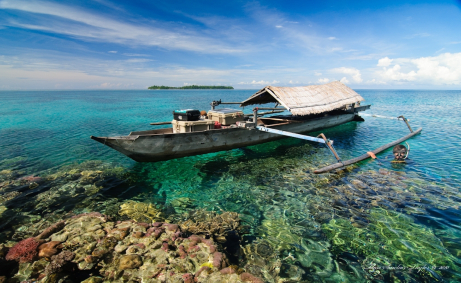
A Gates scholar has been awarded an Australian Geographic award for a canoe expedition.
A Gates scholar has been awarded a prestigious Australian Geographic award for a canoe expedition around Indonesia’s Togean Islands which highlighted the impact of overfishing on traditional communities.
Alex Vail, who is due to begin a PhD at Cambridge in September, travelled to the Islands with two colleagues. The three were the first people to circumnavigate them in a dugout canoe, given the inherent dangers of treacherous weather conditions, sharks, crocodiles, malaria-carrying mosquitoes, parasites and pirates.
The aim of the trip, which was sponsored by Australian Geographic and took place last December and January, was, says Vail, “to highlight to the public that there are communities in the world that can live with fragile ecosystems, in this case the reefs and islands of the coral triangle, with minimal impact”.

To do so they aimed to emulate the way of life of the Bajo or Sea Gypsies who have lived sustainable lives in this region for hundreds or thousands of years. They planned to paddle the 180km around the Islands, taking from the land just what they needed to survive.
When they arrived, however, they found that this was no longer possible due to overfishing. Vail says: “Although the corals and smaller fish of the reef were still in excellent condition, all of the fish over about 20cm are gone, they have been fished to oblivion, and this has been done using only relatively traditional techniques.”
Vail says the three are doing all they can to highlight the situation and have had an article published in Australian Geographic Outdoor magazine recently.
The trip has won them the Australian Geographic “Spirit of Adventure Award” from the Australian Geographic Society, which is one of seven awards that celebrate the “living legends of Australian adventure and conservation”. The award will be publicly announced and formally presented on 6 October.
Vail has had a non-traditional upbringing. From the age of four, he has lived on remote Lizard Island, a 7 km2 speck of coral-fringed granite 270 km north of the Australian city of Cairns, where his parents – both biologists – run the Lizard Island Research Station.
After leaving school, Vail moved back to Queensland and James Cook University to study Zoology and Marine Biology, the subjects that have fascinated him since childhood.
At Cambridge, Vail will join Dr Andrea Manica’s research group in the Department of Zoology, where he will examine the cooperative hunting behaviour that occurs between fish called groupers and moray eels.

Photos: Tane Sinclair-Taylor