



A new paper led by Gates Cambridge Scholar Abdullah Hasan Safir finds Global South voices are being sidelined in the field of AI Ethics.
We show that the global project of AI Ethics fails to deliver its promise to be universally useful by keeping the global majority populations in the Southern regions marginalised as ‘others’.
Abdullah Hasan Safir et al
A Gates Cambridge Scholar is first author of a paper how AI Ethics is sidelining Global South voices, reinforcing marginalisation.
The study, Distributive Epistemic Injustice in AI Ethics: A Co-productionist Account of Global North-South Politics in Knowledge Production, was published by the Association for Computing Machinery and is based on a study of nearly 6,000 AI Ethics publications between 1960 and 2024. Its first author is Abdullah Hasan Safir [2024 – pictured above], who is doing a PhD in Interdisciplinary Design. Other co-authors include Gates Cambridge Scholars Ramit Debnath [2018] and Kerry McInerney [2017].
The findings were recently presented at the ACM’s FAccT conference, considered one of the top AI Ethics conferences in the world. They show that experts from the Global North currently legitimise their expertise in AI Ethics through dynamic citational and collaborative practices in knowledge production within the field, including co-citation and institutional of AI Ethics.
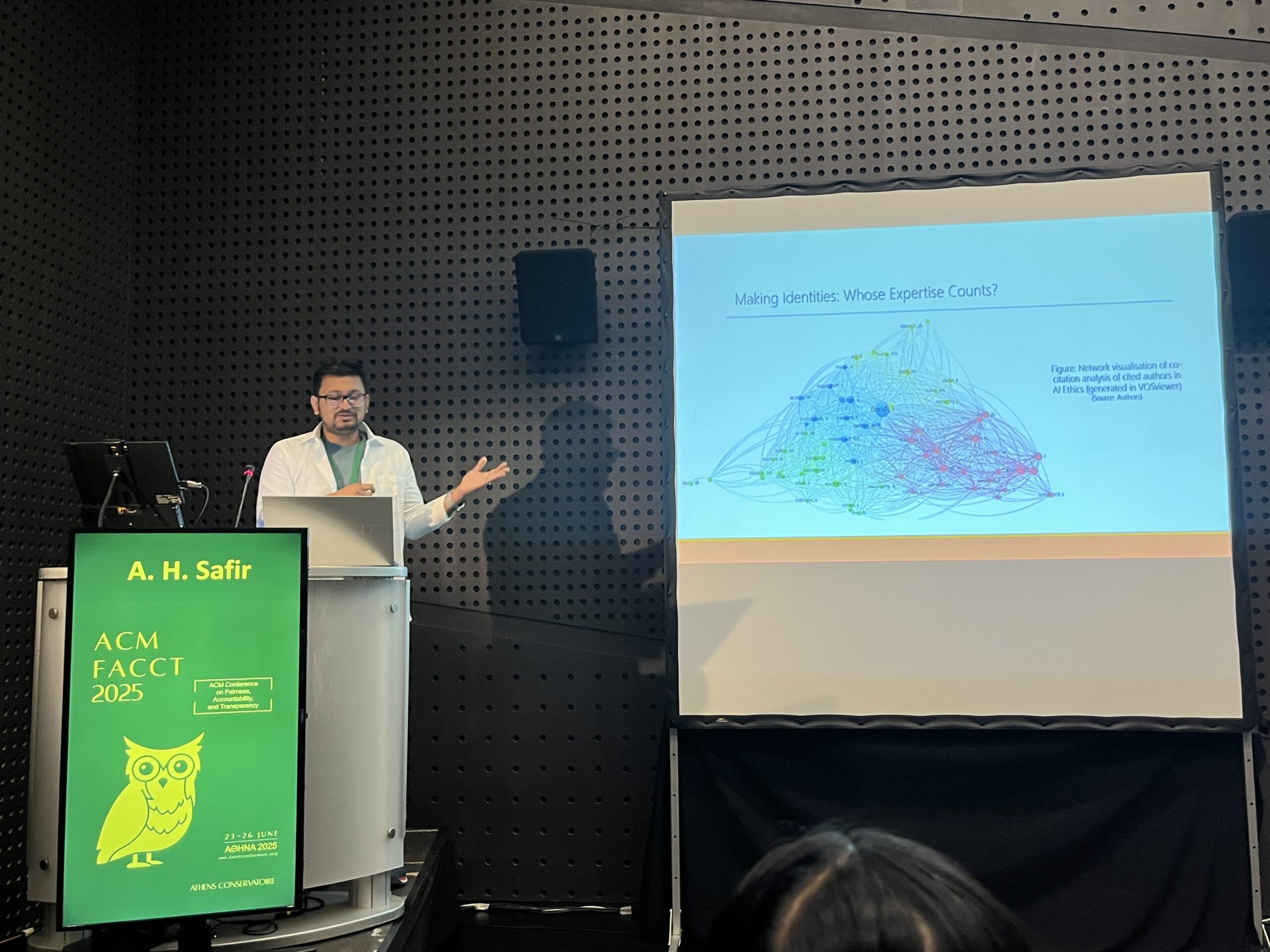 For instance, a study of the distribution of research outputs in AI Ethics suggests “an unbalanced ratio”. Among the top 50, four are in Australia and two institutions are in Asia. The remaining 44 institutions are either in Europe or in North America and include universities, the research wings of tech companies such as Microsoft and IBM, and public research organisations such as the Alan Turing Institute. There are no institutions in Latin or Central America, sub-Saharan Africa or the region of the Middle East and North Africa (MENA).
The authors say: “Collectively, they shape the discourses and institutional ways of understanding around the ethical development of AI technologies worldwide. This techno-politics of knowledge-making in AI Ethics culminates in creating epistemic injustice for the Global South.”
“We show that the global project of AI Ethics fails to deliver its promise to be universally useful by keeping the global majority populations in the Southern regions marginalised as ‘others’.”
*Read the paper here.