


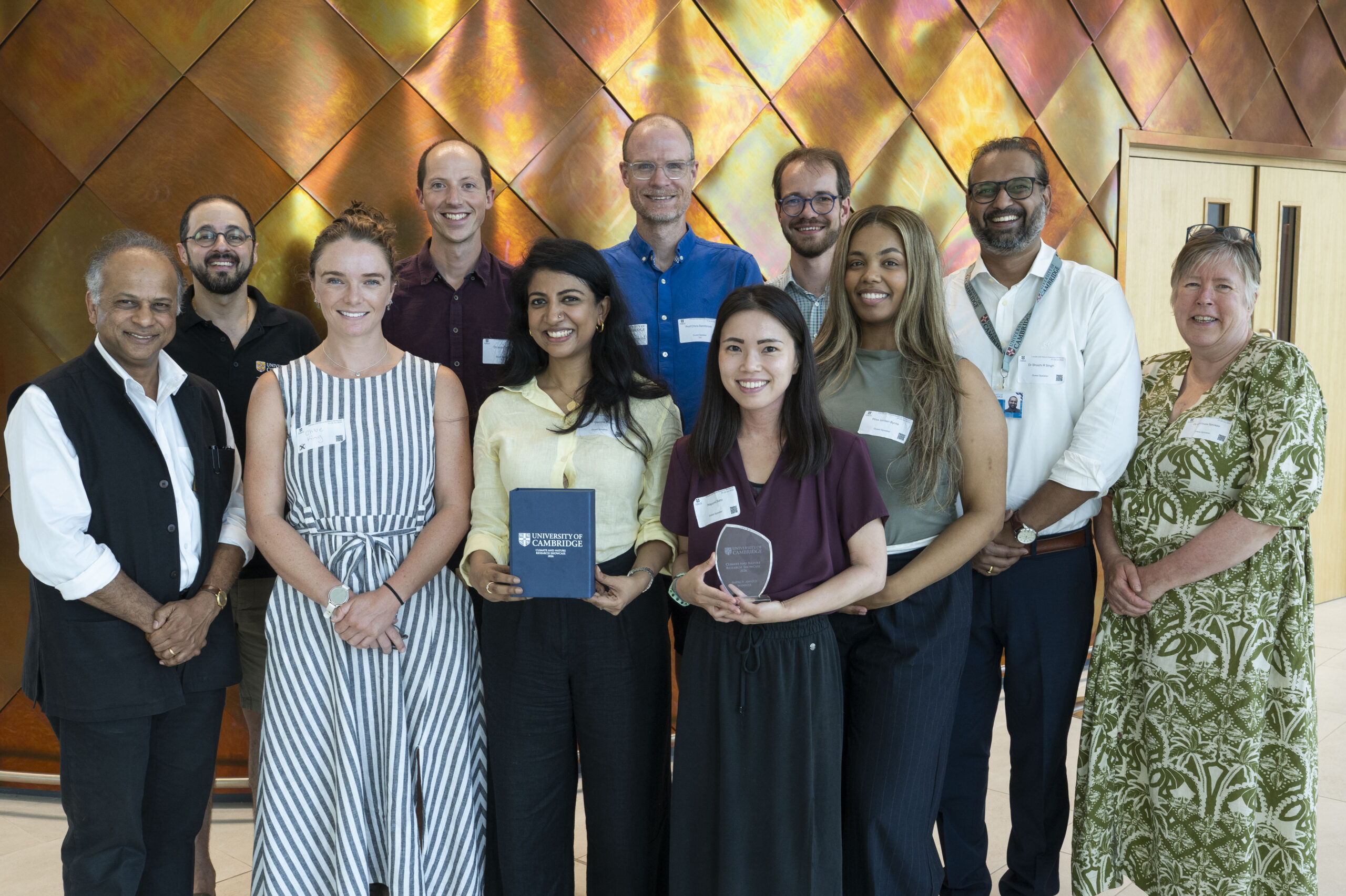
Mayumi Sato and Kamiar Mohaddes won Impact Awards for their work on environmental justice and climate change economics.
Two Gates Cambridge Scholars were recently awarded the Impact Award at the Climate and Nature Research Showcase by the University of Cambridge and Cambridge Zero.
Kamiar Mohaddes and Mayumi Sato were presented with their awards by Dr Lucinda Spokes, Head of Public Engagement in the Cambridge Research Office at the ceremony last Friday and gave brief speeches.
The University-wide Cambridge Awards for Research Impact and Engagement, run by the Engagement, Knowledge Exchange and Impact team in the University’s Research Strategy Office, celebrate outstanding achievement, innovation and creativity in developing and delivering ambitious engagement and impact plans that generate meaningful economic, social and cultural benefit from research.
This year, applicants were asked to choose a thematic category for their research and last week’s ceremony recognised those within the Climate and Nature theme.
Global environmental defenders
Mayumi [2021], who did her PhD in Sociology, was recognised for her Global Environmental Defenders and the Pursuit of Planetary Stewardship project.
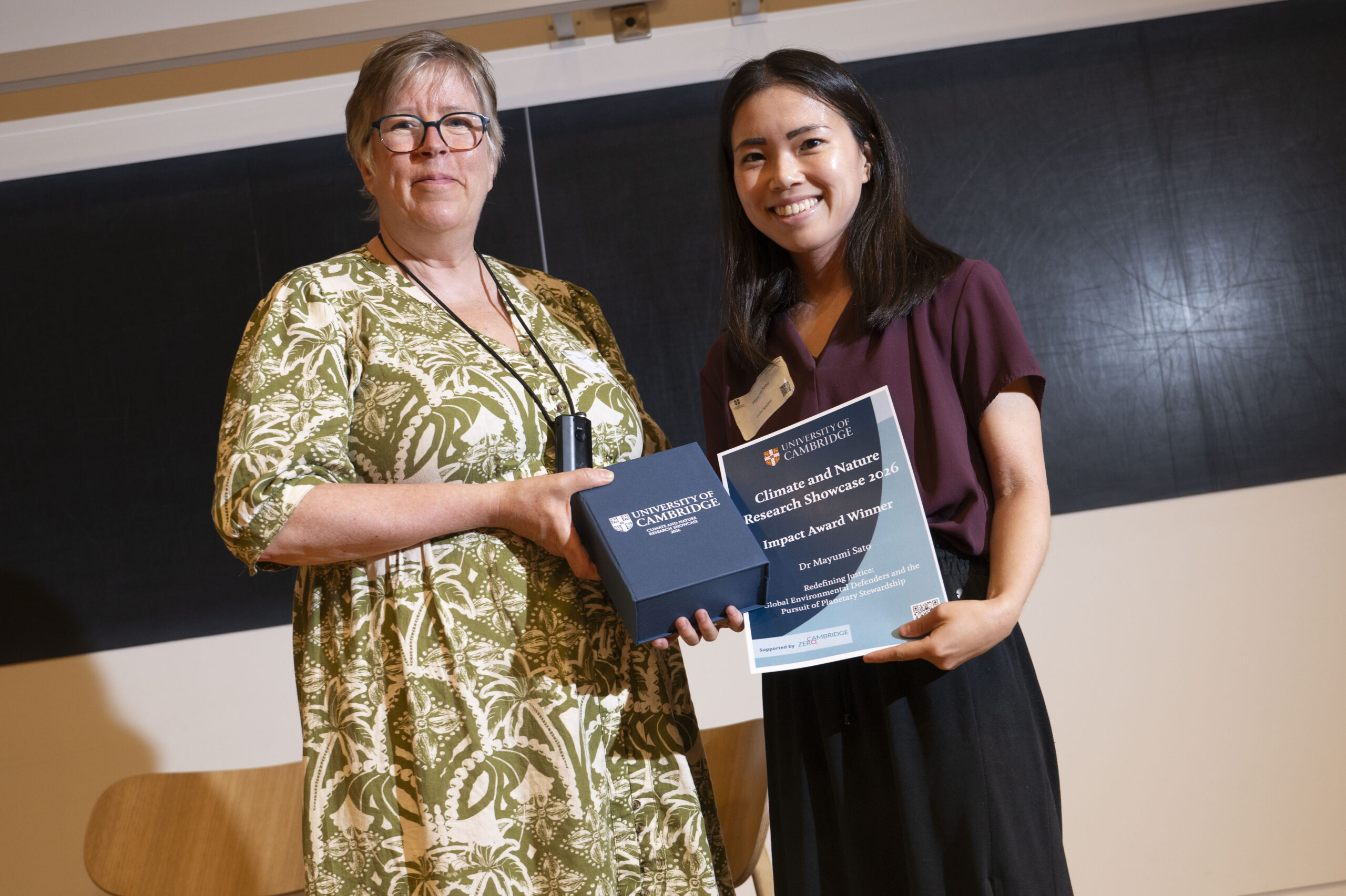
Mayumi receives her award from Dr Lucinda Spokes
The project works with environmental defenders in the Global South to redefine and expand understandings of environmental justice beyond western-centric imaginaries and notions of struggle. Using participatory action research, it examines what it means to be an environmental defender from diverse epistemologies and centres the agency of environmental defenders in restoring the environment, rather than seeing them as victims of it. Working with Indigenous communities, smallholder farmers, community leaders, environmental organisations, fishers, shepherds, cooperatives and youth and women groups across sociopolitical contexts, the project examines the various and creative land defence strategies used by environmental defenders which are often ignored in scholarship.
Mayumi states: “By working with environmental defenders to see how they protect their land and waterways, the project documents how they negotiate their organising in restricted civic space, and how environmental stewardship can manifest through creative and discreet ways. It provides alternative understandings on how environmental defenders must exercise forms of land protection that are not always visible to the eye to navigate suppression of rights and mobility against corporate, state and colonial encroachment.”
Mayumi says that her PhD has enabled her to connect her research in ways that reached audiences beyond academia, including through film, Zines and colouring books so that those who supported and informed her research benefitted from outputs that they would find useful.
Mayumi, who was named a 2026 Top Agri-Food Pioneer by the World Food Prize Foundation for its 40th year anniversary, adds: “Being part of the Gates community allowed me to further my community engagement and leadership significantly. Through the Academic Development Fund, I was able to carry out multiple projects in line with and beyond my PhD, which broadened my understanding of global environmental justice and human rights. This led me to working with communities in West Africa, SWANA and Southeast Asia, and I have been able to translate and provide scientific evidence and technical knowledge on how to build equitable agrifood systems and land access for intergovernmental and non-profit organisations.”
Overturning climate orthodoxy
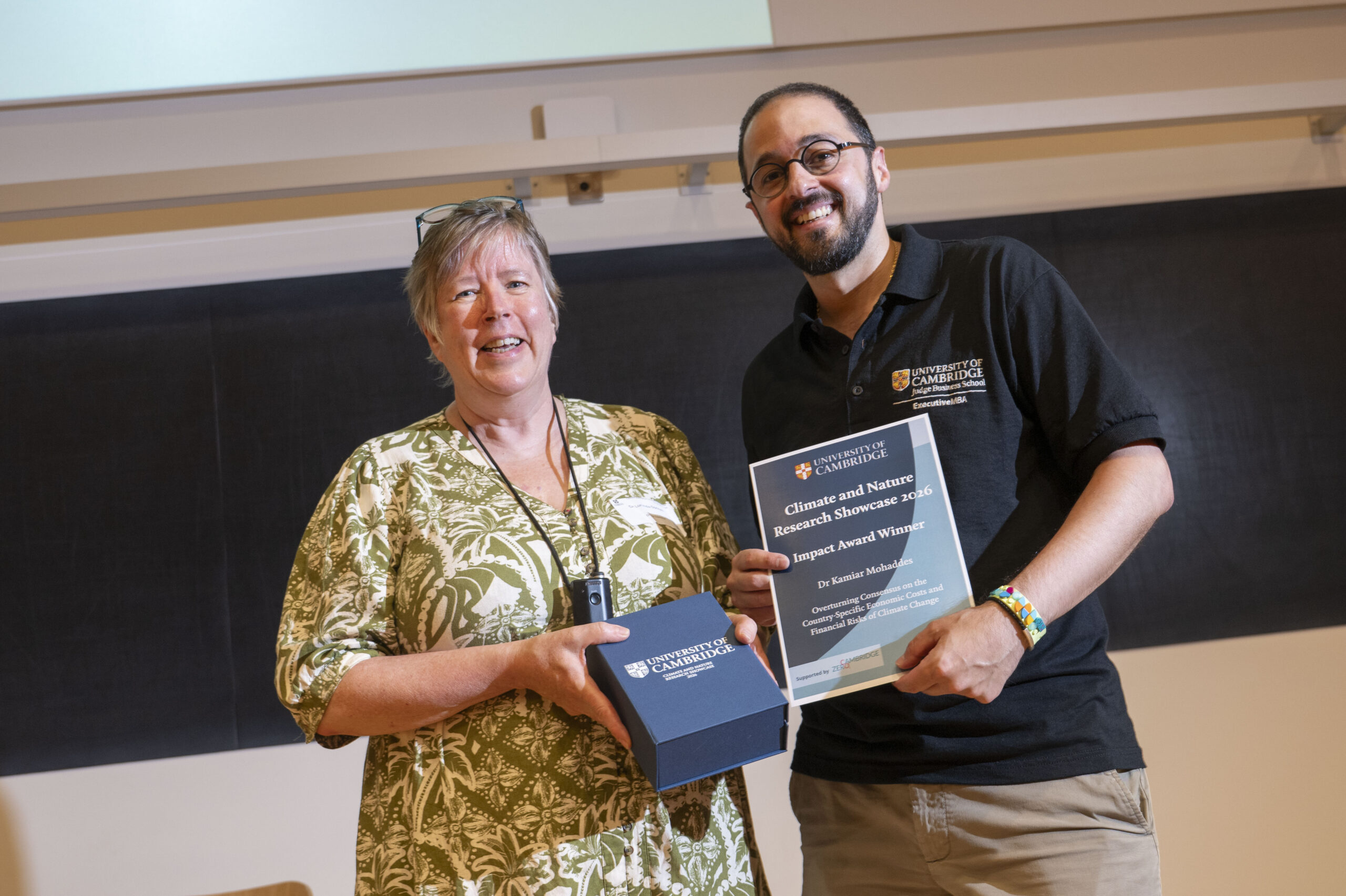
Kamiar receives his award from Dr Lucinda Spokes
Kamiar [2005], who is Associate Professor in Economics and Policy at the University of Cambridge and Assistant Director of the Energy Policy Research Group, won an award for his work as Director of the climaTRACES Lab under the title “Overturning Consensus on the Country-Specific Economic Costs and Financial Risks of Climate Change”.
Kamiar co-founded the interdisciplinary lab with fellow Gates Cambridge Scholar Ramit Debnath. That work has changed the prevailing orthodoxy that many cooler, wealthier nations would escape the financial fallout and even profit from warmer climes.
The team set out to quantify the economic implications of climate change and showed through a series of studies that all countries – rich or poor, hot or cold – would suffer economically under the current emissions trajectory.
With colleagues at the Boston Consulting Group, they showed that the net cost of inaction – the cost of climate change less the cost of climate action – is 11% to 27% of cumulative GDP (with a 9x return on investment) in the long term.
Further, using artificial intelligence to simulate the effects of climate change on Standard and Poor’s credit ratings for 108 countries by 2030, as well as decades into the future, they also showed that ecological damage will affect national finances much sooner in the form of sovereign credit ratings. The first “climate smart” credit ratings, which they developed, suggested that – if nothing is done to curb emissions – up to 63 nations could be downgraded by over a notch on average by the end of this decade, with countries such as Germany and Sweden dropping three notches and the US and Canada falling two notches.
A range of public and private sector actors now use results from the team to inform governments and clients of the macroeconomic costs and financial risks of climate change, as well as potential policy options and actions at business level.
*Picture credit: David Rose/Cambridge Zero.