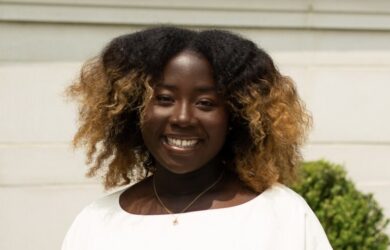


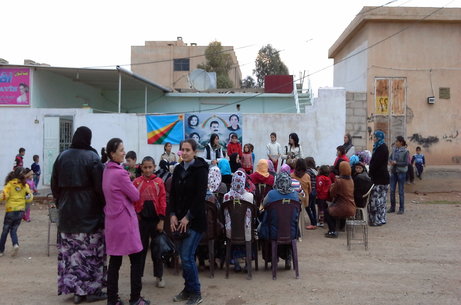
Johanna Riha was part of a recent delegation to the Kurdish region of northern Syria where a new form of self-government is being rolled out.
A Gates Cambridge Scholar has recently taken part in a delegation to the Kurdish region of northern Syria which is calling for international aid and recognition of the new form of self-government being established there.
Residents of the predominantly Kurdish areas of northern and northeastern Syria have established themselves as a new political entity that they call Rojava, comprising three autonomous cantons, one of which is the besieged city of Kobanê. Rojava includes a commitment to gender liberation and direct democratic self-government.
Gates Cambridge Scholar Johanna Riha [2011] was part of a delegation of scholars from Europe, Turkey, and North America who travelled to Rojava in December to learn more about the ideals and practices of the Rojava revolution and to witness at first hand, in one of its cantons, its claims to gender liberation and democratic self-government.
They visited major cities as well as rural villages and attended a meeting of a self-governing people’s council in a Qamislo neighborhood. They also spoke to representatives of TEV-DEM, the broad-based Movement for a Democratic Society that constructed the institutions of self-government and to journalists, members of the security forces, members of political parties, such as the Democratic Union Party (PYD), and many others, including government representatives and members of the women’s umbrella organisation Yekîtiya Star and leaders of the Syriac Women’s Union.
They also visited schools, colleges, cooperatives, workplaces and a women’s academy in Rimelan and met with members of the self-government in charge of economic development, healthcare, and foreign affairs.
They were guests at the large Mesopotamia Academy of Social Sciences in Qamislo. Prior to the revolution, Kurds in Syria were not allowed to speak their own language, give their children Kurdish names, open shops with non-Kurdish names, found private Kurdish schools, or publish Kurdish books or writings. There was no local university, but Rojava’s self-government has taken the first steps toward creating a university.
The scholars say that the Mesopotamia Academy of Social Sciences, in Qamislo, needs international solidarity, exchange, experience and material support, particularly books in Kurdish, Arabic and English, in order to succeed, as well as lecturers, computers, projectors, and speakers.
The scholars also visited the Newroz refugee camp, where Yezidis from Mount Sinjar emphasised their ambitions for self-governance and self defence and pleaded for international assistance. The refugees said that they suffer under the embargo imposed on Rojava and lack basic needs.
Johanna, who is doing a PhD in Public Health and Primary Care, says the role of Turkey in supporting the rise of al-Nusra and ISIS was explicitly brought up by almost everyone they met.
The scholars issued a statement. They say: “In Rojava, we believe, genuinely democratic structures have indeed been established. Not only is the system of government accountable to the people, but it springs out of new structures that make direct democracy possible: popular assemblies and democratic councils. Women participate on an equal footing with men at every level and also organise in autonomous councils, assemblies and committees to address their specific concerns. The women we met embodied the empowerment, self-confidence and pride recently gained by the women of Rojava.We saw banners and slogans that read: “The Rojavan revolution is a women’s revolution.” It really is.”
They say the model points to “an alternative future for Syria and the Middle East, a future where the peoples of different ethnicities and religions can live together, united by mutual tolerance and common institutions”.
They called for the lifting of the embargo on Rojava, for the international community to channel aid to the region and for international recognition of Rojava, including recognition by NGOs. They said: “It seeks not to become an independent state but rather to help create a genuinely democratic Syria and become integrated into it. Its unique system of self-government deserves to be acknowledged as a possible solution to the many ethnic and religious conflicts that ravage the region.”
*Picture of women’s neighbourhood assembly.