

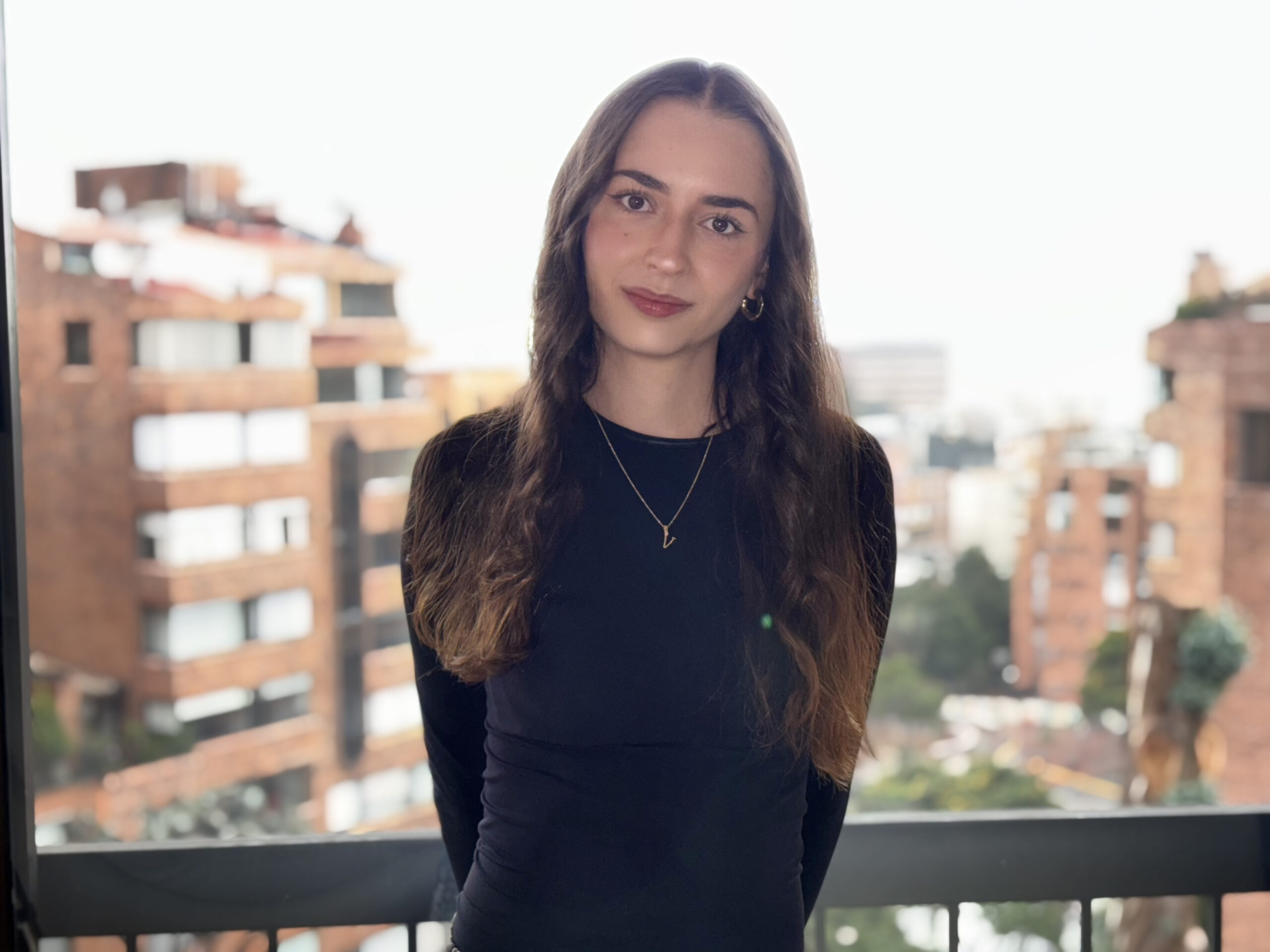
Viviana Gomez Ramirez talks about her aim to study how disorder shapes quantum materials' properties and behaviour.
Doing this PhD has been a long-standing dream - something everyone who knows me is aware of. Doing it at Cambridge and with a Gates Cambridge Scholarship is truly extraordinary.
Viviana Gomez Ramirez
Viviana Gomez Ramirez [2026] likes to focus on the big questions in Physics, seeing it as a form of Philosophy.
Her PhD, which she starts in the autumn, aims to extend her work on statistical mechanics, condensed matter and systems where disorder drives emergent behaviour to the world of quantum materials. She will study how disorder shapes the materials’ magnetic properties and collective behaviour.
Alongside her work in fundamental Physics, Viviana is seeking to use her knowledge of 2D-materials like graphene to improve the lives of her fellow Colombians. She is co-founder and Chief Technology Officer of start-up Seebgen which develops and supplies high-performance graphene slurries for multipurpose applications, from energy generation to ballistic protection plates – protective inserts used in body armour systems which provide resistance against ballistic threats. These can be used by rural and vulnerable communities who have endured a long history of armed conflict.
Childhood
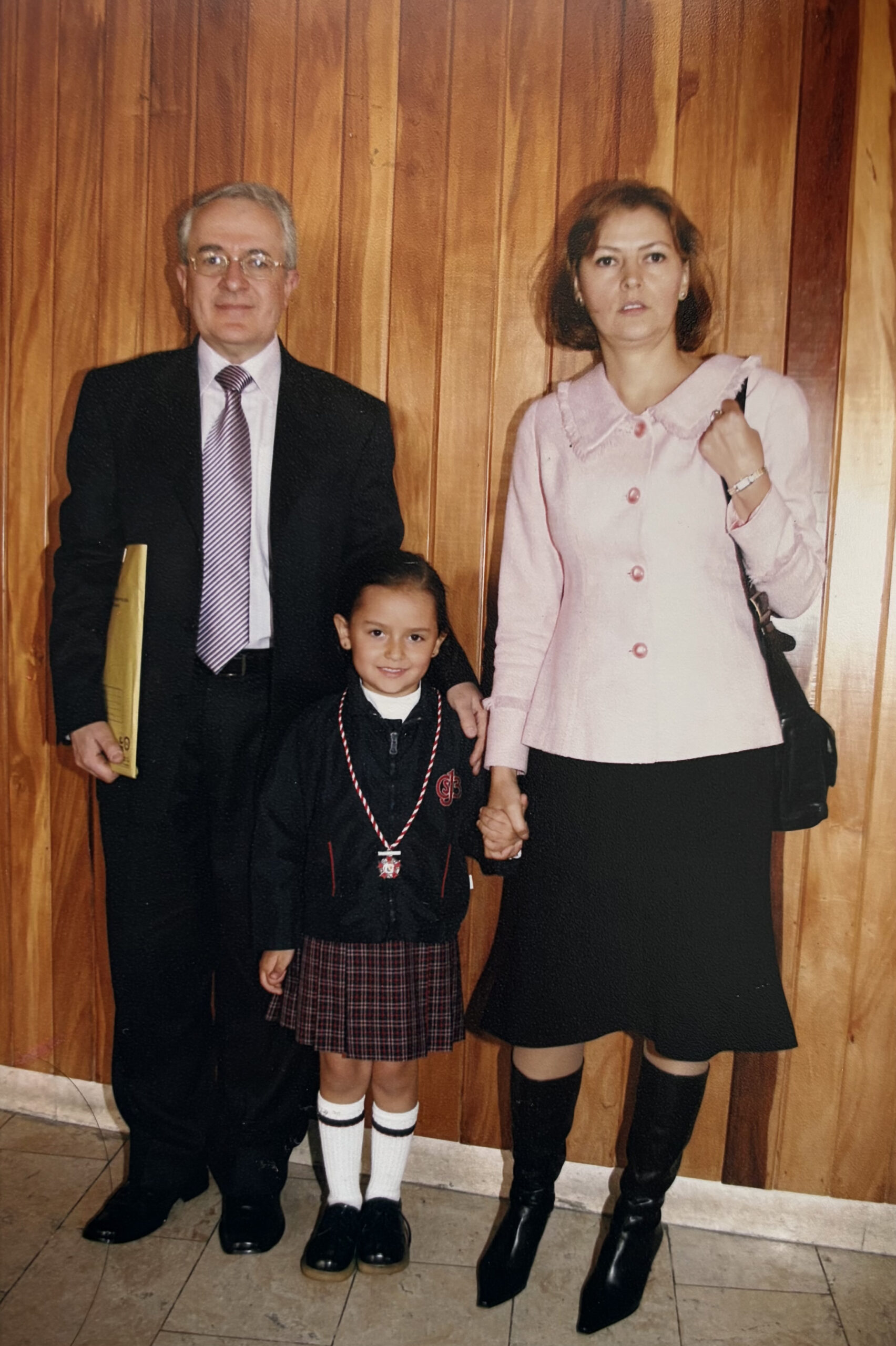 Viviana was born and grew up in Bogotá. Her parents were the first generation in their families to go to college, her father studying Economics and her mother Business Administration. Both are now running a company together that sells tools. Viviana says they instilled a sense of entrepreneurship in her as well as a love of maths. “My dad always talked about how much he loved maths and how important it was for the world,” she says. She also has an older sister who shares her interest in mathematics.
Viviana attended a Catholic all girls’ school which she says shaped her academic confidence. She excelled at Physics from an early age and helped her fellow students to solve Physics problems. Even at primary school, some of her teachers were telling her she should study Physics. One teacher mentioned that they saw her eventually studying outside Colombia. Although it didn’t register at the time with her, those words stayed in her head.
Viviana loved learning, with Physics and Philosophy being her favourite classes. She read a lot of books on Philosophy as she was growing up and took part in local STEM-based Olympiads. By the end of secondary school she was sure that she wanted to go to university and study Physics and relished the breadth of what the subject offered.
Undergraduate studies
She began her undergraduate studies at the Universidad de los Andes in Bogotá in 2020, spending two months in classes before the Covid lockdown meant she had to study at home for two years. During the pandemic, Viviana spent all of her spare time studying. She also strived to keep engaging with others, attending online conferences and events.
In her third year she took a class in statistical mechanics which changed the way she understood Physics. Statistical mechanics explores the macroscopic properties of systems made up of a vast number of particles, such as atoms or molecules. It operates according to the premise that the large-scale behaviours of these systems can be understood as averages of their microscopic constituents’ behaviours. By employing statistical methods, it provides a probabilistic framework to relate these macroscopic properties to the underlying microscopic dynamics governed by classical physics and quantum mechanics.
“It was a really profound philosophical change for me,” says Viviana. “Classical mechanics assumes we can, in principle, know everything about a system, but statistical mechanics assumes we cannot have complete information.”
By 2023, she was working in the statistical physics group at the university, building thermodynamic models of fractal lattices. She is still there and says her supervisor Professor Gabriel Tellez has helped to grow her confidence through treating her as a genuine collaborator as well as helping her to learn a great deal along the way.
Viviana is also working as a research assistant for Professor Yenny Hernandez in the nanomaterials laboratory where she has been synthesising and characterising 2D materials. “She taught me how to be rigorous and kind, ambitious and collaborative while trusting me with the responsibility to lead projects,” says Viviana.
Start-up and PhD
She co-founded the start-up with Professor Hernandez and other laboratory colleagues. It aims to bring graphene technology to the Colombian market. Seebgen grew out of a realisation that the nanomaterials lab could produce graphene at lower than average prices. “I want to contribute to the technological development of Colombia,” says Viviana. “We often import new technologies and don’t trust ourselves enough.”
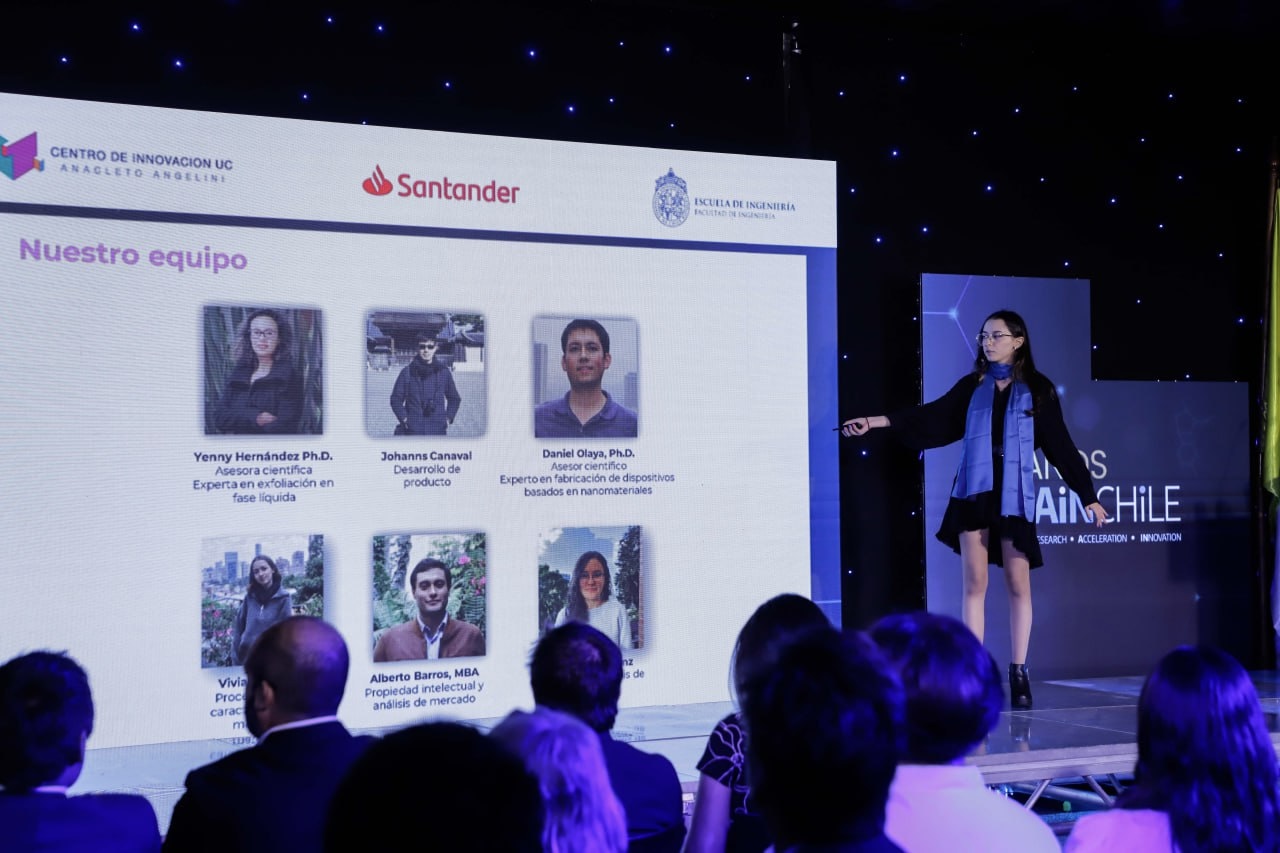 A lightbulb moment came when the researchers started talking to local companies and trying to understand their problems and how they could address them through graphene-related products. Viviana leads the start-up’s science projects. She will remain on the board when she starts her PhD, but in a more strategic role.
Her PhD will bring together theoretical and experimental physics as part of her work on the theory of condensed matter. She is excited to start her research at Cambridge, a world leader in this area. “I will continue to work on statistical mechanics, particularly at its interface with materials science, focusing on the intersection between complex dynamics and topology,” she says.
She is particularly interested in the randomness and disorder in condensed matter, such as spin glasses and quantum spin liquids. A spin glass is a diluted magnetic material where magnetic moments interact randomly, resulting in numerous metastable states that prevent equilibrium. A quantum spin liquid is a phase of matter that can be formed by interacting quantum spins in certain magnetic materials.
Understanding better how condensed matter works is key to unlocking the powers of superconductivity which allows materials to conduct electricity with zero resistance and expel magnetic fields, enabling highly efficient energy transmission.
Viviana says her work on randomness may have relevance in a range of complex systems, from financial markets to pandemic spread. “We don’t know exactly how a virus will spread in a pandemic, but there are useful parallels with statistical systems with many interacting agents, such as gases and spin systems, where randomness plays a central role in shaping collective behaviour,” she says.
Viviana is looking forward to becoming a Gates Cambridge Scholar and to drawing on a network that aims to have real world impact. “We may study different topics, but we share the same purpose of improving the lives of others,” she says. “It’s a life-changing opportunity for me. Doing this PhD has been a long-standing dream – something everyone who knows me is aware of. Doing it at Cambridge and with a Gates Cambridge Scholarship is truly extraordinary.”