

A new study led by Vaithish Velazhahan provides a template for future understanding of fungal G protein-coupled receptors
As the first structure of a fungal GPCR, this structure provides a template for the understanding of other class D GPCRs and for the design of novel drugs targeting fungal GPCRs.
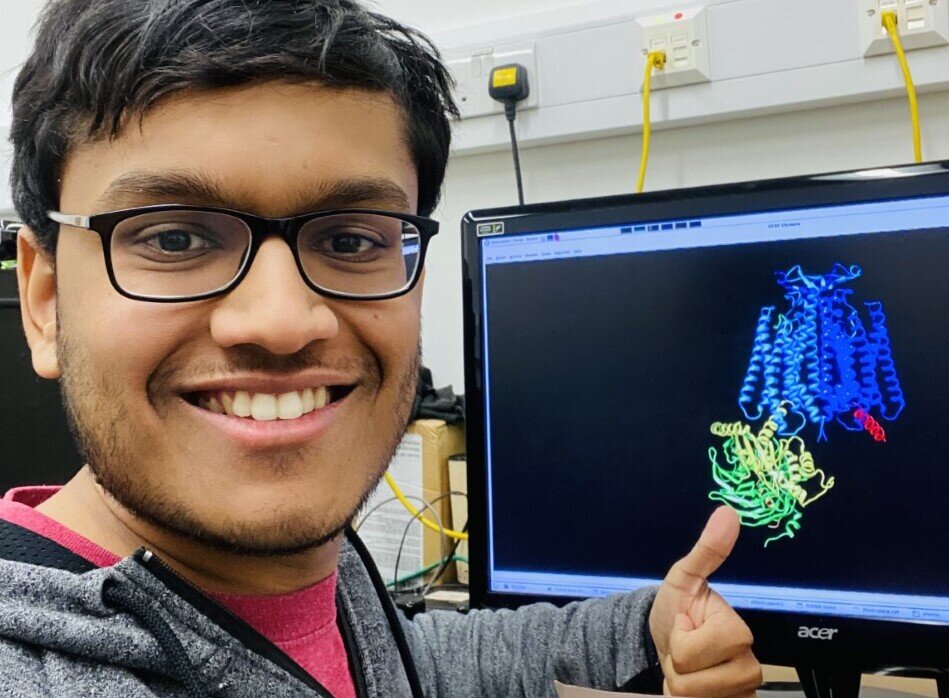
Vaithish Velazhahan
A new study led by a Gates Cambridge Scholar sheds light on the atomic structure of fungal G protein-coupled receptors (GPCRs).
GPCRs are membrane proteins that convert signals from a wide range of stimuli. They are also the targets of approximately 34% of all Food and Drug Administration-approved drugs, due to their wide-ranging important functions in human cells. The design of new, improved drugs with fewer side-effects requires a fuller understanding of their structures, but so far this has been elusive.
GPCRs in fungi could also be useful drug targets, but no structures of fungal GPCRs have previously been solved. However, a new study on which Gates Cambridge Scholar Vaithish Velazhahan [2018 – pictured above] is lead author, has determined the first structure of a fungal GPCR. The study is published in Nature this week.
Vaithish explains that GPCRs can be divided into six classes, A – F, based on their evolutionary relationships to each other. Electron cryo-microscopy (cryo-EM) and X-ray crystallography have enabled determination of over 370 structures of vertebrate GPCRs in classes A, B, C, and F. Class D GPCRs are found exclusively in fungi where they regulate survival and reproduction. Vaithish, a PhD student in Chris Tates’ group in the Structural Studies Division of the MRC Laboratory of Molecular Biology, set out to solve the structure of the class D GPCR Ste2 – a pheromone receptor in Saccharomyces cerevisiae yeast.
After engineering a version of a yeast G protein that would capture Ste2 in an active state and developing methods to purify and then assemble the required components, Vaithish used cryo-EM to solve the structure of a Ste2 dimer in an active state and coupled to two G proteins. Molecular dynamics simulations performed in collaboration with Nagarajan Vaidehi’s group at the Beckman Research Institute of the City of Hope, USA, showed an unexpected mobility of one of the G proteins, which is now under further study.
He says: “As the first structure of a fungal GPCR, this structure provides a template for the understanding of other class D GPCRs and for the design of novel drugs targeting fungal GPCRs.”
In collaboration with David Gloriam’s group at the University of Copenhagen, Denmark, a unified nomenclature for Class D1 GPCRs was developed to facilitate future work.
This is also the first high-resolution structure of a GPCR dimer where the interface involves extensive interactions within the transmembrane region.
The tools developed for this piece of work are expected to provide a foundation for structure determination and understanding of other fungal GPCRs, including those implicated in several major fungal diseases, such as candidiasis, or that can reduce crop spoilage caused by fungal pathogens.
*The work was funded by UKRI MRC, Gates Cambridge Trust, ERC, Sosei Heptares, Lunbeckfonden, Novo Nordisk Fonden, Independent Research Fund Denmark, and NIH.