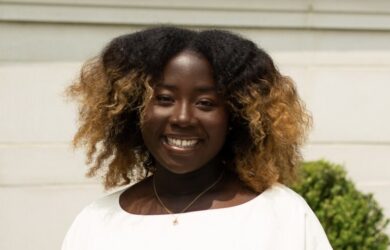


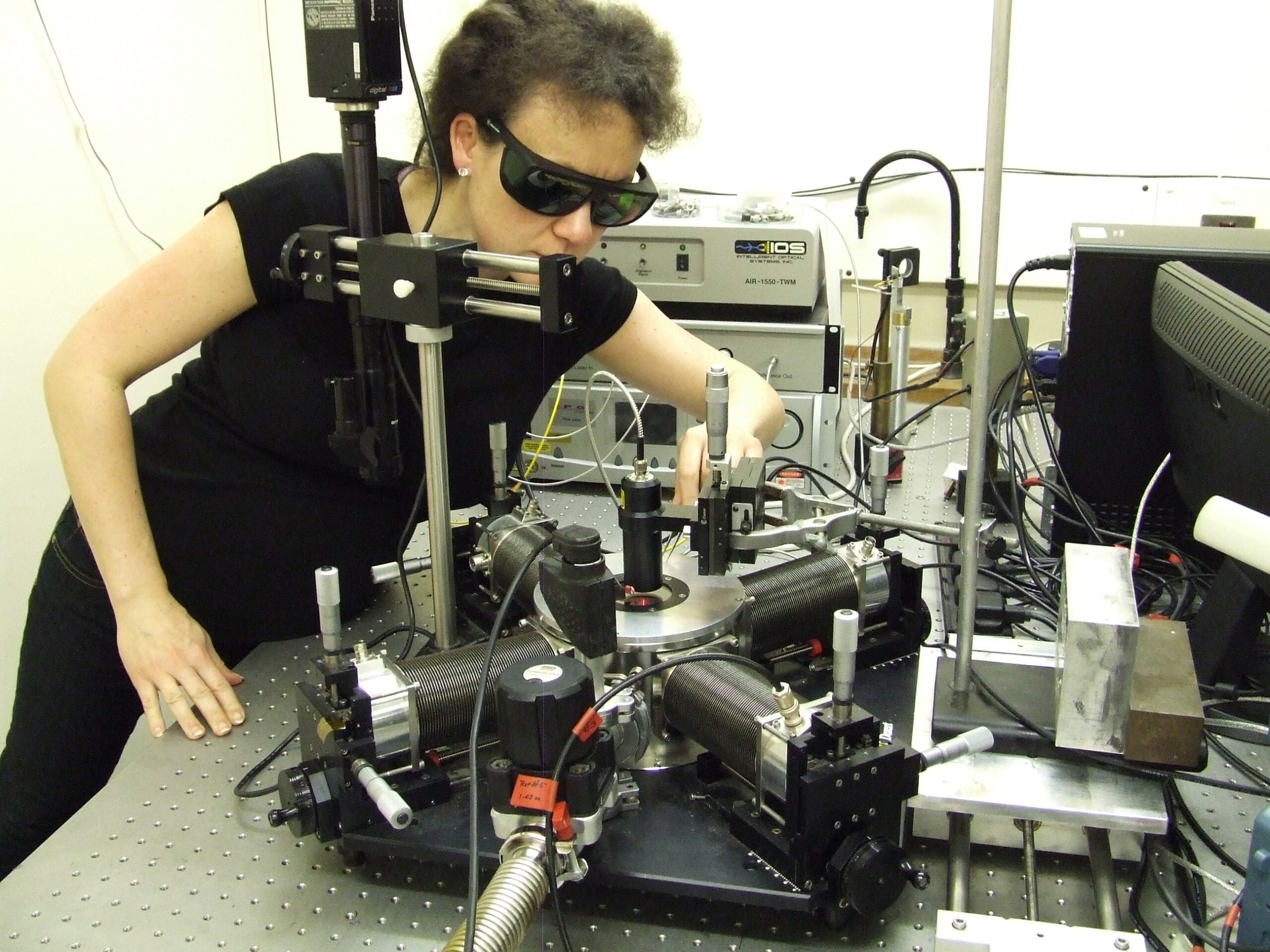
This month, 25 years since they enrolled, we will be celebrating the Gates Cambridge Originals - the Class of 2001, beginning with Okansa Ruzak.
My life would have been completely different if not for Gates Cambridge. It changed my life significantly for the better and I am trying to pay this back in all the work I do.
Oksana Ruzak
Oksana Ruzak [now Trushkevych] describes herself as both a physicist and an engineer and as someone who is motivated by a desire to have a positive impact and to make a difference. Her research work has focused on photonics, materials and ultrasonics.
Over the last 25 years, she has moved from Engineering to Physics and back again, recently achieving Chartered Engineer status. She has worked both in industry and academia as well as doing outreach work that opens up Engineering to a broader range of students.
Being from Ukraine, she has also been dedicated to supporting her fellow Ukrainians through activism, fundraising and other ways of giving back.
Oksana’s PhD looked at the dynamic holography of liquid crystals, how, if you add dyes and nanostructured carbon materials, it makes liquid crystals more sensitive to light. She says: “Being able to do holography with low light powers is useful for things like medical imaging. The ultimate aim is to form 3D images of things in real time with low power consumption which brings savings in production costs. This can be used to build up an image on a special screen so doctors can make better judgements. Visualisation is very important.”
After Cambridge
After submitting her thesis Oksana [2001] travelled to Nepal and hiked up to Everest Base Camp and climbed the Island Peak (a 6,189 metre climb), returning to do her viva. Oksana remained in Cambridge, after being offered a postdoctoral position at the Centre for Advanced Photonics and Electronics. She also won a Junior Research Fellowship at Wolfson College to continue her research on liquid crystal-based work and received a Visiting Research Fellowship from the International Institute of Complex Adaptive Matter at the University of Colorado at Boulder. She returned to the UK to continue her research and to investigate how different nanomaterials could be added to liquid crystals to make new functional materials for photonic and radio frequency applications.
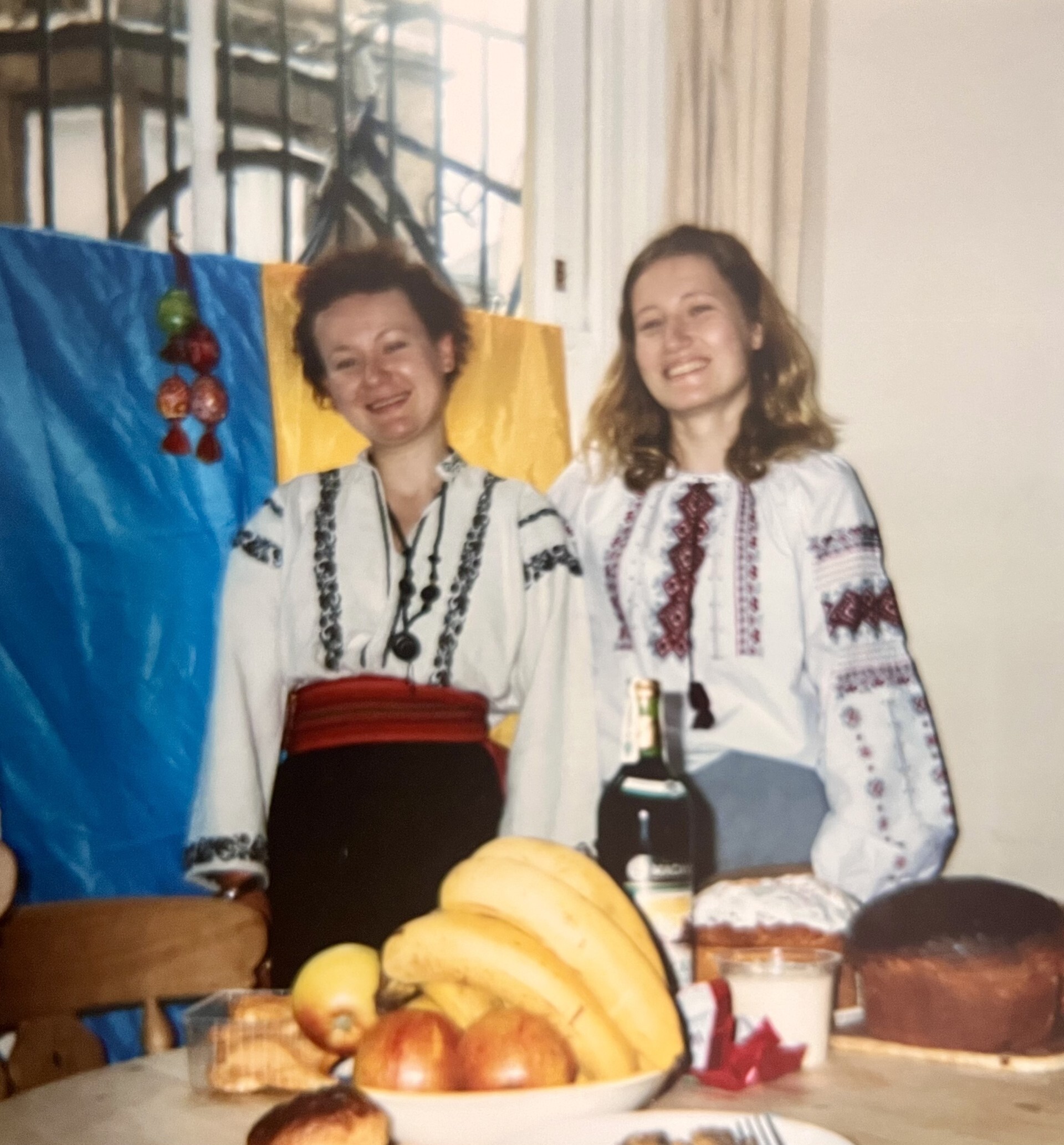
Oksana at a traditional Ukrainian celebration with the Cambridge University Ukrainian Society president Zoryana Oliynyk
Oksana moved to the University of Warwick in 2011, just after getting married. The move was in response to the ‘two body problem’, a physics problem which, when applied to the personal relationships of academics, means that a couple need to find a job at the same institution in order to live together. Oksana says she was very lucky to find a wonderful research supervisor at Warwick who supported her transfer from Engineering to Physics where she studied ultrasonics. “It was a new area for me and very stimulating mentally,” she says. “It was all about which problems I wanted to solve, and I love Engineering because it is about the application of research in everyday life, and about changing the world.”
Photonics, which she had studied at Cambridge, is a branch of optics that involves the application of generation, detection and manipulation of light in the form of photons through emission, transmission, modulation, signal processing, switching, amplification and sensing. Oksana’s work at Warwick saw her applying her knowledge of liquid crystals and optics to the world of ultrasound. “They are both all about waves so there are commonalities,” she says.
Nevertheless, the switch was a steep learning curve which brought together fundamental physics and experimental work. Initially, Oksana was studying magnetic materials, for example, how magnets can do the job of the environmentally unfriendly gas currently used in fridges, as well as how ultrasound can be used in engineering, for instance, to look at cracks in airplanes or large buildings. Throughout her academic career, liquid crystals have been a constant and this year Oksana hosted the annual British Liquid Crystal Society conference at Warwick, which was something she has always wanted to do. She joined the Society, which was set up to promote education and research on liquid crystals in the UK, when she started her PhD in 2001.
Teaching and outreach
Oksana has pushed the boundaries in her teaching work, leading an interdisciplinary module on the science of music – which she is still teaching – which covers different aspects of music, drawing on physics, maths, neuroscience and psychology. The module builds on her love of music – she has sung in many choirs, did ballroom dancing and has a passion for classical music. The course came about because of her interest in outreach work as well as her interest in music. Her love of outreach work is fuelled by the untimely death of her mother during Covid after she delayed medical treatment for a melanoma because of a distrust of science. “I feel that scientists need to share more about our work to build trust in what we are doing,” says Oksana.
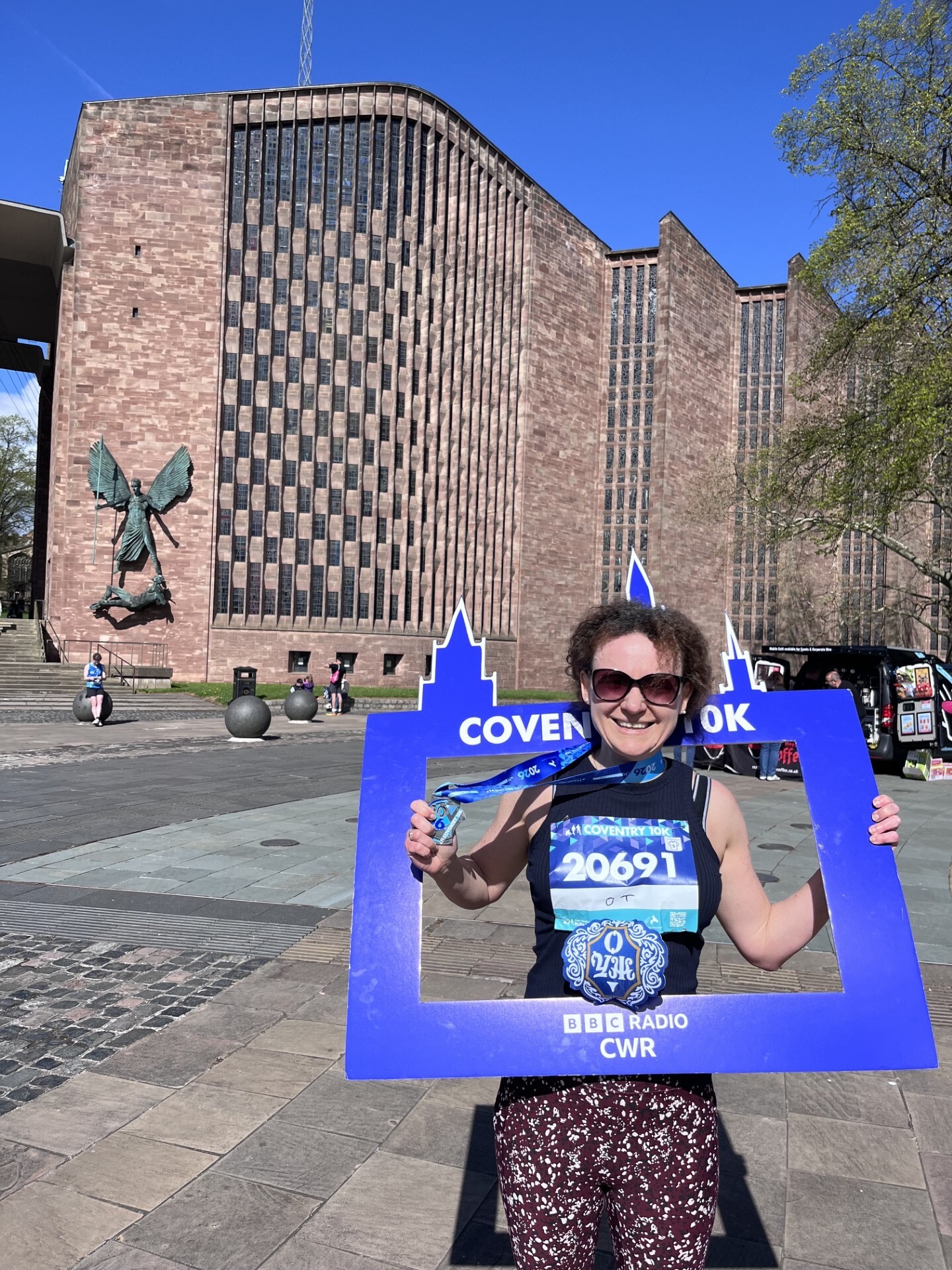
Oksana in April 2026, having run the Coventry 10K with a personal best to raise money for Organisation of Women in Great Britain
Her outreach work has seen her take part in cultural events across the Midlands, working with a professional quartet. The events demonstrated how acoustic waves behave. “We talk about what making musical sounds is and explain the physics behind things. We do experiments about resonance, giving people balloons and playing music loudly so they can feel the vibrations. That has implications for deaf people who may perceive sound differently through touch and it shows how energy can be transferred at a distance and can have practical implications, such as the ability to recharge the batteries of medical implants, such as pacemakers,” says Oksana.
Oksana has also been using her knowledge of optics, music and ultrasonics to develop a course on Acoustics and Waves for Engineering students, which will go a little beyond the traditional ideas of mechanical engineering being predominantly about automotive, aerospace or robotics industries – the cliché that may deter students with different motivations and interests.
Oksana is keen to broaden the intake of Engineering students and to show Engineering applies to many walks of life. She says: “We need different types of people to consider Engineering. We need diversity in every aspect.” She currently leads her department’s widening participation work, working with schools and programmes that support children from backgrounds that are traditionally underrepresented in the higher education sector. She loves the saying that “talent is everywhere, opportunity is not”, and feels this outlook links back to the philosophy behind Gates Cambridge Scholarships and the Gates Cambridge community.
Industry collaborations
Over the course of her career, Oksana has advanced the field in different ways, from outreach and widening participation work and published papers to developing patents that have uses in everything from manufacturing to medicine. They include work on visualising ultrasound using liquid crystals, with applications in ultrasound surgery procedures and in training.
At Warwick, Oksana has also worked with the spin-off company Sonemat on a project that used thermography to test for and identify small cracks in additively manufactured parts as they were made, significantly reducing waste and production costs. She maintains strong industrial partnerships and is currently Deputy Director of Warwick’s Centre for Industrial Ultrasonics, which helps industry access specialist research expertise and facilities.
Oksana is currently working on novel approaches to ultrasonic testing, building on her research that won her the John Grimwade medal 2024 from British Institute of Non-destructive Testing. She is developing testing and monitoring methods for different types of concrete, including the infamous reinforced autoclaved aerated concrete [RACC], the material at the centre of safety concerns in UK public buildings, such as schools, back in 2023. Oksana says new methods for testing and monitoring concrete infrastructure in a wide variety of settings, including arches, tunnels and bridges, are needed.
Her research, in collaboration with the Manufacturing Technology Centre and other industrial partners, including Fibretech, investigates techniques that are capable of monitoring deterioration in a continuous, non-invasive way through embedded ultrasound sensors. She says: “It’s exciting work because it could help support decisions about repairs much earlier, rather than requiring structures to be fully rebuilt. It could have applications in natural disaster and conflict zones, and it could also help tackle climate change. Producing new concrete generates significant CO2 emissions, so reducing the need for rebuilding could have a substantial impact.”
Ukraine
Oksana, who has three children, two daughters and a son, born between 2013 and 2018, has managed all of this while working part time for much of her career. She now has a full-time academic position and is very happy with the way her work is going.
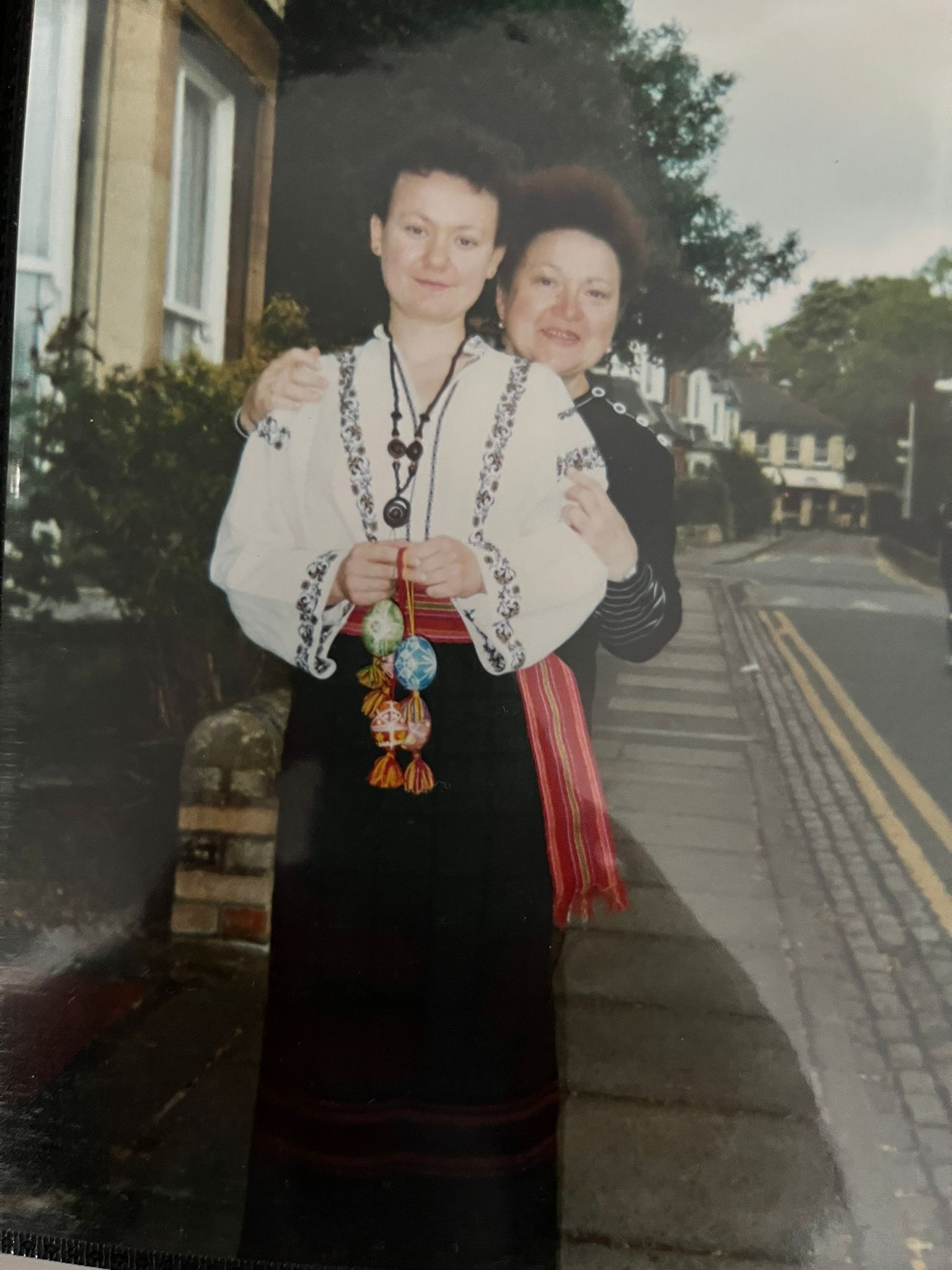
Oksana on the way to an Easter celebration in Cambridge with her late mother, on Park Parade. Round her neck she is wearing pysanky – traditional painted eggs, which she painted herself.
She has also been very active in Ukrainian organisations. Her student activism started back in Ukraine where she co-founded a student organisation that built on an earlier movement which pushed for Ukrainian independence in 1991. It focused on activities such as archaeological digs and reviving traditional arts and music. At Cambridge she was secretary for many years of the Cambridge University Ukrainian Society.
She is pleased to see how active CUUS and a parallel student organisation at Warwick have become. She is also a member of the committee of the Coventry branch of the Association of Ukrainian Women in Great Britain. They are sending equipment, such as power banks and electricity generators, to Ukraine. The current drive is to raise funds to support disabled children and older adult care centres in regions close to the frontline. They also send xmas presents to children whose fathers have been killed in service. The Coventry branch was recently nominated for the King’s Award for Voluntary Service (often described as the MBE for voluntary organisations).
In 2013 Oksana and fellow Gates Cambridge Scholar Svitlana Kobzar [2005] issued a joint statement on behalf of Ukraine in relation to the Russian invasion of Crimea. Oksana says she travels back to Ukraine regularly. She admits to being scared when she goes there, but says going makes her feel more connected to her friends and family in Ukraine. “Otherwise how can I look them in the eye if I have not experienced what they are going through,” she says. “I am so lucky to live in safety.”
From the first days of the full-scale invasion, Oksana has been a member of the Ukraine working group at Warwick, contributing to the University’s response to the crisis and helping it to twin with Ukrainian organisations. Warwick is twinned with a university in Kharkiv and Oksana often acts as a mediator between British academics and Ukrainians to help negotiate the language barrier and different approaches to research. She is also actively seeking collaboration and further twinning opportunities.
Oksana is also a host to a Ukrainian liquid crystal theory expert who is supported by Warwick’s Fernandes fellowship. She really values the opportunity to work and collaborate with him, and they have co-authored a paper and two research grant applications.
Gates Cambridge
She says her PhD at Cambridge was “transformational”. “My life would have been completely different if not for Gates Cambridge. It changed my life significantly for the better,” she says, “and I am trying to pay this back in all the work I do, in particular through my widening participation activities.”
She recalls those early days of the Gates Cambridge Scholarship programme: “It was an exciting time and we definitely all felt committed to the Gates vision from the start. There were many meetings of scholars. We definitely felt like a body of scholars.”
She adds: “I always assumed that everyone was motivated by a desire to improve the lives of others, but the reality is often less rosy. However, in the Gates Cambridge Scholar community you can see that everyone lives and breathes action and not just words when it comes to making the world a better place. That is what is unique about the community.”