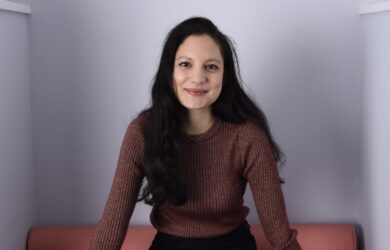


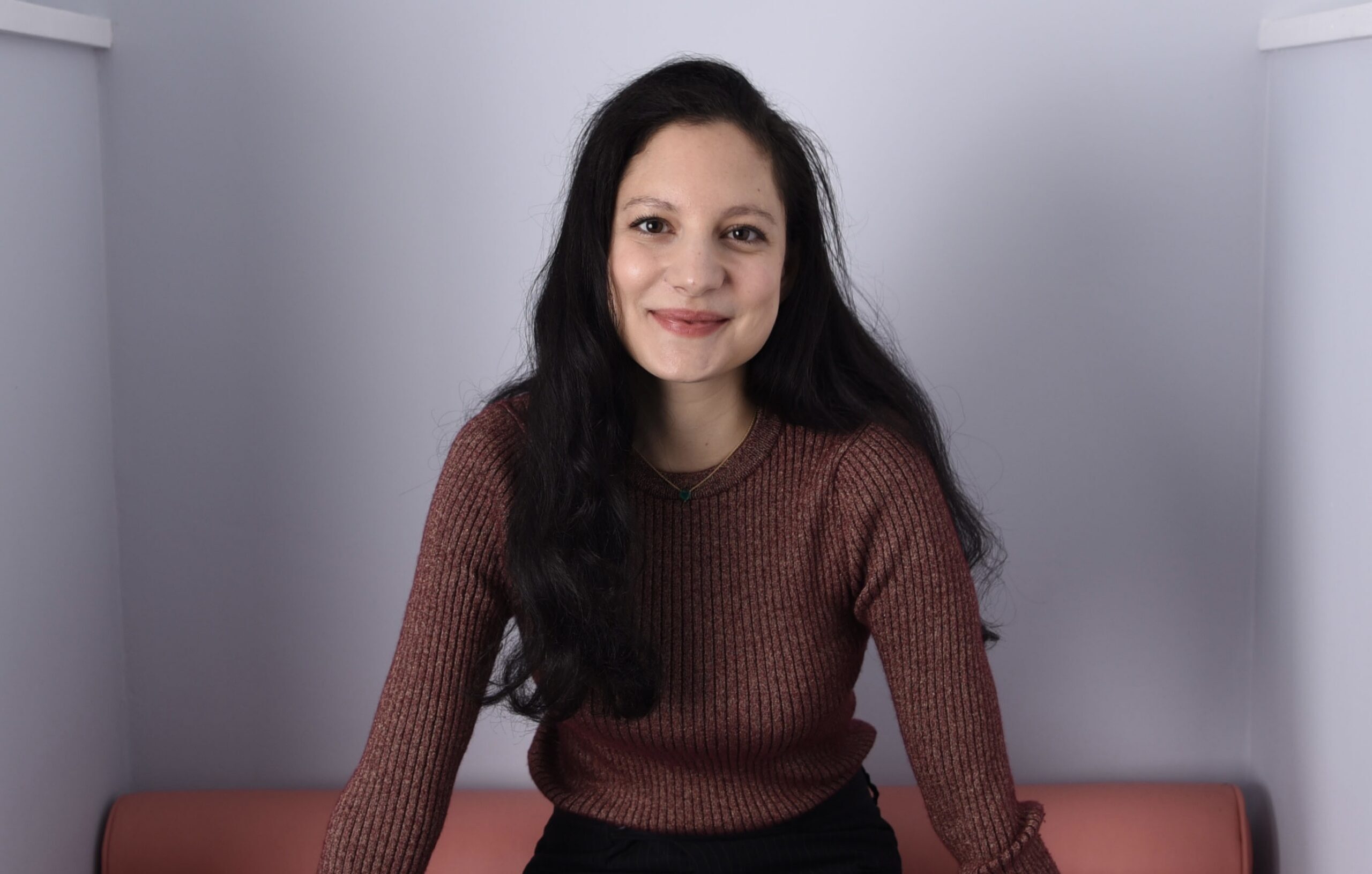
Jeanne-Rose Arn's PhD explored how the justice system should treat false beliefs and self-deception
If a lot of our mental activity is unconscious, as cognitive science increasingly suggests, we may need to rethink the basis of responsibility and focus not only on the internal states of people, but also on external things such as relationships of power and the demands they generate.
Jeanne-Rose Arn
When someone unconsciously forms a false belief despite possessing evidence to the contrary, are they responsible for the harm they cause when they act on it, and if so, why?
Lawyer and philosopher Jeanne-Rose Arn [2019] tackled that question in her Cambridge PhD, setting herself an ambitious task: to develop new theories in three fields. In philosophy of mind, she proposed a new account of how we process information when we deceive ourselves. In moral philosophy and criminal law, she used it to rethink responsibility.
She says: “In my thesis, self-deception plays three roles: the phenomenon to be explained and given a framework, the case that brings a set of assumptions about the mind and culpability into view, and the way into an account of responsibility for what we do when it results from unconscious processes.”
Her work suggests that responsibility cannot always be understood by looking at an individual’s mental state alone. “When we hold people responsible, what matters may have to do with the structure of the relationships they are in and the demands those relationships create, not just with their mental states,” she states.
Self-deception and Responsibility received a 2026 Yorke Prize from the Faculty of Law, which recognises exceptional research in law. Jeanne has written several articles and is working on two books related to her research. Now, as a lecturer in the Faculty of Law at the University of Geneva and a research associate at the Geneva Centre for Philanthropy, she is applying her work to a new field: AI.
Throughout her career, she has paired research with action, from practising international arbitration, defending religious groups against hate speech in the Swiss courts, co-authoring a handbook on the rights of immigrant women to combat misinformation, to serving on the Gates Cambridge Council, where she brought Scholars together to debate the challenges of the next 20 years.
Early days
Jeanne was born and grew up in Geneva. Her parents are both artists – her mother is a painter and her father was a writer. At school, she always loved art and would finish her lessons quickly so she could spend more time on art. She jokes that she was almost running her own Montessori school as a young child.
But due to her strong independent streak and her need to prove herself in her own right, she was determined to use her creativity in another way. She also loved sport and was known for her vocal defence of fellow students’ rights. People who knew her said she should study Law.
Since she was a young child, Jeanne had a hankering to travel, particularly to the US. Her father used to regale her and her brother with tales about his travels in the Sahara and Asia. Her family also had links with the US.
With US culture permeating Europe and seeming to match her energy and interest, Jeanne had a sense that the US was a place that could “make things happen”, despite her family not having a television. Growing up in an artistic and intellectual family surrounded by books and art, innovation and creativity were highly valued and topics such as philosophy and politics were frequently discussed at the dinner table.
Jeanne says she was always very independent, keen to learn and to try new things. And, living in the relative safety of Geneva, she had few fears.
Such was her determination to go to the US that, at the earliest opportunity – she had just turned 15 – she was accepted onto an exchange programme to spend a year in Michigan. She lived with an American family and says she learned a lot about US culture, but says it was challenging, particularly given she didn’t speak English before she left. “The experience made me aware of how differently society can be structured from one place to the other,” she says.
She returned to Geneva after a year to high school where she combined her studies with pre-professional dance training at the Conservatory. Because she earned high grades, she was allowed a trimester off school each year, which she used for work placements in journalism and biotechnology.
When it came to university, she debated between Law and Maths. She chose Law because she saw it as a way to understand and change society. “With Law you can decompose and recompose,” she says. “I wanted to understand how that works and to have the tools to do it myself.”
Studying Law and Philosophy together
Jeanne started her studies in Law at the University of Geneva, but soon found that decomposing to its foundations also meant asking philosophical questions. After a year she decided to do a second course of study in Philosophy alongside law. “When you go back to the fundamentals of law and in order to bring about changes, you need to ask philosophical questions,” she says.
She used both law and philosophy to build a map to understand how society, institutions and the world fit together. “I think in systems,” she states. “It is not enough to focus on incremental changes in one area because it may not be coherent in another area.”
She combined most of her second and third year of her Law degree in the second year, leaving her a year to complete philosophy, she then went on to do a master’s in both subjects simultaneously. Her master’s in philosophy focused on philosophy of mind: “I was interested in how the mind works and questions of consciousness.”
A University Prize led her to Harvard Law School, where she found encouragement for her interdisciplinary approach. “Harvard taught me how to use my interdisciplinary background in law and philosophy in research, policymaking and later in my practice as a lawyer,” she says. She also took courses in legal theory to understand the foundations of the US legal system and how different it is from the continental system and served as a research assistant.
The experience reinforced her interest in drawing on different ways of thinking. “Using perspectives from different disciplines and places enables you to think differently about problems and come up with innovative solutions,” she says.
Her master’s dissertations gave her the opportunity to pursue distinct questions in law and philosophy. In law, she wrote her dissertation on governance. In philosophy, she examined the theory of sense-data – the idea that we perceive the world only indirectly, through the direct object of sensory awareness.
She completed the philosophy dissertation at the Swiss Centre for Affective Sciences, under the supervision of Professor Julien Deonna. Next door was the Human Brain Project, a European flagship that aimed to simulate the human brain on supercomputers. It was at that point that she started to reflect on the relationship between the mind and law.
She finished her master’s in 2015, then practised as a lawyer, handling international arbitration cases while continuing her academic work. She held research and teaching positions in legal philosophy and tort law at the University of Geneva and the University of Fribourg.
She also engaged on societal issues surrounding the impact of false beliefs: she co-authored a handbook on the rights of immigrant women in Switzerland to combat misinformation, defended religious groups against hate speech in the Swiss courts and worked on a high-profile criminal case that raised questions about how courts should handle unconscious negligence.
Given her research can be very abstract, she says it was good to combine it with legal practice. “It kept me grounded,” she says. Across both areas of work, she noticed that some parts of the law struggle more than others to keep pace with a rapidly changing world. Among them was the question of how unconscious cognitive processes affect responsibility – a question that would take her to Cambridge.
Mind and responsibility in Cambridge
Jeanne decided to come to the UK to investigate self-deception, choosing Cambridge because it offered a space where she could work across disciplinary boundaries. Gates Cambridge was pivotal too: she saw the scholarship as a springboard from which to lead change.
Her PhD brought together three different fields that have increasingly grown apart: philosophy of mind, moral philosophy and criminal law: “Each of these fields makes use of assumptions about the others, but when you examine them collectively, significant tensions arise that require resolution,” she says.
At the centre of her work are the unconscious processes that enable us to deceive ourselves and which govern much of our reality. She asks how self-deception works and whether people who deceive themselves are morally and legally responsible for actions based on false beliefs. She says this opens up wider issues about responsibility.
Her answer leads beyond the individual mind to the relationships in which people act. “If a lot of our mental activity is unconscious, as cognitive science increasingly suggests, we may need to rethink the basis of responsibility and focus not only on the internal states of people, but also on external things such as relationships of power and the demands they generate,” she states.
“This idea isn’t in fact counterintuitive. For example, we tend to hold a public official or the CEO of a large company responsible for harm, even when they are unaware of the risk they are taking.”
She gives the example of a person who, due to a campaign of misinformation, forms a false belief and acts on it, although she had access to the correct evidence (for example, through the internet or news sources). For Jeanne, whether she is responsible or not depends on the person’s position of power vis-à-vis the victim.
Her thesis received a 2026 Cambridge Law Faculty Yorke Prize, which recognises exceptional research in law. The Prize was endowed in 1873. Her published work includes an article on unconscious negligence in Jurisprudence and a chapter on moral responsibility and relationships of power in Philanthropy: Multidisciplinary Perspectives.
She is now turning her PhD into a monograph. Jeanne credits her supervisors, Professor Antje du Bois-Pedain in Law and Professor Richard Holton in Philosophy, and her advisor, Professor Findlay Stark in Law, who became as important to her as her supervisors.
Alongside her research, Jeanne became involved in the Gates Cambridge Community. She joined the Gates Cambridge Council at the beginning of her PhD, conscious of the importance of community, particularly during Covid. As an internal officer, she organised symposia where Scholars shared their research, meeting many Scholars and Alumni. It included a two-day event, The Next 20 Years: Global Challenges for the Future.
This interest in connecting ideas with action also led her beyond the University. With the support of King’s Provost Gillian Tett, she attended Aspen Ideas Festival, a platform for leaders to discuss future challenges. She also joined the one-year-long King’s Entrepreneurship Lab programme.
“The ELab connected me with entrepreneurs and innovators and equipped me with practical tools to turn my ideas into action,” she says, praising the college for its focus on innovation and enterprise.
Innovation is at the centre of her new work because her theories have implications for AI, how it is programmed and the consequences of that. She says that her externalist theory, with its emphasis on factors outside the individual’s mind, can help with pinpointing responsibility in cases where AI is involved in a way that normal theories of responsibility struggle. It can also prove helpful in cases with many actors, including corporations and AI systems.
Putting ideas to work
Towards the end of her PhD, the University of Geneva recruited her as a lecturer in law and philosophy in its Faculty of Law. Alongside her teaching, she is finishing a French-language introduction to legal philosophy, co-authored with a University of Geneva Colleague.
She is also a research associate at the Geneva Centre for Philanthropy, a multidisciplinary research centre partnered with philanthropic foundations. There, she can apply her work on power and responsibility to corporate social responsibility, philanthropy and democracy.
The questions raised by her thesis has also led her towards AI. In articles in progress, she examines automation biases and what happens to responsibility when people rely on automated systems to make their judgments. She is also exploring whether AI’s sycophancy might protect those beliefs about oneself that resist revision, removing the friction of contrary evidence and, if so, who is responsible for the harms that follow.
Her next book takes the inquiry further, asking how responsibility should be understood when AI is involved in decisions that lead to harm. The answers could have far-reaching implications for how AI is designed. “The questions that are interesting in the classroom are becoming urgent questions in industry,” she states.
But Jeanne does not see these exchanges as running only one way. She is curious too about what artificial intelligence may teach us about ourselves. “Maybe AI will also help us understand better how our own mind works,” she says. “We do not understand human intelligence very well. It’s an exciting time.”