

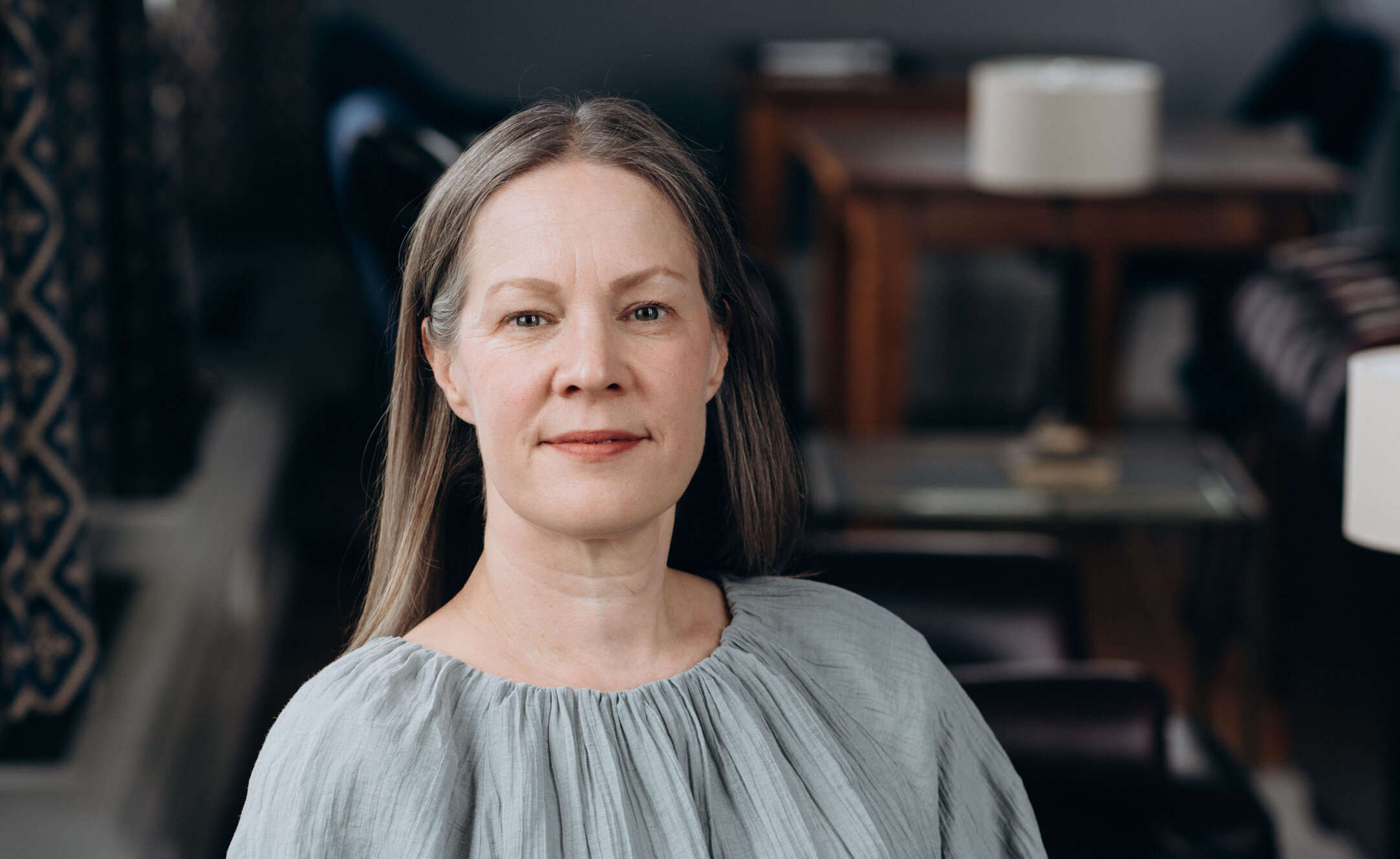
Professor Riikka Hofmann talks about her work in education to bridge the gap between evidence and policy.
I didn’t go into research for an easy life. I went into it for a meaningful life. My research is not so much about what should change or how it should change, but about generating knowledge about how to achieve change.
Riikka Hofmann
Education always matters, says Riikka Hofmann, Professor of the Learning Sciences at the University of Cambridge. “And because it matters so much it is always a contested area. But I didn’t go into research for an easy life. I went into it for a meaningful life. My research is not so much about what should change or how it should change, but about generating knowledge about how to achieve change.”
To do so, Riikka’s work has straddled the worlds of academia, policy and practice with a focus on equity and sustainability.
Early career
Riikka [2001] wasn’t initially set on a career in education, but she was drawn to it through her interest in transformation of people and systems. Her undergraduate degree at the University of Helsinki and LMU Munich was in social sciences and research methods. She had not intended to go into academia, but as a master’s student she got the opportunity to work as a research assistant for both institutions, with the projects she worked on being linked by one thread – how people and organisations learn to change. She became interested in particular in how we give young people the agency and resilience to lead the future world.
She and her husband decided to come to Cambridge to fulfill their research goals and to have a bit of an adventure. Riikka was attracted by the university’s tradition of high quality original scholarship, the exposure it could provide to amazing scholars and her commitment to widening participation which she felt aligned well with Gates Cambridge’s mission. “At the time it was thought that high quality research and changing the world were two separate jobs, but Gates Cambridge understands they are part and parcel of the same thing and that was very important to me,” she says.
She found out about Gates Cambridge through the Faculty of Education after she said she would like to come to Cambridge, but couldn’t afford to. “In my first year I couldn’t believe I was at Cambridge and had been given this opportunity. I could not have come without Gates Cambridge,” she says.
She adds that no-one knew about the programme when she started, but because of the people the Scholarship attracted they got to work to build strong foundations from the outset. “We didn’t wait for the university to figure out who we were. The scaffold was there and the community and Trust took it forward,” says Riikka.
Her PhD was on how children can have a sense of agency as learners. She became more and more interested in how difficult it is for teachers to change their practice to help individual learners because of the social norms that act as a barrier to change. For instance, she saw teachers design activities that encouraged children to discover answers for themselves rather than being fed them by the teacher. However, she found that the children still thought it was the teacher who had all the answers because that norm is so firmly embedded.
That work led Riikka to ask research questions in her later work about the role of social and institutional norms and how people need to be involved in decision-making to feel a sense of agency. She refers to her work with the NHS where she has found doctors and professionals don’t think they can change administrative systems around, for example, pre-clinical care or the organisation of a medical practice even if doing so could benefit patient care. “People in established organisations have a really strong sense of how things are done and what the norms are,” she says. Heavy workloads mean it is often easier to go along with them. However, if the norms are interrogated, their positives and negatives debated, any changes needed articulated and everyone affected involved then things can change for the better, she states.
Government collaboration
When Riikka was doing post-doctoral work in the 2010s, the UK government started to seek greater collaboration with social sciences and to look for evidence of what works. Under the coalition government from 2010-2015 Riikka put herself forward, buoyed by her work at Cambridge and by being a Gates Cambridge Scholar, to be part of the Cabinet Office-led cross-Whitehall Trials Advice Panel which involves advising the Government on research methods in policy evaluations. She was the only Faculty of Education member on the panel and one of the most junior. She says education is vital as it is about understanding how transformation works and looking at phenomena from multiple angles and lenses.
She has found that policy work, which she continues and which has led to other advisory panel work, including the Leadership Research Evidence and Impact Advisory Panel and the What Works Centre for Children’s Social Care, very stimulating. It has involved multiple stakeholders and knowledge exchange across sectors, understanding different ways of working, different ways of expressing ideas and different accountability structures.
She says: “It has been an incredibly rewarding journey of reciprocal learning. I have been able to support learning in government and to learn how evidence can be used to influence decision-making. What is most rewarding is when you see conversations about using research evidence trickle down. Even when an issue is too novel or complex and the evidence is not there yet, policymakers know how to use the evidence that is available to think about these things and to find new ways to discover better answers.”
Riikka is particularly proud of having created a sense of continuity in how to use knowledge in policy-making across government. “It’s very much about long-term relationships across the civil service,” she states.
Current work
Riikka is currently working across three linked areas. One is a project with school leaders in the Cambridgeshire Fens and East Cambridgeshire, one of the most deprived areas of the UK, and with the regional Department for Education team which aims to understand how schools with entrenched challenges can change their practices. She is helping to develop evidence to build a research-informed, sustainable model that can help other schools in resource-poor areas.
The second project is working with the NHS on collaborative, place-based change models to ensure good clinical ideas and treatments are used properly and not left to gather dust on shelves. The third is working with the Cabinet Office, addressing how civil servants across grades learn to work together more effectively and sustainably, work aligned with the University’s new plans for a School of Government.
“The underlying question uniting all three areas is the same: how professionals in the public sector can change highly established practices to improve outcomes for the public,” says Riikka, adding that it is vital that innovations are used in ways that ensure the government capitalises on their full benefits.
Gates Cambridge
Alongside her policy and research work, Riikka has also been a valued member of the Gates Cambridge Trust team, having done reviews of candidates for years and been on interview panels for the last three years. “It’s incredibly interesting and rewarding work,” she says. “I have the opportunity to meet these young people who will be the leaders of the future, to hear their ideas and discuss and debate with them. Education is about hope and sometimes hope is hard to find, but during the Gates Cambridge interviews, seeing candidates’ capability, motivation and resilience, it is much easier,” she states.
She adds: “Gates Cambridge continues to be so important because it understands that scholarship and impact are not separate things, that when the going gets tough we need to work harder and that we need a multidisciplinary community to tackle today’s challenges. The ethos of Gates Cambridge means there is always a home you can return to, a community that is always there even if you have not been in touch recently, where you can always have a conversation. It’s not about agreeing but about questioning together and being open so you can create change in the world.”