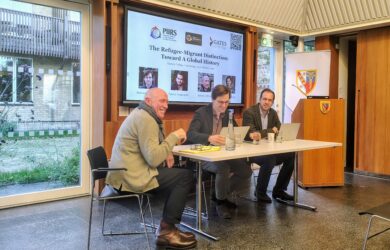



Three Scholars discuss innovative ways to get their ideas across on the second episode of season two of the Gates Cambridge podcast
How do you get your ideas across in an increasingly noisy and divided world? Three Gates Cambridge Scholars discuss their innovative solutions in the second episode of series two of our podcast, So, now what?
Jakub Szamalek [2009], Ragnhild Freng Dale [2013] and Cansu Karabiyik [2016] discuss the different ways they have innovated, through video games, theatre and stand-up comedy.
They talk about how using different mediums has helped get their research, ideas or culture across to a wider audience and made people think in a different way and how entertainment and the arts help us to understand our fast-changing world. They also discuss the difference between writing novels and writing video games, online misinformation and the importance of thinking slowly and about being passionate and authentic.
Cansu Karabiyik received her PhD in medical science in 2021. Since then she has spent her days as a neuroscientist developing treatments for neurodegenerative diseases and her evenings as a stand-up comedian performing in clubs in New York City.
Jakub Szamalek is an award-winning novelist and video game writer, who co-created international bestsellers such as “The Witcher 3” and “Cyberpunk 2077”, currently Narrative Director at Rebel Wolves, a game development studio he co-founded. He did his PhD in Classical Archaeology. His most recent book, “Inner Space”, will come out in English in July 2025.
Ragnhild Freng Dale is a social anthropologist and senior researcher at the Western Norway Research Institute. Her research interests include energy imaginaries, justice in climate transitions and the impacts of energy infrastructure on local and indigenous communities. She thrives working on projects that are multimodal and experimental, especially in collaboration with the performing arts field.
The episode is the second of eight in the new anniversary series which will cover everything from astronomy and biodiversity to new research into ageing societies. The podcasts will be posted on the last Tuesday of the month with the March podcast being on the subject of what works when it comes to promoting conservation and biodiversity.
Listen to the new episode here.