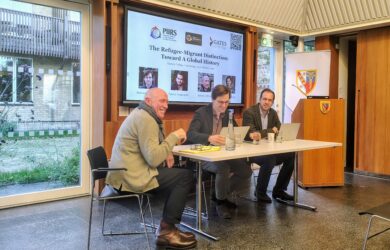


Scholars discuss their research at an internal symposium next week.
Is your online password safe? Find out why passwords are likely to stay with us for decades to come even though most can be easily guess and the majority of us have forgotten about half the passwords we’ve ever registered.
A Gates Scholars Council internal symposium on 2nd May will hear from Joseph Bonneau [2008] about his PhD research on online security which has involved the largest ever sample of passwords to date and was recently highlighted in The Economist. He says the average Internet user has registered over 25 password-protected accounts, has used a total of 6 different passwords and has forgotten about half of the passwords they have ever registered. Moreover, the majority of their passwords can be guessed with fewer than a million guesses (an easy task for a computer) and a few percent can be guessed in a dozen or so tries by almost anyone.
In his talk, he will look at the future of authentication on the web and ask how we got to this state of affairs and how we can get out of it. He will also ask why passwords have lasted so long and why they appear likely to remain with us for decades to come.
Also speaking at the symposium are Luis Perez Simon [2011], Marianne Bauer [2008] and Muktha Natrajan [2011].
Luis will talk about the New Socialist Man in Cuba and how he has manifested himself in and affected Cuban culture. Luis, who is doing his PhD in Latin American Studies, says that Socialist cultural politics in Cuba focused until the collapse of the Soviet bloc on promulgating and inculcating the ideological paradigm of the New Socialist Man as a way to politicise civil society. His research looks at the socio-political consequences of this indoctrination strategy.
Marianne, who is doing her PhD in Theoretical Physics will talk about the latest developments in research using cold atomic systems as quantum simulators. She says: “Cold atomic systems are for physicists what playgrounds are for children: they allow them to play in a controlled and clean set-up, and teach them skills that they can apply in the real world. Since their discovery in 1995, they are one of the superhot topics in physics, despite their name. And progress in both theory and experiment has been enormous.”
Muktha Natrajan, who is doing a PhD in Clinical Neurosciences, will talk about her research into Multiple Sclerosis, a disease potentially caused by an autoimmune attack that removes the myelin sheaths around neurons. Her work focuses on the process of clearing myelin debris and forming new myelin sheaths. She looks specifically at the role of macrophages in clearing myelin debris, whose efficiency appears to deteriorate with age. She says understanding this could inform future therapeutic developments for treating MS.
The symposium takes place in the Gates Room at 7pm on 2nd May. All Gates Cambridge scholars and friends are invited to come along.