


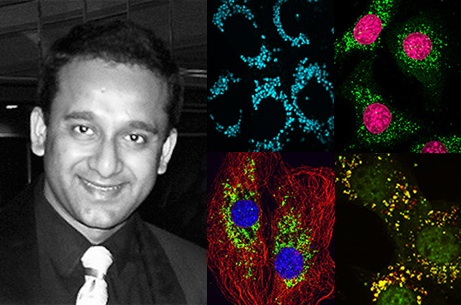
Sovan Sarkar is lead author on a paper which suggests a rare and fatal disease that involves an inability to properly metabolise cholesterol and other lipids could have more than one cause.
Scientists have discovered that a rare and fatal disease which involves an inability to properly metabolise cholesterol and other lipids could have more than one cause and suggest that a two-pronged approach could have beneficial results.
The research on the lipid storage disorder Niemann-Pick type C1 (NPC1) disease is published in the journal Cell Reports and is led by Gates Cambridge Alumnus Sovan Sarkar [2002].
It suggests NPC1 is caused not only by defects in cholesterol processing but also in autophagy – a key cellular degradation pathway that malfunctions in many neurodegenerative diseases. The researchers believe targeting both the cholesterol accumulation and stalled autophagy found in NPC1 with combination therapy could represent a viable treatment strategy.
Symptoms of NCP1 include learning disabilities, mental retardation, and delayed development of fine motor skills. The disease is fatal, with most children succumbing before age 20, according to the National Niemann-Pick Foundation. Scientists have long explored the problematic accumulation of cellular cholesterol that is a hallmark of the disease, but the research conducted by Sarkar and fellow researchers at MIT’s Whitehead Institute reveals for the first time that impaired autophagy in the cells of NPC1 patients is contributing to disease pathology.
“Autophagy is a very important mechanism, which contributes to many neurodegenerative diseases and also Niemann-Pick,” says Whitehead Founding Member Rudolf Jaenisch, who is a professor of biology at MIT. “Our research indicates that if you improve autophagy, you can somewhat improve the phenotype.”
Autophagy is a housekeeping process that allows cells to reuse certain components and prevent the build-up of problematic proteins. Whitehead researchers observed that cells of mice carrying a mutated copy of the NPC1 gene not only had the characteristic cholesterol accumulations seen in patients, but also abnormalities in the autophagosomes necessary for non-starvation (basal) autophagy. They concluded that in NPC1, autophagy is interrupted, causing the process to stall and certain intermediary products of autophagy, including autophagosomes, to amass.
Treatment with HP-beta-cyclodextrin is currently in Phase I clinical trials for improving cholesterol processing in NPC1 patients. However, Whitehead researchers found that high doses of HP-beta-cyclodextrin impair autophagy and suggest that treatment needs to be carefully controlled. The scientists treated diseased cells with a combination of low-dose HP-beta-cyclodextrin, which does not further affect autophagy, and lithium or rapamycin, which tap into a form of autophagy that is activated by starvation. Together, the drugs rescued cells from both the manifestations of NPC1.
“This dual treatment may have more benefits in patients than using HP-beta-cyclodextrin alone,” says Sarkar. “With these drugs together, we can rescue both the cholesterol and autophagy defects. We’re not suggesting ‘use rapamycin and cyclodextrin’. Since rapamycin and other drugs that inhibit the metabolic mTOR pathway can possibly have side-effects pertaining to suppression of mTOR’s critical cellular functions, we’re suggesting that we need to stimulate autophagy, ideally by mTOR-independent autophagy activators, and remove cholesterol as a treatment strategy.”
Sarkar, who did his PhD in Medical Genetics at the University of Cambridge, was also a Research Fellow of Hughes Hall where he is presently a Former Fellow. He received the Biochemical Society Early Career Research Award 2012 in cell biology based on his work at the University of Cambridge.
At Whitehead Institute, he is currently searching for other potential therapeutics that correct the faulty mechanisms in NPC1 using induced pluripotent stem cell-based disease models. Such drugs may remedy the autophagy issues identified in other neurodegenerative and lipid/lysosomal storage diseases.