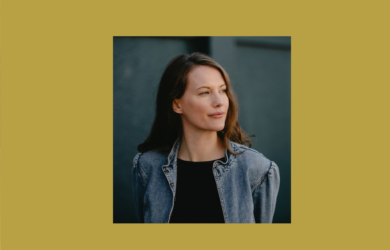


Victoria Herrmann has launched a website to catalogue the impact of climate change on coastal communities in America.
A Gates Cambridge Scholar has launched a new website in partnership with the National Trust for Historic Preservation to catalogue her research into coastal communities, culture and climate change in America.
The website shares Victoria Herrmann's research from America's Eroding Edges, a project she is completing with funding from the National Geographic's Science and Exploration Committee as an Explorer who aims to connect and share narratives of climate change and community vulnerability along America's most fragile coastlines.
During her fieldwork earlier this year, she visited American Samoa, a US territory in the Pacific Ocean, and Tangier Island, a small watermen community off the coasts of Maryland and Virginia, to interview and collaborate with Americans who, she says, “have been largely cropped out of America’s climate change portrait". Over the next two years, she will connect American Samoa's narrative with communities in Alaska, Guam, the Northern Mariana Islands, Louisiana and elsewhere in America.
Over the next year, the website will catalogue those experiences, explore the challenges of all those facing the impacts of climate change on their homes, livelihoods and cultures, raise awareness of what is happening and aim to inspire effective action.
Victoria [2014] is doing a PhD in Polar Studies. She is the President and Managing Director of the Arctic Institute, where she leads the Institute's research on climate change and community adaptation in Arctic communities. For America's Eroding Edges she is also working with research associate Eli Keene and with local partners, including photographers and video makers, from the communities she visits.
The first country spotlighted on the website is American Samoa which is located over 2,500 miles southwest of Hawaii.
Victoria says that, over the last 50 years, sea levels around the Samoan archipelago have risen at a rate of about 0.8 inches per decade. However, climate change is accelerating this trend as well as causing more climate events, such as tropical storms. At the same time the islands, former active volcanoes, are sinking. Combined this has a significant impact on coastal areas where most of the population lives. The country has taken action, such as building defence walls, but it is unclear how long this can sustain the pressure of rising waters. If Samoans are forced to move to the mountains, says Victoria, this will have a huge impact on their culture and way of life.
She says: "When asked about climate change, the majority of residents interviewed quickly move beyond impacts on the landscape and focus instead on how environmental changes are disrupting their livelihoods, language, culture, identity, and futures.
"In American Samoa, as in the rest of America, climate change is ultimately a story about people. As the seas continue to erode away American Samoa’s coastal villages, the prospect of moving inland, up the mountains becomes more real. And doing so may mean leaving behind not only homes and ancestral lands, but also livelihoods and cultural heritage."
Later this year, Victoria will be co-convening an international working group on cultural heritage and climate relocation as part of the Pocantico Call to Action. She has previously worked with the Carnegie Endowment for International Peace, the United Nations, the US State Department and the Metropolitan Museum of Art.
Picture credit of American Samoa: Eli Keene