


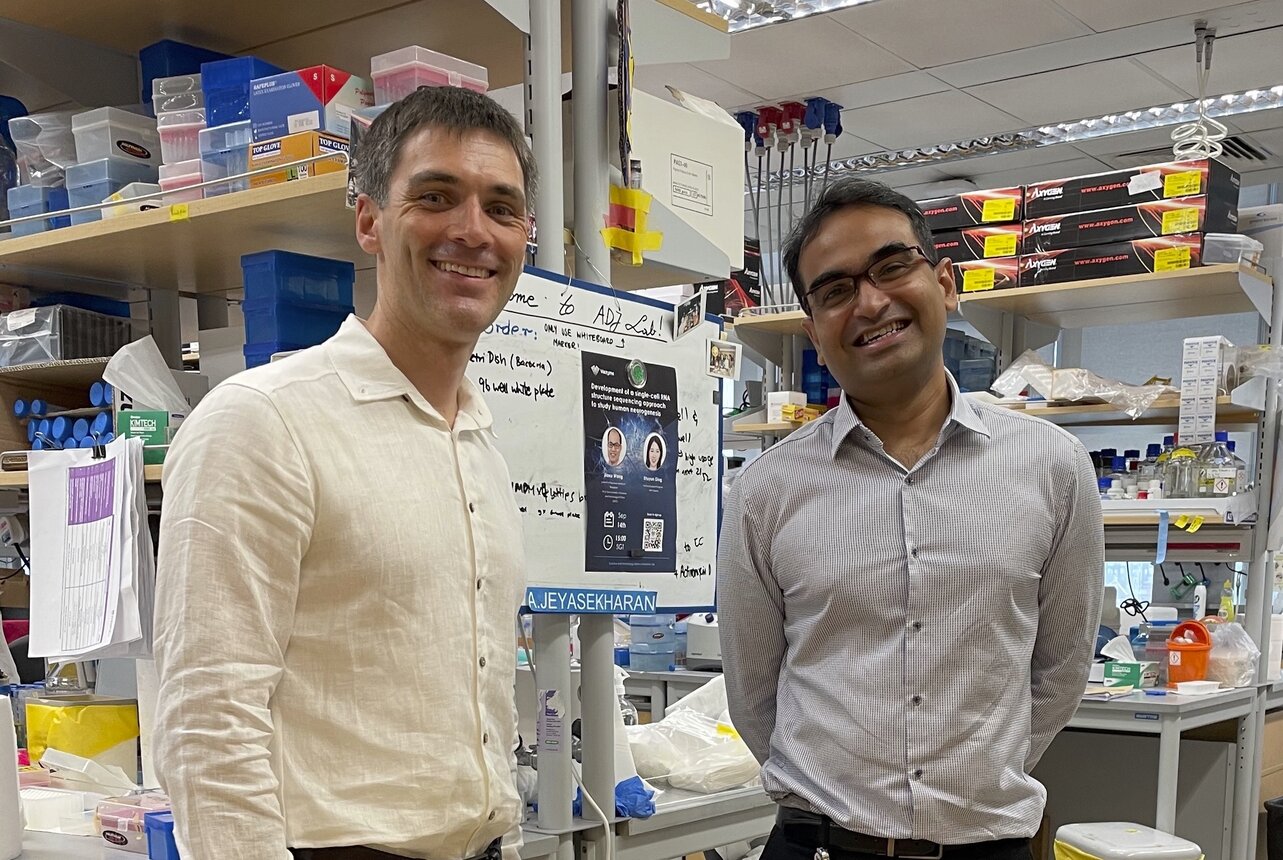
Anand Jeyasekharan and Chandler Robinson are collaborating on a new drug candidate that could tackle a variety of cancers
MNPR-202 has the potential to disrupt the current chemotherapy landscape and impact a broad range of cancers.
Dr Anand Jeyasekharan
Two Gates Cambridge Scholars have joined forces to work on a drug candidate that has the potential to replace one of the most widely used cancer drugs around the world.
Dr Anand Jeyasekharan [2004], who did his PhD in Oncology, and Dr Chandler Robinson [2009] who did an MBA at Cambridge, will collaborate on a drug candidate that has the potential to replace Doxorubicin. The molecule, known as MNPR-202, is a novel advance on Doxoubicin, which is used in over a million cancer patients each year.
Anand runs a scientific lab and, as a doctor, treats cancer patients at the National University of Singapore Hospital. He is a leading expert on how the immune system recognises cancer cells upon treatment with DNA-damaging chemotherapy, such as Doxorubicin.
Chandler is co-founder and CEO of the cancer-focused biotech company Monopar Therapeutics Inc. (Nasdaq: MNPR – https://www.gatescambridge.org/about/news/double-success-for-chandler-robinson/). The Gates Cambridge Scholarship helped enable the development of his first drug, which is for use to combat the rare genetic disorder Wilson Disease. The Wilson drug recently had positive Phase 3 clinical data, is now owned by AstraZeneca and is on its way toward regulatory approval around the world.
The drug candidate Anand and Chandler are collaborating on, MNPR-202, is a proprietary molecule owned by Monopar which has been designed to retain the anti-cancer activity of Doxorubicin but without the side effect of irreversible heart damage.
Doxorubicin is approved in 14 different cancer indications, including soft tissue and bone sarcomas; metastatic stomach, ovarian, thyroid, lung and breast cancer; acute myeloid and lymphoblastic leukemia; Hodgkin and non-Hodgkin lymphoma and neuroblastoma. However, cumulative dose effects of Doxorubicin can result in irreversible heart damage and death, which is why a restrictive lifetime cumulative dose limitation has been placed on its use.
Even if patients are responding to the drug, after six to eight cycles they have to be taken off it permanently. The hope is that a novel comparator like MPNR-202, which is designed to not affect the heart, will not need such a limitation and could be dosed in higher quantities and for extended periods of time in order to increase survival beyond what is possible with Doxorubicin.
Anand and Chandler began their collaboration on MNPR-202 about a year ago. The research is taking place in Anand’s lab and has already yielded promising results which the two Scholars hope to present at a leading cancer conference in early 2023.
“We have compared MNPR-202 to Doxorubicin across multiple cancer cell lines, and MNPR-202 appears to induce more DNA damage and apoptosis in cancer cells. Interestingly, it also has a distinct profile of innate immune activation while retaining a similar cytotoxic potency,” said Anand. “The findings to-date suggest it may be superior to Doxorubicin in certain combination regimens.”
Given the promising results to date, Chandler and Anand are discussing pathways for getting MNPR-202 into the clinic, with Anand leading a Phase 1 clinical trial at the National University of Singapore Hospital. Anand is particularly interested in its combination with cancer immunotherapies. “MNPR-202 has the potential to disrupt the current chemotherapy landscape and impact a broad range of cancers,” he said.