


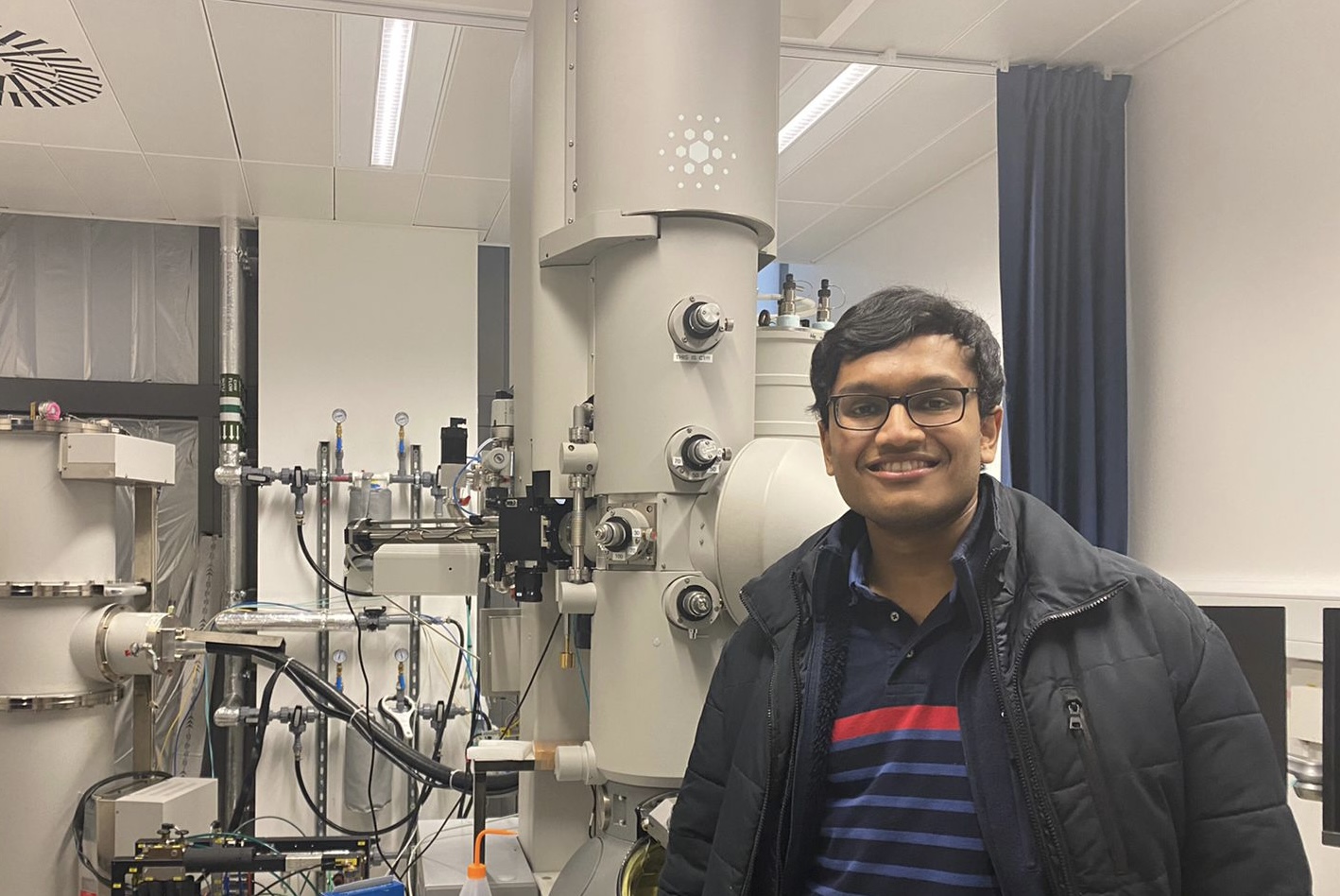
Vaithish Velazhahan is first author of a Nature paper on the GPCR Ste2, with important implications for treating fungal diseases.
A Gates Cambridge Scholar has shed new light on an important G protein-coupled receptor [GPCR] which could help researchers to better understand and treat fungal diseases such as candidiasis and pulmonary aspergillosis.
GPCRs are membrane proteins which are essential for signal transduction and communicating with an organism’s surrounding environment. GPCRs are divided into six classes (A-F); Class D GPCRs are found exclusively in fungi and regulate fungal survival and reproduction.
Previous research by Gates Cambridge Scholar Vaithish Velazhahan [2018] determined the first ever structure of a fungal GPCR, using Ste2, a prototypical Class D1 GPCR which is essential for mating in the yeast Saccharomyces cerevisiae. Ste2 was found to form a homodimer and couple to two G proteins simultaneously, which provided the first insights into how a transmembrane-mediated GPCR dimer could form and interact with G proteins.
Vaithish, who is doing his PhD in Biological Science at the MRC Laboratory of Molecular Biology, is first author on a new paper, published in Nature, which takes that research forward and shows that Ste2 has a novel method of activation which is unique from mammalian GPCRs.
To capture Ste2 in its various conformations along the activation pathway, Vaithish used different peptide ligands, purifying the GPCR separately under each condition. To purify ligand-free Ste2, Vaithish developed a method called pre-stabilisation of a GPCR by weak association (PSGWAY). This method involves adding a purified wild type heterotrimeric protein, Gpa1-Ste4-Ste18, to help stabilise ligand-free Ste2 before its purification. Then electron cryomicroscopy (cryo-EM) was used to collect multiple datasets of different samples, involving over 32,000 micrographs in total.
Computational processing of the datasets led to the determination of four new Ste2 structures: a ligand-free state, an antagonist-bound state and two agonist-bound intermediate states. Their research highlights that Ste2 has a structural and activation mechanism distinct from all previously determined monomeric GPCRs.
Molecular dynamics simulations were then performed using these structures and revealed allosteric communication pipelines that differed between the various states. The study suggests ways in which allosteric communication within Ste2 may affect their activation which is also relevant to understanding allosteric communication across other transmembrane-mediated GPCR dimers in humans.
The research could have important implications as fungal diseases, such as invasive candidiasis and pulmonary aspergillosis, account for a major disease burden worldwide and cause life-threatening conditions in humans. In addition, they can threaten global food supply through crop infection. An improved understanding of fungal GPCRs can help to tackle these issues.
Due to their wide-ranging cellular functions, GPCRs are also critical to drug development, with approximately one third of all FDA-approved drugs targeting them. Understanding the activation method of Ste2 could encourage new possibilities for rational drug design. More specifically, the research may make it possible to specifically target fungal GPCR signalling without also inadvertently targeting human GPCRs. The researchers say such a fungal-specific means of drug development could help design medicines which avoid off-target effects and possible therapeutic side-effects.
The research was funded by UKRI MRC, the Gates Cambridge Trust and the National Institutes of Health.