

Reptiles and amphibians whose forest habitat has been depleted by humans could have a better chance of survival in some types of agricultural settings than others, according to a new study led by a Gates Cambridge Scholar.
Reptiles and amphibians whose forest habitat has been depleted by humans could have a better chance of survival in some types of agricultural settings than others, according to a new study on animal conservation.
The study, just published in the online version of Biological Conservation and out in the print version later this month, is led by Gates Cambridge Scholar David Kurz [2013]. It shows that agricultural land uses such as heart of palm [palmito] plantations are more suitable complements to forests than pasture.
Due to a growing human population, more and more land is being converted to agriculture. As a result, it is thought that global food needs will increase 70-110% by 2050, driving massive expansion of agriculture in the coming decades.
When agriculture expands, it often ends up fragmenting forested habitat, particularly in the tropics. This can be devastating for forest-dwelling animals because not only are they losing their natural habitat, but populations of animals are often split up and isolated from one another. Other potential hazards resulting from habitat loss are greater access of human hunters to forest animals, increased risk of disease and parasites and effects such as higher temperatures, increased pollution and competition from non-native species. Habitat loss is therefore one of the leading threats to forest-dwelling wildlife.
For this reason, land managers and conservationists need to look at agricultural areas as potential corridors between patches of forest, as well as “buffer zones” that can provide important food and habitat resources for a wide range of species.
The new research shows that different human land-uses are not uniform in their ecological effects on forest-dwelling animals and that understanding these differences is crucial for identifying agricultural environments that can complement the natural forest habitats of sensitive reptile and amphibian species.
The researchers studied reptiles and amphibians in forest fragments, pastures and palmito plantations in northeastern Costa Rica. Both number of species and abundance were greatest in forest, intermediate in palmito and lowest in pasture. Palmito also supported populations, particularly reptile populations, that were similar in composition to those found in forest. The results show that two important land uses in Costa Rica differ in their capacity to support sustainable reptile and amphibian populations in areas dominated by agricultural production.
The research is based on David’s senior thesis at Princeton, where he studied in the Department of Ecology & Evolutionary Biology. David is currently doing an MPhil in Zoology at Cambridge. He says: “Our study showed that heart of palm may be a promising form of agriculture to complement natural forests as habitat for reptiles and amphibians. A complementary approach could mean, for instance, that agriculture like palmito could help provide corridors between forest fragments so that otherwise-isolated animal populations can intermingle, which is better for genetic diversity and makes a species much less likely to go extinct. We also showed that the type of agriculture bordering forest fragments really does matter in terms of the ecology of a landscape. Agriculture will never be able to totally replace natural habitats, but the goal is to make it as eco-friendly as possible.”
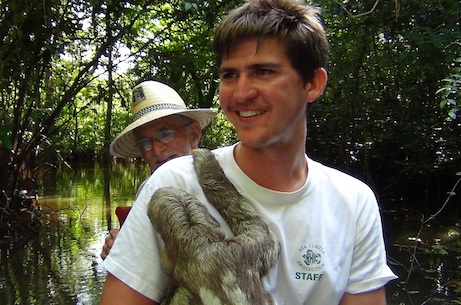
*Photo: David with a sloth in Brazil.