

Lisa Neidhardt's study looks to understand the mechanisms of protein folding, with implications for age-related diseases.
There is hope that over time a better understanding of the cell’s coping mechanisms may translate into the design of helpful interventions.
Lisa Neidhardt
A new study co-authored by a Gates Cambridge Scholar sheds light on the mechanisms of protein folding and could be an important step towards developing treatments for age-related diseases.
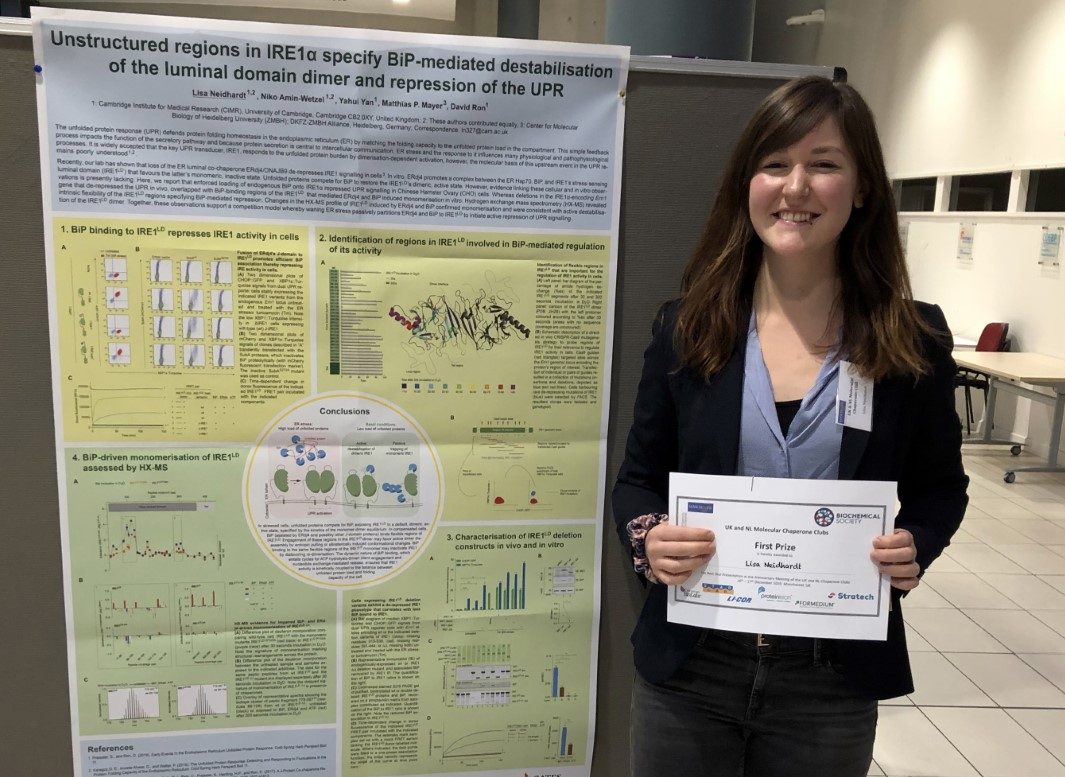
Lisa Neidhardt is co-first author of the study published in eLife Sciences. Lisa has also spoken about her findings at a recent UK and NL Chaperone Club conference at the University of Manchester where she won first prize for her presentations.
Her work focuses on understanding the folding process in proteins. Proteins are produced as linear polymers of amino acids. To function, they must fold on themselves, creating three-dimensional objects with diverse activities.
Cells have chaperones that can assist this folding process, and these are found in all the major sites of protein production, notably, also in the endoplasmic reticulum, the site of folding of most secreted proteins destined for use outside the cell. To match the supply of chaperones to the demand of unfolded proteins, cells are endowed with tools, referred to as stress receptors, that recognise the burden of unfolded proteins and generate signals that inform cells on the need for more chaperones.
However, the nature of the recognition process by which the stress receptors are activated in proportion to the burden of unfolded proteins remains incompletely understood.
The new study reveals mechanistic insights into the regulation of the stress-receptor IRE1 that is maintained in an inactive state (repressed) by BiP, a major chaperone of the endoplasmic reticulum. The data supports a model whereby recognition of the burden of unfolded proteins is based on the availability of enough BiP to repress IRE1, with rising levels of unfolded proteins competing with IRE1 for BiP’s attention, releasing the brake BiP imposes on IRE1 activity.
Lisa [2019], who is doing a PhD in Medical Science, says: “Our findings bear on a fundamental question in life science, the recognition by cells of unfolded proteins. The burden of unfolded proteins protein acting over time, contributes to the attrition of organismal function in aging-related diseases. Therefore, there is hope that over time a better understanding of the cell’s coping mechanisms may translate into the design of helpful interventions.”
Lisa Neidhardt
- Alumni
- Germany
- 2019 PhD Medical Science at the Cambridge Institute for Medical Research
- Jesus College
Since my first biology lessons in school I have been fascinated by understanding nature and I have steadily developed the strong ambition to become a scientific researcher. I undertook my Bachelor’s and Master’s study in biochemistry at Free University of Berlin, where my research mainly focused on protein folding homeostasis during aging and neurodegenerative diseases in particular of Huntington’s disease. For my PhD I joined the lab of David Ron at the Cambridge Institute for Medical Research, where I will study cellular adaptations to the stress of unfolded and misfolded proteins in the secretory pathway. The unfolded protein response (UPR) defends protein folding homeostasis in the endoplasmic reticulum (ER) by matching the folding capacity to the unfolded protein load in the compartment. This simple feedback process impacts the function of the secretory pathway and because protein secretion is central to intercellular communication, ER stress and the response to it influences many physiological and pathophysiological processes. I am personally very much interested in impact through innovation and sustainable technologies, in particular alternative proteins to reshape our food system.
Previous Education
Free University of Berlin Biochemistry 2018
Free University of Berlin Biochemistry 2015