

Niamh O'Neill's research aims to provide more accurate information about molecular crystals using machine learning
We are trying to train cheaper classical methods using data from highly accurate but expensive simulation techniques using machine learning.
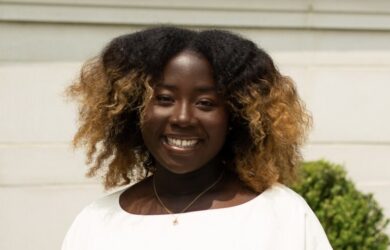
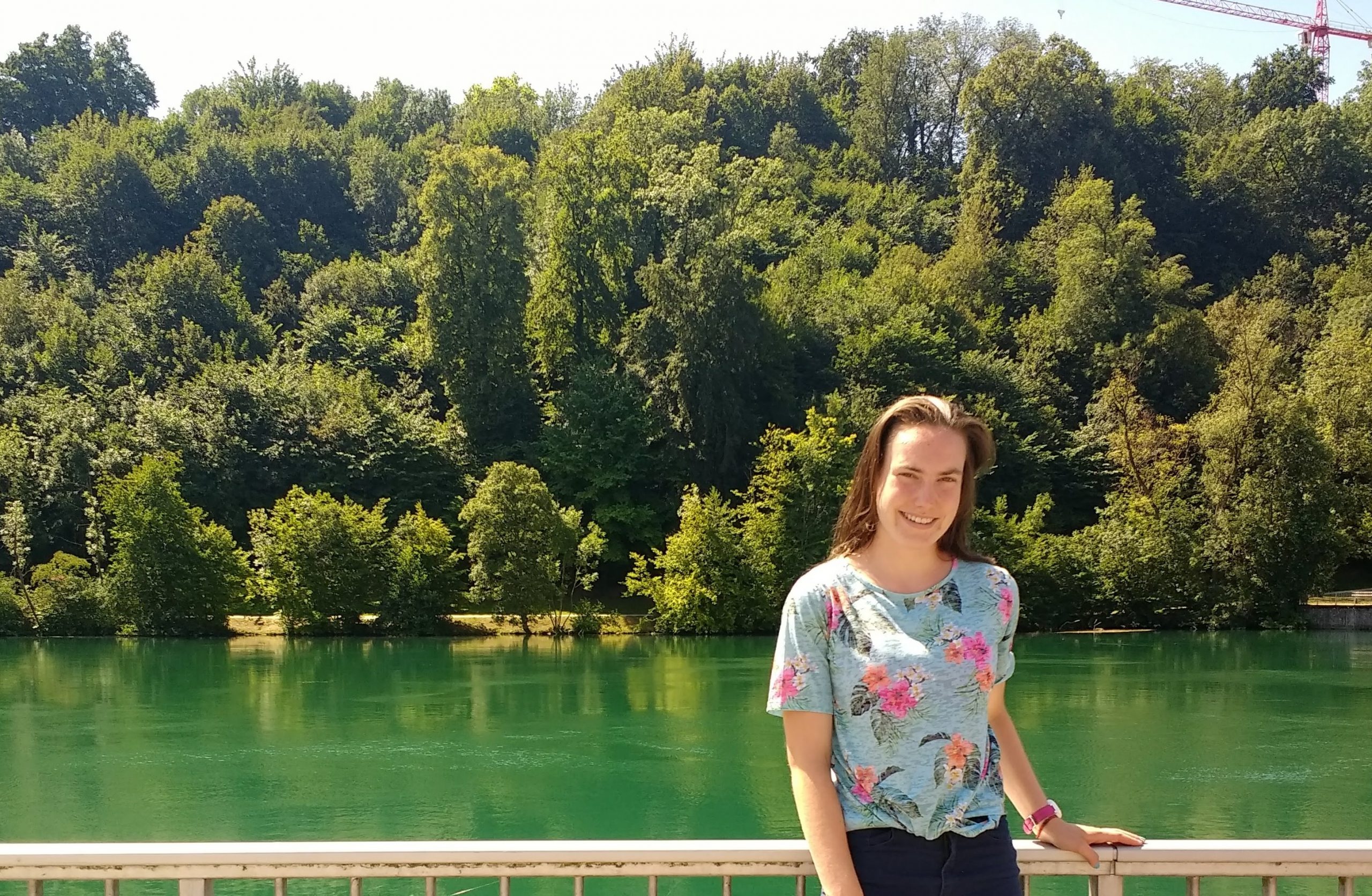
Niamh O'Neill
Niamh O’Neill’s research is fundamental to progress in making high quality and accurate predictions about the properties of molecular crystals.
For her PhD she aims to develop methods to model and simulate molecular crystals in more computationally efficient ways than are currently available. “We use highly accurate quantum mechanical methods for smaller systems, but they are too expensive to use on bigger systems,” she says. “We are trying to train cheaper classical methods using data from these highly accurate but expensive simulation techniques using machine learning.”
Given most drugs are made from molecular crystals, Niamh says there are a lot of applications if scientists can work out how to model and simulate them with as much accuracy as possible. “We need the models to be accurate to make good predictions,” she says, citing the case of thalidomide where the energy difference between the drug having a positive or negative impact was very narrow.
An early interest in science
Niamh was born in Dublin in a scientific household. Her mother is a chemistry lecturer and her father is an electronic engineer and Niamh says she was always interested in what her parents were doing and asked them a lot of questions as she grew up.
She always preferred science and maths at her school, Castleknock Community College, and competed in the Irish Science Olympiad, winning a silver medal, as well as the European Union Science Olympiad. The experience gave her a broader picture of science, a taste of what studying it at university might be like and the opportunity to meet students from all over Europe.
Niamh was also a keen gaelic football player at school, playing midfield for Dublin until she was 18 and travelling around Ireland for matches. Since going to university, she has taken up running and was treasurer of the university athletics club. She runs for the university and in club competitions.
Computational chemistry
Niamh is completing a four-year undergraduate degree at University College Dublin, which started with a broad focus on science and became more specialised in chemistry by the third year. After her second year Niamh won an Amgen Scholarship and was sent to ETH Zurich under Professor Gisbert Schneider to do a research project in computer-assisted drug design.
“I didn’t know about computational chemistry as a field before, but it combined my love of chemistry and maths,” she says. She really enjoyed the experience of doing research, working with PhD students on a ranking system for bioactive molecules designed by artificial intelligence, and at the end of her two months she spent three days at a symposium in Cambridge, once again meeting other students from across Europe. “It was a very collaborative experience and when I returned I was really excited about computational chemistry,” she says.
She was very keen to learn as much as she could about the field, so she contacted Professor Clémence Corminboeuf at the EPFL in Lausanne and spent the summer after her third year working with her on a model that describes different types of bonding in chemical systems. “The research essentially involved solving a mathematical problem and then putting a chemistry hat on to make sense of the results from a chemical point of view. I also enjoyed the challenge of computationally implementing the solution,” she says.
Understanding the mechanism of reactions
She learnt a lot from the experience and she returned to Dublin to do a computational research project for her Bachelor’s thesis, modelling different reaction pathways for enyne metathesis reactions which she says are relevant, for example, in natural product synthesis. “These are a very powerful class of reactions, with lots of different mechanistic possibilities. If we can understand the fundamental mechanism of the reaction we can save a lot of time and resources when we go to do experiments in the lab,” she says.
Niamh knew after her summer experiences that she wanted to do a PhD. She contacted Professor Angelos Michaelides at Cambridge to talk about his work and to find out more about how she could further her work as well as building her skills through the CDT in Computational Methods for Material Science. She is looking forward to beginning her PhD at Cambridge in the autumn.